Haplogroup R1b1a1b1a1a1c2b2b1

– 5 min read


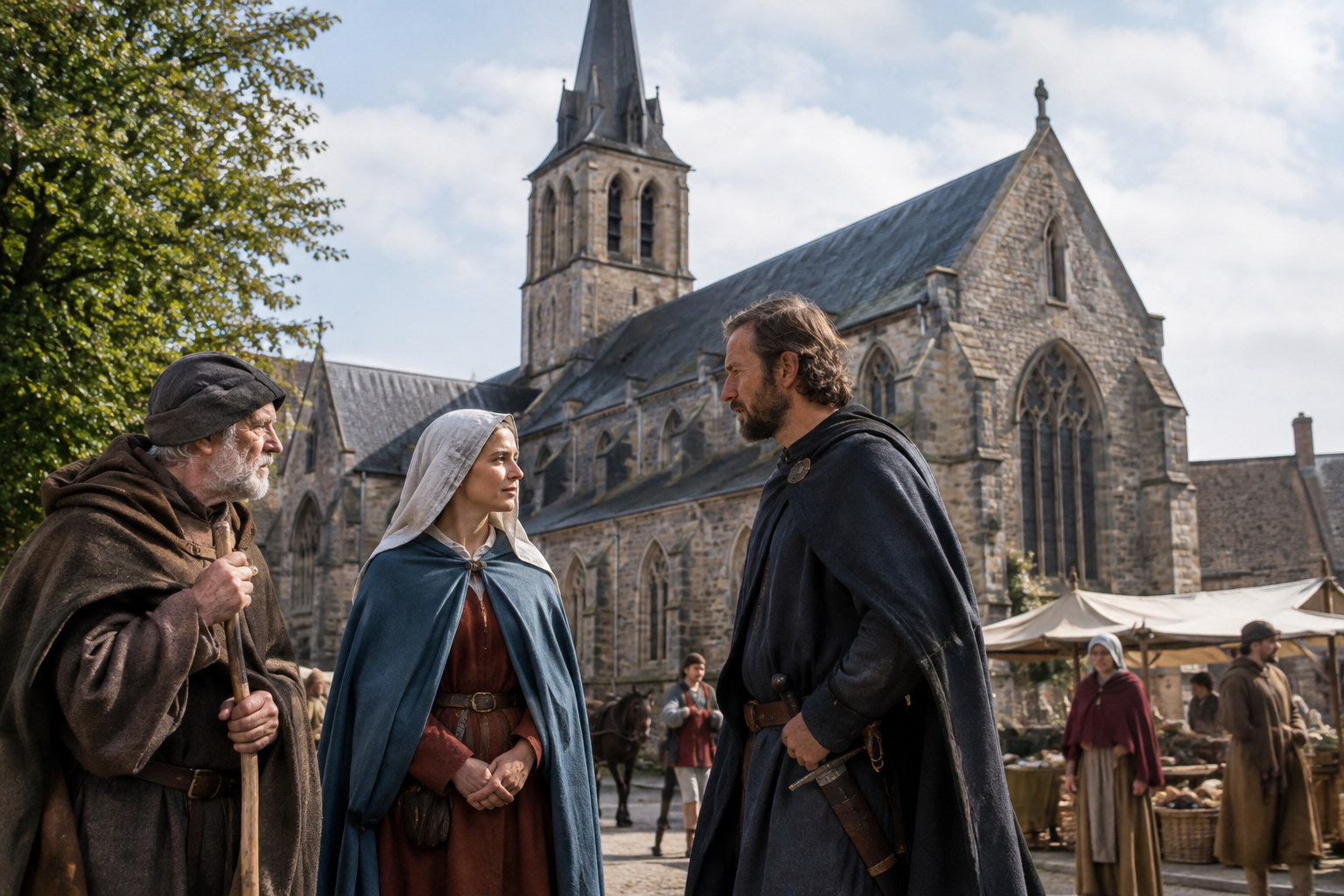
At Sint-Truiden in medieval Belgium, three men buried at the Onze-Lieve-Vrouwekerk help pin a very specific Y-chromosome line to a real place and time. The sample IDs ST2326, dated around AD 990, ST2638 from about AD 1030, and ST0062 from about AD 1300, all come from the same ecclesiastical setting in a town that was growing in importance in the medieval Low Countries. For anyone carrying the Y-DNA haplogroup R1b1a1b1a1a1c2b2b1, that cluster is immediately interesting because it places this paternal line, or a reported association with it, among men living through the making of an urban Christian community.
This is also a good reminder of what Y-DNA can and cannot do. It follows one direct paternal line only, not a person's whole ancestry. But when the same narrow branch appears more than once at one medieval site, it becomes archaeologically useful: not as a fairy-tale claim about dynasties, but as evidence that a particular male line was present in a specific community over several centuries.
One sample can be a curiosity. Three samples from the same site, spread across roughly three hundred years, are something more substantial. ST2326, ST2638, and ST0062 show continuity of male-line presence at Sint-Truiden from the late 10th century into the 14th. That is exactly the period when towns in the region were being shaped by churches, markets, lordship, pilgrimage, and the everyday churn of medieval settlement.
Onze-Lieve-Vrouwekerk was not an abstract dot on the map. It stood within a religious and urban landscape that mattered in the County of Loon and the wider orbit of the prince-bishopric of Liege. When men carrying a reported branch such as R1b1a1b1a1a1c2b2b1 appear there across multiple dates, the point is not that they were all close relatives. The point is that this paternal line was part of the town's social fabric long enough to show up repeatedly in the burial record.
That pattern fits the broader questions raised by recent work on medieval Sint-Truiden: how urbanization could draw together people, standardize burial in Christian settings, and still preserve traces of local continuity. A study focused on these burials and their regional context can be found here: https://genomebiology.biomedcentral.com/articles/10.1186/s13059-025-03580-z.
The haplogroup name here is extremely narrow: R1b1a1b1a1a1c2b2b1. That sits deep within the much larger R1b family, a broad Y-DNA grouping widely found in western Europe. It would be careless to take the history of all R1b and paste it directly onto this one twig of the tree. A fine-grained subclade represents a much more specific paternal history, and in this case the strongest evidence in hand is medieval and local: Sint-Truiden, not all of Europe.
That matters because readers often want a sweeping origin story. The evidence here is better used the other way round. Start from the attested medieval cluster, then place it in the history of the Low Countries: a region shaped by earlier Roman influence, post-Roman transformation, Christian institutions, and the growth of towns tied into trade networks stretching across the North Sea world and inland Europe.
In plain terms, the useful historical claim is modest but real. By around AD 990 to AD 1300, this paternal line was present in a churchyard community in present-day Belgium. That does not make it exclusively Belgian, nor does it identify language, class, or ethnicity on its own. It does, however, give the lineage an anchored medieval context.
ST2326, the earliest of the three, belongs to a moment when western European towns were changing rapidly but unevenly. Around AD 990, Sint-Truiden was already tied to ecclesiastical power and regional lordship, yet still close enough to the early medieval world that local continuity mattered. A man from this period carrying the reported branch connects the lineage to that threshold moment between Carolingian legacies and the more densely urbanized world to come.
ST2638, dated around AD 1030, sits only a generation or two later, but in historical terms this was an age of consolidation. Reforming churches, expanding markets, and stronger territorial structures were remaking the social map. Another occurrence of the same reported paternal branch so close in time suggests that this was not a fleeting arrival visible in a single stray burial.
By the time of ST0062, around AD 1300, Sint-Truiden belonged to a thoroughly medieval world of developed urban institutions, craft production, and regional exchange. Finding the same reported lineage in that setting extends the visible lifespan of this paternal branch at the site by roughly three centuries. That is a small but telling piece of continuity in a period when medieval populations were mobile, mixed, and anything but static.
It would be a mistake to imagine medieval Belgium as a sealed local world. Sint-Truiden lay within a broader corridor linking the Rhine-Meuse zone, northern France, the German lands, and the North Sea basin. Long before these three men were buried, the region had absorbed Roman military and civilian movements, post-Roman resettlement, and centuries of exchange between countryside and town.
That wider background helps explain why a lineage like R1b1a1b1a1a1c2b2b1 may appear in a medieval church context without needing a dramatic migration tale attached to each individual. Male lines can persist locally for centuries, but they can also travel through marriage patterns, craft mobility, clerical households, military service, or urban immigration. In a town cemetery, the interesting question is not whether one simple label explains everyone, but how continuity and mobility coexisted.
The archaeological and genomic picture across nearby regions increasingly points in that direction. The Lower Rhine and adjacent zones show communities shaped by both local persistence and outside connections, whether in Roman frontier settings or later medieval towns. Sint-Truiden fits that historical geography rather well.
A church cemetery is not just a convenient place to recover DNA. It is a social institution. Burial around a church placed the dead within a Christian community and, often, within an urban or semi-urban order that recorded belonging differently from earlier pagan or loosely organized burial grounds.
That is why the Sint-Truiden trio matters beyond raw haplogroup notation. These are not isolated bones from an uncertain context. They are men buried within a named religious site over a long medieval span. That gives the lineage a setting tied to parish life, memory, and the developing town itself.
There is a broader European parallel here too: paternal lines often look more changeable in the record than maternal ones, because migration, inheritance, and social structure can shift male-line patterns quite sharply. Readers interested in how paternal histories can move while communities still show continuity may find a useful comparison in work on Croatia's long-term genetic record.
For this haplogroup, the most defensible story is not one of grand conquest or noble pedigree. It is the quieter, stronger story of recurrence. Three medieval men from Sint-Truiden - ST2326, ST2638, and ST0062 - place the reported branch R1b1a1b1a1a1c2b2b1 in a real community between about AD 990 and AD 1300, in a town shaped by church life and urban growth in the Low Countries.
For someone researching this paternal line today, that is genuinely useful. It suggests that one documented chapter of its history lies in the medieval towns of northwestern Europe, where continuity could survive amid mobility, commerce, and institutional change. Not every lineage gets that kind of site-specific anchor, and Sint-Truiden provides one.






Comments