Haplogroup R1b1a1b1a1a1c2b2a1b2

– 6 min read


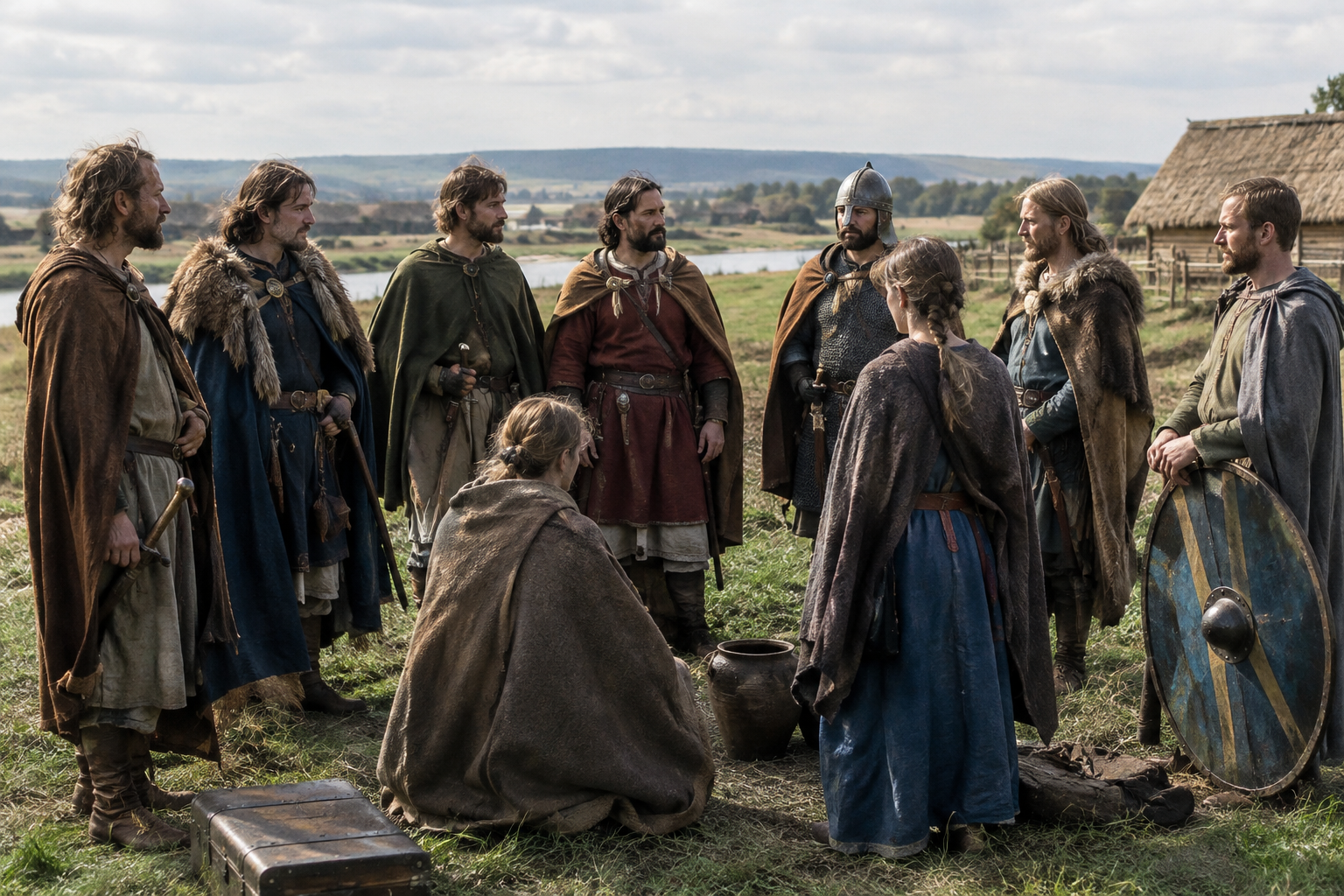
Some Y-chromosome lineages turn up like old place-names: not everywhere, not always loudly, but in just the right spots to tell us who was moving, who was settling, and who was part of the upheavals that remade Europe after Rome. The haplogroup R1b1a1b1a1a1c2b2a1b2 belongs to that sort of story. It is a very specific paternal branch, deep within the wider R1b family, and that matters because narrow subclades often illuminate particular episodes of history far better than the broad umbrella label alone.
That also requires caution. Y-DNA haplogroups trace one direct paternal line only: father to father to father. They do not describe a person's whole ancestry, culture, language, or identity. Still, when a rare or specific branch appears in ancient cemeteries across Hungary, Germany, and early medieval England, it becomes a useful historical clue. In this case, the supplied ancient samples place this lineage in the world of Longobards, Franks, Thuringians, Jutes, and Anglo-Saxons - precisely the societies that emerged from the collapse of Roman power in the West.
The broader R1b haplogroup is one of the major paternal lineages of western Eurasia, with a long and complicated prehistory. But one of the common mistakes in popular writing is to take the whole grand history of R1b and pin it directly onto a much narrower branch. We should not do that here. What we can say is that R1b1a1b1a1a1c2b2a1b2 is a downstream lineage within that much wider paternal tree, and the ancient evidence supplied for it places it squarely in early medieval north-central Europe and the North Sea world.
That distribution is historically interesting because it overlaps with regions tied to Migration Period and post-Roman political change: Pannonia on the Middle Danube, German-speaking lands east of the Rhine, and Kent in southeastern England. Rather than imagining one simple folk migration, the safer conclusion is that this branch appears among men living in several connected frontier societies of the 5th to 7th centuries AD. These were communities shaped by alliance, military service, resettlement, intermarriage, and the formation of new kingdoms.
Explore How Ancient DNA Rewrites History
The most revealing part of this haplogroup's story is not a neat origin myth but a set of burials scattered across an unstable world. In western Hungary, two men from the Longobard period stand out: SZL070 from Longobard Period Pannonia Savaria Szeleste Barbaricum Hungary, dated 525 AD, and MFC016 from Longobard Period Pannonia Arrabona Menfocsanak Barbaricum Hungary, dated 550 AD. These are not just dots on a map. They belong to the Danubian frontier zone, where post-Roman power was being renegotiated by groups conventionally labelled "barbarian" in Roman sources, though in reality they were deeply entangled with the empire they replaced.
Pannonia mattered because it was a corridor. Armies crossed it, federate groups settled in it, and peoples later known from Italy, Bavaria, or the Elbe world passed through it. The appearance of this paternal branch in Longobard-period graves suggests that men carrying related Y-lineages were part of those communities in the Middle Danube basin during the 6th century.
Further west and north, the same branch appears in early medieval Germany. OBM054, from the Thuringii Tribe Germany Obermoellern, dated 500 AD, places the lineage in the old Thuringian zone. ADN014, from a Frankish Grave Lower Saxony Hannover-Anderten Germany, dated 400 AD, pushes it into the broader Frankish and north German frontier. Then Mln14, from Merovingian Period Frankish Moemlingen Germany, dated 650 AD, shows it still present in the age of the Merovingian kingdoms.
Taken together, these samples do not prove one dynasty, one tribe, or one uninterrupted family. But they do suggest that closely related paternal lines were present across several Germanic-speaking political worlds over at least two and a half centuries.
Read About the German Frontier After Rome
Then the story reaches Kent. Four supplied samples from Buckland, Dover are especially valuable: BUK040, described as Jute Early Anglo Saxon Period Buckland Dover England, dated 400 AD; BUK011, Early Anglo Saxon Period Buckland Dover England, dated 400 AD; and BUK001 and BUK006, both Early Medieval Buckland Dover England, each dated 400 AD.
Dover is one of those places where history almost overexplains itself. It faces the Continent. It is a crossing point, a military point, and a settlement point. If this haplogroup appears in Buckland burials associated with Jutish and early Anglo-Saxon contexts, that fits the wider archaeological picture of North Sea mobility in late Roman and post-Roman Britain. Men carrying this paternal branch, or closely related ones, were not confined to one inland homeland. They were part of the movement linking the Continent to southeastern England.
Again, caution first: sharing a haplogroup with a Buckland burial does not make anyone today "a Jute," nor does it identify an exact ethnic label for every ancient carrier. What it does show is that this branch belonged to the population mix involved in the making of early medieval England.
Discover Anglo-Saxon Migration DNA
The noble-family material supplied here is limited but suggestive: Riddarhuset Lillieskold. Riddarhuset, the Swedish House of Nobility, preserves the memory of lineages elevated into the formal noble order of early modern Sweden. The Lillieskold family therefore belongs not to the Migration Period itself, but to a later Scandinavian world in which ancestry, heraldry, military service, and landed status were carefully recorded and displayed.
That is worth pausing over, because genealogies and genetics do different jobs. A noble house such as Lillieskold preserves a documented social history: names, marriages, offices, estates, and rank. A Y-DNA haplogroup preserves a biological history of one paternal line. Sometimes those two histories overlap neatly. Often they do not. Adoptions, illegitimacy, branching family lines, and incomplete records all complicate the picture. So while a historical association may invite comparison, it does not prove that every man of the family carried this exact haplogroup.
Even so, there is an intriguing geographical contrast here. The ancient samples cluster around continental Germanic and North Sea contexts, while the noble reference points us toward Sweden's aristocratic memory culture. That does not establish direct descent. But it does remind us that paternal lines can survive enormous political changes: from frontier cemeteries and Migration Period war bands to the paper world of coats of arms, ennoblements, and noble registries.
Explore the Lillieskold Family
In many noble-house histories, castles and manor seats loom very large. They are visible, durable, and wonderfully theatrical. Genetics is less obliging. A castle can preserve a family's historical footprint in a region, but it cannot by itself prove a paternal haplogroup. That matters here because the supplied family note does not include a confirmed castle location or a documented Y-DNA test from a verified historical Lillieskold male line.
So the responsible way to connect castles and chromosomes is not to pretend they are the same kind of evidence. Castles show how a family presented power and continuity. Ancient DNA shows how paternal lines were distributed among older populations. When the two are placed side by side, they can deepen the story of a region - but only if we resist the temptation to jump from broad historical association to precise genealogical claim.
For readers interested in that Scandinavian noble context, the Lillieskold connection also sits comfortably beside other Swedish family histories on MyTrueAncestry, where documentary tradition and genetic curiosity meet without being confused with one another.
R1b1a1b1a1a1c2b2a1b2 is historically interesting because its supplied ancient record belongs to exactly the centuries when western Europe was being rebuilt. From SZL070 and MFC016 in Longobard-period Hungary, to OBM054, ADN014, and Mln14 in German and Frankish contexts, to BUK040, BUK011, BUK001, and BUK006 in Dover, this paternal branch appears in communities linked by migration, warfare, settlement, and new political identities.
That is the real excitement of Y-DNA. Not that it hands us a fairy-tale pedigree, but that it lets us see continuity and movement across centuries that written sources only dimly describe. One paternal line can appear in multiple regions and multiple cultural settings, quietly demonstrating how entangled early medieval Europe really was.
If this haplogroup appears in your own Y-DNA results, it does not mean you descend from a Longobard warrior, a Frankish noble, or a man buried at Buckland Dover in any direct, provable sense. But it does place one of your paternal lines in a historical landscape that ancient DNA is making sharper every year.
Upload your DNA to MyTrueAncestry to explore whether your results show links to ancient individuals, archaeological cultures, and historical populations like those discussed here. These comparisons can offer remarkable insight into your deeper ancestry, even when they do not prove direct descent from a specific ancient person or noble family.






Comments