Haplogroup R1b1a1b1a1a1c2b2a1b1a4b2a2b1

– 6 min read


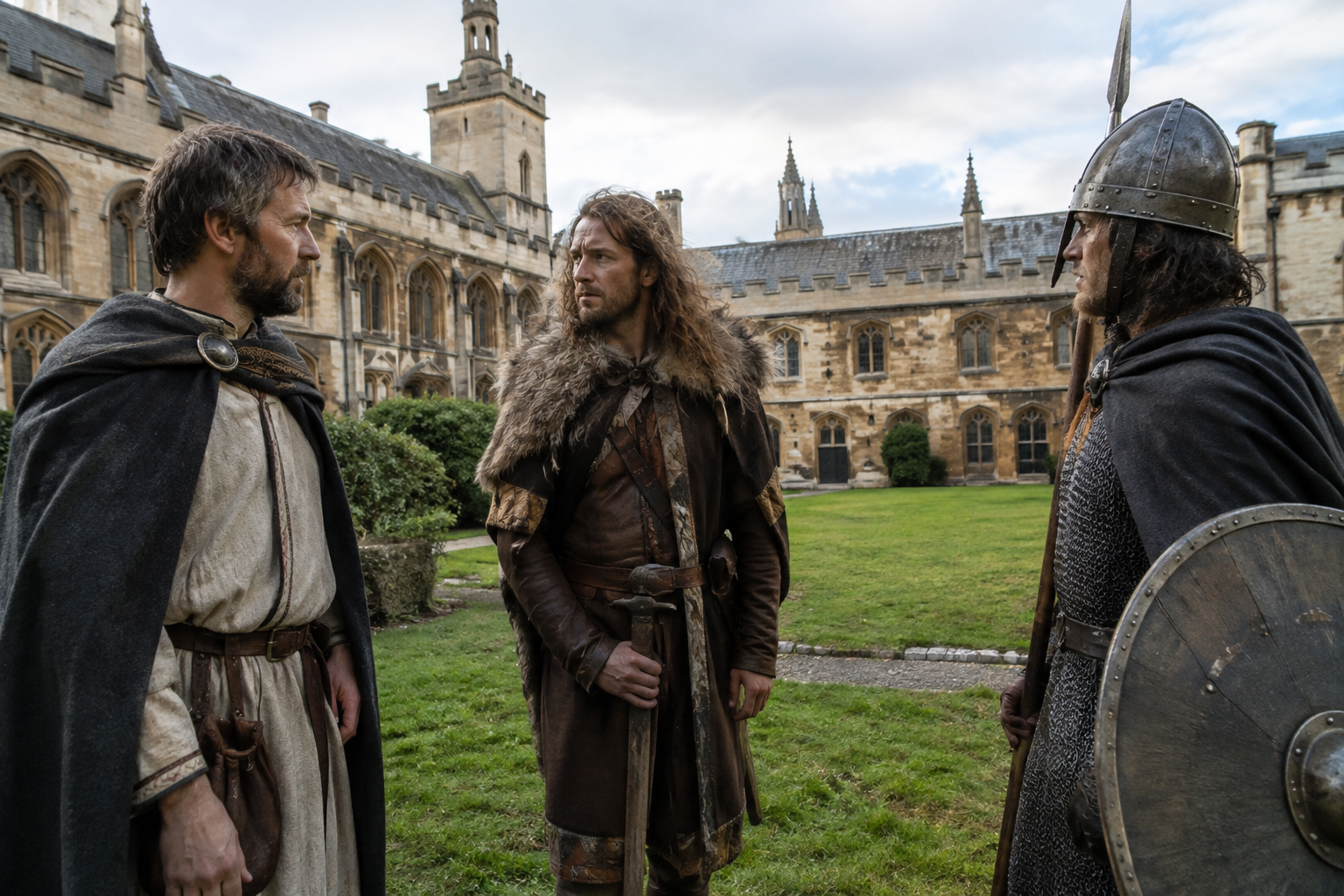
Some Y-chromosome branches announce themselves with famous royal case studies or with neat textbook migrations. Others are more elusive, appearing not as a single grand saga but as a set of clues scattered across medieval England, post-Roman Germany, Viking Age Norway, and later historical landscapes in Scotland. That is what makes the very specific paternal lineage R1b1a1b1a1a1c2b2a1b1a4b2a2b1 so interesting.
At once, a caution. A Y-DNA haplogroup tracks only one line of ancestry: your direct paternal line, father to father to father. It does not describe your whole ancestry, your culture, or your identity. And with such a narrow subclade, we must be especially careful not to pour the entire history of broad R1b into one tiny downstream twig. Still, ancient DNA allows us to see where related paternal lines appear in the record, and that can place this branch in a striking historical setting across northwestern Europe.
This haplogroup belongs deep within the immense Y-chromosome family known as R1b, one of the major paternal lineages found across much of western Europe today. Broadly speaking, R1b has often been discussed in connection with later prehistoric movements that reshaped Europe after the Neolithic, especially during the Copper Age and Bronze Age. But a highly specific branch like R1b1a1b1a1a1c2b2a1b1a4b2a2b1 belongs to a much narrower chapter than that vast background.
So what can we responsibly say? Not that every bearer of this subclade belonged to one people, one language group, or one noble family. Rather, the evidence points to a paternal line embedded in the histories of northern and western Europe, especially in regions shaped by the long interaction of post-Roman Germanic groups, Scandinavian mobility, and medieval British settlement. In other words, this is not a haplogroup that sits still in one tidy ethnic box. It appears in landscapes where frontiers shifted, kingdoms rose, and men moved as settlers, warriors, clergy, tenants, and lords.
For readers interested in the deeper archaeological background behind many western European paternal lines, this broader context is worth exploring further.
Explore Celtic Origins and Ancient DNA
The supplied ancient samples are especially revealing because they do not come from one place or one century. Instead, they trace a line of evidence across several hundred years and across a broad northern European zone.
The earliest is DRH057, described as an Ancient Individual: Thuringii Tribe Germany Roman Deersheim Saxony-Anhalt Year:500 AD ID:DRH057. The wording alone is evocative. This is a man from the world of the late Roman and immediate post-Roman frontier, in a region where imperial structures had weakened and new political identities were forming. The Thuringii are known historically as one of the early Germanic peoples of central Germany. A sample like DRH057 matters because it places a related paternal line in a world of migration-era reorganization, when communities in central Europe were anything but static.
Then there is VK389, the Ancient Individual: Viking Age Spearman Telemark Norway Year:900 AD ID:VK389. That description almost writes its own footnote to history: a spearman in Viking Age Telemark, in southern Norway, at the height of Scandinavian maritime expansion. One should not leap from a shared Y-line to claims of direct descent, but this sample shows that related paternal ancestry was present in a classic Norse setting. It helps explain why such lineages can later appear in places touched by Scandinavian movement around the North Sea.
Finally, we have C11119, the Ancient Individual: Medieval Oxfordshire Magdalen College Longwall Quad Year:1170 AD ID:C11119. Here the scene shifts to medieval England. By 1170 AD, Oxfordshire was part of a deeply layered society shaped by Anglo-Saxon foundations, Viking influence in parts of England, Norman rule, church institutions, and growing towns. A paternal line found here does not prove a Viking identity, or an Anglo-Saxon one, or a Norman one. What it does suggest is continuity of related male lines within the mixed social world of medieval England.
Taken together, these three individuals hint at a lineage moving through - or persisting across - central Germany, Scandinavia, and England between 500 and 1170 AD. That is not proof of one uninterrupted family story. It is, however, a very plausible historical corridor.
If you want a wider view of how such mobility played out in the centuries after Rome, this is an excellent companion read.
Read About the German Frontier After Rome
The tempting mistake with Y-DNA is to imagine a single arrow on a map: from here to there, one tribe, one identity, one destiny. Real history is much messier, and far more interesting. A paternal lineage can spread through elite retinues, village continuity, military service, marriage networks, fosterage, clerical households, lordship, or simple local survival through upheaval.
The geography of these samples invites a sensible hypothesis. Related branches of this lineage may have been part of the wider north European population mix that linked central Germanic territories, Scandinavian communities, and the British Isles in the early medieval world. That linkage is historically unsurprising. The North Sea was not a barrier but a busy highway. Traders, raiders, mercenaries, settlers, and churchmen moved across it for centuries.
By the time we reach medieval England, as with C11119 in Oxfordshire, paternal lines from many earlier streams had already blended into local society. Written records might label men by lordship, law, or language. Genetics offers a different sort of evidence: not identity, but biological continuity along one narrow male line.
The Scandinavian side of that story is especially worth following, since VK389 from Telemark sits squarely in the Viking Age world.
This brings us to the later historical association supplied here: Clan Kinkaid and Lennox Castle near Lennoxtown in East Dunbartonshire. Now, to be scrupulously clear, a historical association between a clan and a haplogroup does not prove that every man of that surname, still less every branch of the wider kin group, carried exactly this Y-DNA line. Scottish clans, like all historical families, were social as well as biological formations, and they often included cadet lines, adoptions, alliances, and non-paternal events over centuries.
Even so, the Kinkaid connection is historically suggestive. The castle built in 1837 for John Lennox Kincaid stood on an older estate linked to the old Earls of Lennox. That matters because the Lennox region sits in one of those classic contact zones of medieval and later Scottish history: a place where Gaelic, Brittonic, Anglo-Norman, and broader North Sea influences all left their mark. If a paternal lineage with roots in the wider northwestern European world later appears in a clan associated with Lennox, that is historically plausible without being genealogically proven.
And Lennox Castle itself tells a story far beyond aristocratic display. Designed as a grand Scottish baronial country house, it was later transformed into a hospital and then part of a large institution for people with learning disabilities. During the Second World War it served military needs. After the hospital closed in 2002, much of the complex was demolished, and the castle shell was badly damaged by fire in 2008. Today the ruin stands amid a housing development, a reminder that historical landscapes do not preserve only noble memory. They also preserve changing attitudes to medicine, class, confinement, and care.
That, if you like, is the proper historical counterpart to Y-DNA. A paternal lineage may persist for centuries, but the meaning of place changes constantly. Castles are not proofs of ancestry; they are containers of memory, often untidy ones.
Readers interested in the clan setting behind this later Scottish connection may want to follow the surname history directly.
So what does R1b1a1b1a1a1c2b2a1b1a4b2a2b1 reveal? Not a fairy tale of instant noble descent, and not a shortcut to ethnic certainty. What it offers is something better: a historically grounded paternal thread running through the kinds of societies that shaped northern Europe after Rome - migration-period Germany, Viking Age Norway, medieval England, and later Scottish historical memory.
The samples DRH057, VK389, and C11119 show how ancient DNA turns abstract haplogroups into real human evidence. One man lived among the Thuringii in Saxony-Anhalt around 500 AD. Another bore arms in Viking Age Telemark around 900 AD. Another lived in medieval Oxfordshire in 1170 AD. They were not the same person, not proven close kin, and not stepping stones to a documented clan pedigree. But together they show how one paternal branch can appear across centuries of upheaval and settlement.
That is the real excitement of archaeogenetics. It does not replace history. It gives history another set of witnesses.
If you have tested your DNA, MyTrueAncestry can help you explore whether your results show connections to ancient individuals, historical populations, and paternal lineages like the one discussed here. Those matches do not necessarily prove direct descent from a specific ancient man or noble family, but they can open remarkable new perspectives on where parts of your ancestry fit within the human past.






Comments