Haplogroup R1b1a1b1a1a1c2b2a1b1a4b2a2

– 5 min read


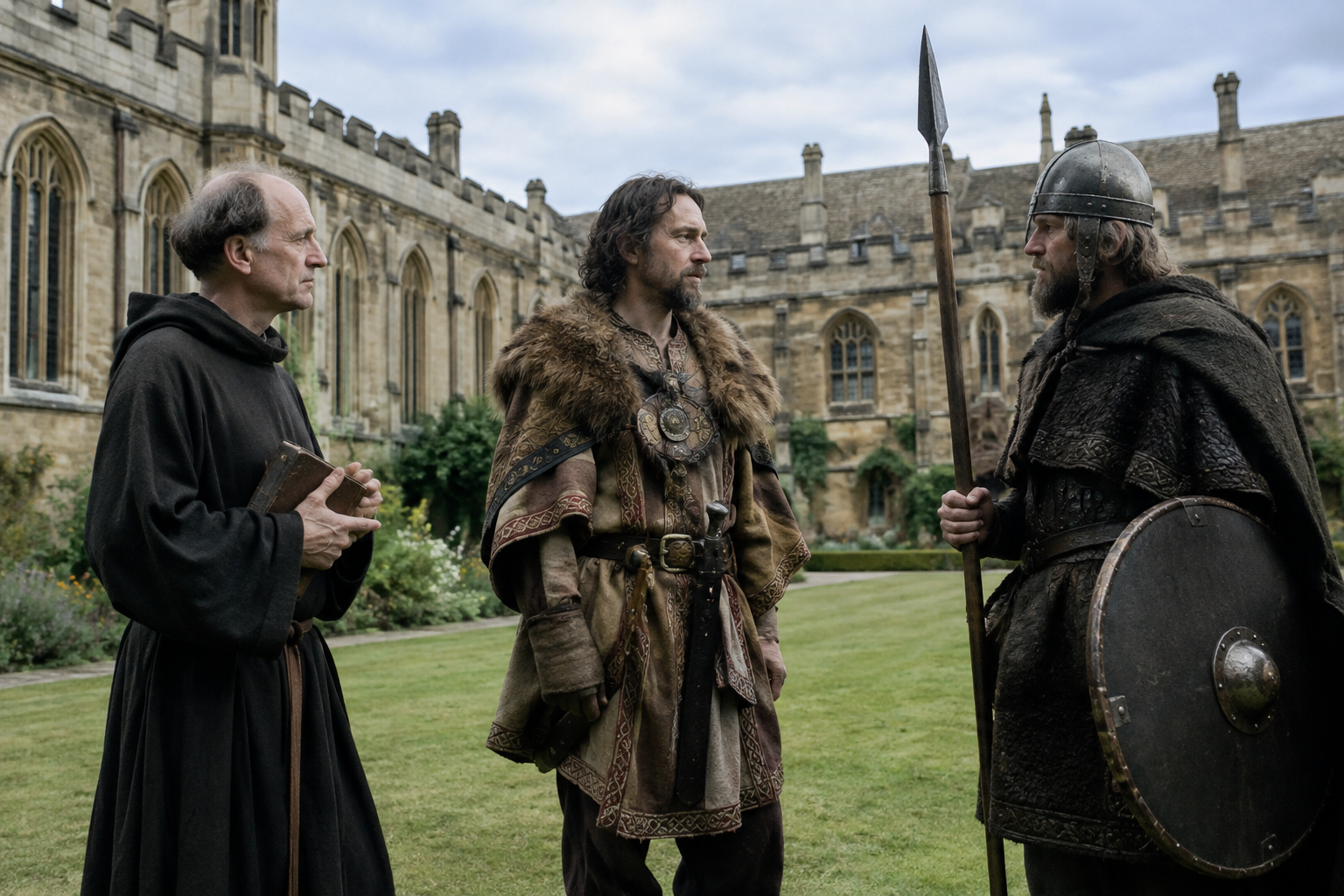
In about AD 1170, one man was buried in Oxfordshire at Magdalen College's Longwall Quad. He appears in the ancient DNA record as C11119, a medieval individual from an English landscape already dense with churches, fields, market exchange, and layered memories of Roman and Anglo-Saxon Britain. For anyone carrying the very specific Y-DNA line R1b1a1b1a1a1c2b2a1b1a4b2a2, that Oxford burial is immediately interesting because it places this paternal branch, or a reported association with it, in a firmly medieval setting rather than in some misty and over-generalized prehistoric past.
That matters because Y-DNA follows one direct paternal line only: father to son across generations. It is powerful, but narrow. In this case, the most useful pattern is not a grand claim about one tribe or one people. It is the recurrence of closely related paternal ancestry in three very different settings: post-Roman central Germany, Viking Age Norway, and medieval England.
Sample C11119 is the clearest late example in this set. Dated to around AD 1170, he belonged to the world of high medieval England, when Oxfordshire stood inside a kingdom that had already absorbed centuries of migration, conquest, and local continuity. By this date, paternal lines found in England could reflect very old British roots, Anglo-Saxon settlement, Scandinavian movement, Norman-era reshuffling, or some combination of all three.
That is exactly why a sample like C11119 is so useful. It does not give us a fairy-tale founder. It gives us a real person in a real medieval landscape, showing that this branch was present in England by the 12th century. A genetic study linked to this sample set, archived at this research project, helps situate such medieval individuals within the growing body of ancient DNA from Britain and northwestern Europe.
Roman and Early Medieval Britain
What C11119 does not do is prove that every modern carrier of R1b1a1b1a1a1c2b2a1b1a4b2a2 descends from medieval Oxfordshire. But he does show the branch established in England at a date when written records begin to thicken, and when paternal lineages were already being folded into the social world of parishes, estates, and towns.
The second key sample is DRH057, dated to about AD 500 and associated here with Deersheim in Saxony-Anhalt, Germany, in a context described as Thuringii. That date places him in the unsettled centuries after the Western Roman Empire's collapse, when central Europe was being reorganized through new kingdoms, military followings, local continuities, and shifting identities recorded imperfectly in later texts.
One should be careful with tribal names. A burial in a region linked with the Thuringii does not magically convert a chromosome into ethnicity. Still, the archaeological and historical setting matters. Around AD 500, central Germany was a frontier of political formation, where older provincial, local, and incoming elements mixed in ways that ancient DNA is now beginning to make visible.
So DRH057 adds something different from the Oxford man. He pushes the paternal trail of this lineage, or at least its reported placement within this branch, back into the early medieval mainland. That makes the English and Norwegian examples harder to treat as isolated curiosities. Instead, we begin to see a north-central European distribution with roots in the centuries often called the Migration Period.
A broader ancient DNA discussion of this world of frontier mixing and post-Roman movement is explored in MyTrueAncestry's piece on Roman-Barbarian Blending on the German Frontier, 400-700 CE, which is useful background for understanding why central German burials can matter far beyond their immediate site.
The third sample, VK389, comes from Telemark in Norway and is dated to about AD 900. The record describes him as a Viking Age spearman. Even without inventing any grave drama, that is enough to place him in one of the best-known mobility zones of early medieval Europe: a Scandinavian world tied together by seafaring, raiding, trading, settlement, and service abroad.
Here the value of the evidence is geographical as much as cultural. Telemark is not England and not Saxony-Anhalt. Yet the presence of the same reported paternal branch in Viking Age Norway suggests that this lineage was circulating within the wider North Sea and Scandinavian sphere before, during, or alongside the movements that reshaped Britain and parts of the Continent.
It would be too neat to say that the Oxford man descended from a Viking precisely like VK389. History is rarely so obliging. But the pairing is still suggestive: one sample from Norway in the Viking Age, another from England in the high Middle Ages, and an earlier one from central Germany in the post-Roman period. Together they map a plausible corridor of male-line continuity across northern Europe.
R1b1a1b1a1a1c2b2a1b1a4b2a2 is an extremely fine-grained label. That is both useful and dangerous. Useful, because such specificity can connect modern testers to narrower paternal clusters than a broad umbrella like R1b ever could. Dangerous, because it tempts us to import the entire history of R1b into one tiny twig without enough evidence.
The safer reading is this: the ancient samples listed here show a reported presence of this lineage, or a very near paternal relationship to it, in northern and central Europe during the early and high Middle Ages. That is already a substantial finding. It suggests that this branch belonged to the male-line population history of places shaped by post-Roman restructuring, Scandinavian mobility, and medieval state formation.
It does not by itself identify an ultimate prehistoric homeland for this exact subclade. Nor does it let us assign one language, one kingdom, or one ethnic badge to every carrier. Y-DNA lines pass through many cultural worlds. The same paternal branch can appear in men who would have lived under very different laws, loyalties, and identities.
When you place DRH057, VK389, and C11119 side by side, the pattern is striking because it is modest. This is not a branch popping up once in a glamorous royal tomb and nowhere else. It appears instead in ordinary but historically rich settings: early medieval central Germany, Viking Age Norway, and medieval England. That sort of spread often tells us more about lived history than a single elite burial ever could.
It also fits a wider picture emerging from ancient DNA: early medieval Europe was not built by one clean replacement after another, but by repeated layers of movement and local persistence. Men carrying related paternal lines could be absorbed into new kingdoms, cross the North Sea, serve in armed retinues, farm established landscapes, and leave descendants in regions that later historians would describe very differently.
An older research preprint often cited in discussions of large-scale Viking genetics can be found at this ancient DNA study. It is best used here not as proof for every detail of these three individuals, but as part of the wider scientific background showing how Scandinavian-linked mobility can be investigated through genomes.
For a modern man carrying R1b1a1b1a1a1c2b2a1b1a4b2a2, the strongest supported insight is that this paternal line is at home in the historical worlds of early medieval and medieval northern Europe. The ancient evidence currently points toward a branch present in the orbit of central German post-Roman communities, Viking Age Scandinavia, and medieval England. That is not a single-origin legend. It is something better: a line that can be placed among the real human traffic of early medieval Europe.






Comments