Haplogroup R1b1a1b1a1a1c2b2a1b1a4b1c1

– 6 min read


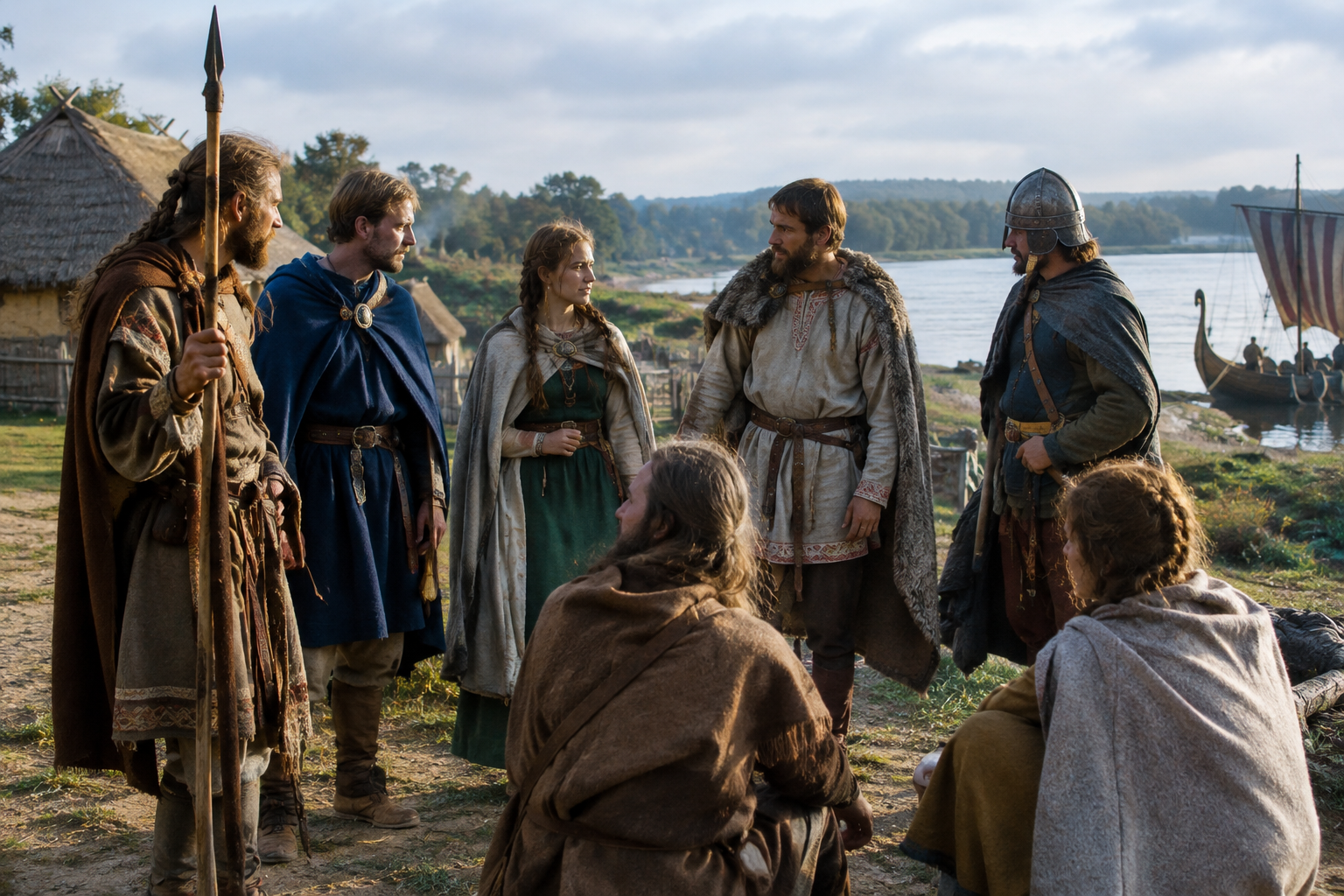
Some Y-DNA haplogroups announce themselves with a grand, familiar label. This one does not. R1b1a1b1a1a1c2b2a1b1a4b1c1 looks less like a famous historical actor than a filing reference in a well-run archive. But that is rather the point. Ancient DNA has taught us that history is not built only from the big banners - Roman, Saxon, Viking, Piast, noble, royal - but from the much smaller paternal branches moving quietly through those larger stories.
Y-DNA traces a direct paternal line: father to son to son across many generations. It tells us something precise, but also something limited. It does not describe a person's whole ancestry, culture, language, or identity. Still, when a narrow branch such as this one appears in burials from early medieval England, Saxony-Anhalt, Sweden, and the Piast frontier, it becomes historically interesting for exactly that reason. It offers a glimpse of male-line continuity and movement across the connected regions of northern Europe.
This subclade sits deep within the wider haplogroup R1b, one of the major Y-chromosome lineages in western Eurasia. For a branch this specific, caution matters. We should not simply pour the entire long history of broad R1b into this much narrower line. What we can say, based on the supplied ancient samples, is that this paternal branch belongs in the medieval and late post-Roman landscapes of the North Sea and adjacent continental world: England, northern Germany, Sweden, and Poland.
Explore Archaeogenetics and Ancient DNA
The most striking thing about this haplogroup, in the evidence supplied here, is not a single dramatic origin story but its appearance in several settings linked by migration, warfare, settlement, and dynastic formation after the end of Roman power in the West.
In England, the sample C10427 comes from Post Roman Iron Age England East Yorkshire Wetwang Slack 224, dated to 450 AD. That date lands in one of the most debated centuries in British history. Roman administration had gone, local societies were adapting, and newcomers from across the North Sea were entering the picture. A paternal line found here reminds us that eastern Britain was not a sealed island, but part of a maritime zone connecting Yorkshire to the Low Countries, northern Germany, Jutland, and beyond.
That wider continental setting is visible in two more samples: BRC022x from Saxon Tribe Migration Period Saxony-Anhalt Bruecken, dated 500 AD, and DRH021 from Thuringii Tribe Germany Deersheim Saxony-Anhalt, also dated 500 AD. These are exactly the kinds of finds that make paternal-line history so intriguing. They place this lineage in regions associated with communities active in the rearrangement of post-Roman Europe. Not proof of a single tribe marching in neat genetic order, of course - life is never so obliging - but evidence that this male line belonged within that world.
Then there is POH009, from Jute Early Medieval Polhill Kent England, dated 600 AD. Kent is crucial. It was one of the main early medieval gateways between Britain and the Continent, and the Jutish association in the sample description points toward another branch of those North Sea connections. If C10427 gives us eastern Yorkshire in a transitional age, POH009 places the same paternal story in the southeast, in a kingdom shaped by sea routes, elite exchange, and early Christian contact.
Put these together and a pattern emerges: not one ethnicity, not one kingdom, but a corridor of related male lines appearing in places that were politically different yet deeply connected by movement across the North Sea.
Explore Anglo-Saxon Migration DNA
Ancient DNA is most useful when it stops us from telling over-neat stories. The presence of this haplogroup in Saxon, Thuringian, Jutish, and English archaeological settings does not mean all these groups were genetically uniform, nor that a haplogroup equals a people. What it does show is that one paternal branch was circulating in the very regions historians already know were linked by migration and settlement in the 5th to 7th centuries.
The later samples widen the picture further. VK34 from Viking Age Skara Varnhem Sweden, dated 1050 AD, places the lineage in medieval Scandinavia. By that date, the Viking Age was giving way to a more settled Christian order, but Scandinavian mobility had already reshaped large parts of the North Atlantic and the Baltic. A Swedish appearance for this paternal branch is therefore not an exotic outlier. It fits a North European world in which men, families, merchants, warriors, and clerics moved across sea lanes that were every bit as important as roads.
Even more intriguing is PCA0422 from the Piast Dynasty Lubusz-Greater Poland Border Santok Lad, dated 1100 AD. Santok sat in a frontier zone of the medieval Piast realm, a strategic place of contact and contest. A sample from a Piast-dynastic context does not prove descent from any modern family, nor does it make this haplogroup "the Piast haplogroup" in some simplistic sense. But it does show that the same paternal branch was present in a medieval political landscape much further east, in a region tied to frontier lordship, state formation, and cross-border interaction.
That is often how ancient Y-DNA works best: less as a badge of identity, more as evidence of long-range male-line connectivity across regions that written history also shows to be entangled.
Read About the Piast Dynasty and DNA
How do we move from burials in Kent, Saxony-Anhalt, Varnhem, and Santok to later noble families in England? Carefully.
The supplied associations bring in two historic houses: the Stanley family of Knowsley Hall in Merseyside and the Pennington family of Muncaster Castle in Cumbria. The important point is that historical association is not the same as proven genetic descent. We should not claim that every Stanley or every Pennington man carried this exact haplogroup, still less that an early medieval burial in Germany or Sweden is the direct ancestor of a named medieval lord. That would be bad history and bad genetics.
What can be said is more interesting than a fantasy pedigree. These families belonged to regions shaped by exactly the kinds of deep population processes the ancient samples illuminate. Knowsley Hall began as a medieval hunting lodge in the royal forest of West Derby and, after the Stanley family gained the estate in the late 1300s, grew into the seat of the Earls of Derby. Rebuilt and enlarged in the 18th century, then reshaped in the early 19th century by Robert Smirke into its present Gothic form, it became not merely an aristocratic residence but also a place of science and collecting. The 13th Earl's menagerie and natural history collection are a pleasing reminder that great houses were sometimes laboratories of curiosity as well as theatres of power.
Muncaster Castle, by contrast, sits in a harsher borderland setting. Its roots stretch back at least to the 13th century, and the Pennington family held it for many centuries after receiving the estate in the reign of Henry III. Much of the present building was formed in the medieval period and later remodelled, especially in the Victorian age, into a grand Gothic style. This was a landscape touched by raiding, warfare, and shifting royal authority. It accumulated the sort of stories old border houses always seem to gather: jesters, hauntings, stubborn family memory.
These castles do not prove a haplogroup. But they do preserve the later social world in which old regional paternal lines could endure, split, merge, disappear, and sometimes survive into documented genealogy.
Discover the House of Pennington
R1b1a1b1a1a1c2b2a1b1a4b1c1 is a good example of why the smallest branches can tell some of the most human stories. In the evidence supplied here, this paternal line appears in post-Roman Yorkshire, early medieval Kent, Migration Period Saxony-Anhalt, Viking Age Sweden, and a Piast frontier context in medieval Poland. That is not a tidy ethnic label. It is a map of northern European entanglement.
For family historians, the lesson is equally important. Y-DNA can link modern men to a deep paternal framework that written records alone could never reach. But it works alongside history, not instead of it. A shared haplogroup may point to distant paternal kinship; it does not prove descent from a specific ancient individual, tribe, or noble house. What it offers is context - sometimes astonishing context - for how a direct male line may fit into the larger history of migration, settlement, and regional continuity.
If this branch appears in your own results, you may be looking at a paternal story with roots in the North Sea world and in the centuries when Roman Britain gave way to early medieval kingdoms, when continental groups reshaped Europe, and when later noble landscapes emerged in places like Merseyside and Cumbria.
Upload your DNA to MyTrueAncestry and see whether your results show connections to ancient individuals such as C10427, BRC022x, DRH021, POH009, VK34, or PCA0422. Those matches cannot by themselves prove direct descent or noble status, but they can place your paternal line inside a much older and more interesting historical map.
Ancient DNA has made the past less abstract. It has given us men in graves, in frontier zones, in churchyards, in cemeteries, and in the long shadow of later castles. That is where haplogroups become properly historical: not as slogans, but as evidence.






Comments