Haplogroup R1b1a1b1a1a1c2b2a1b1a4a

– 6 min read


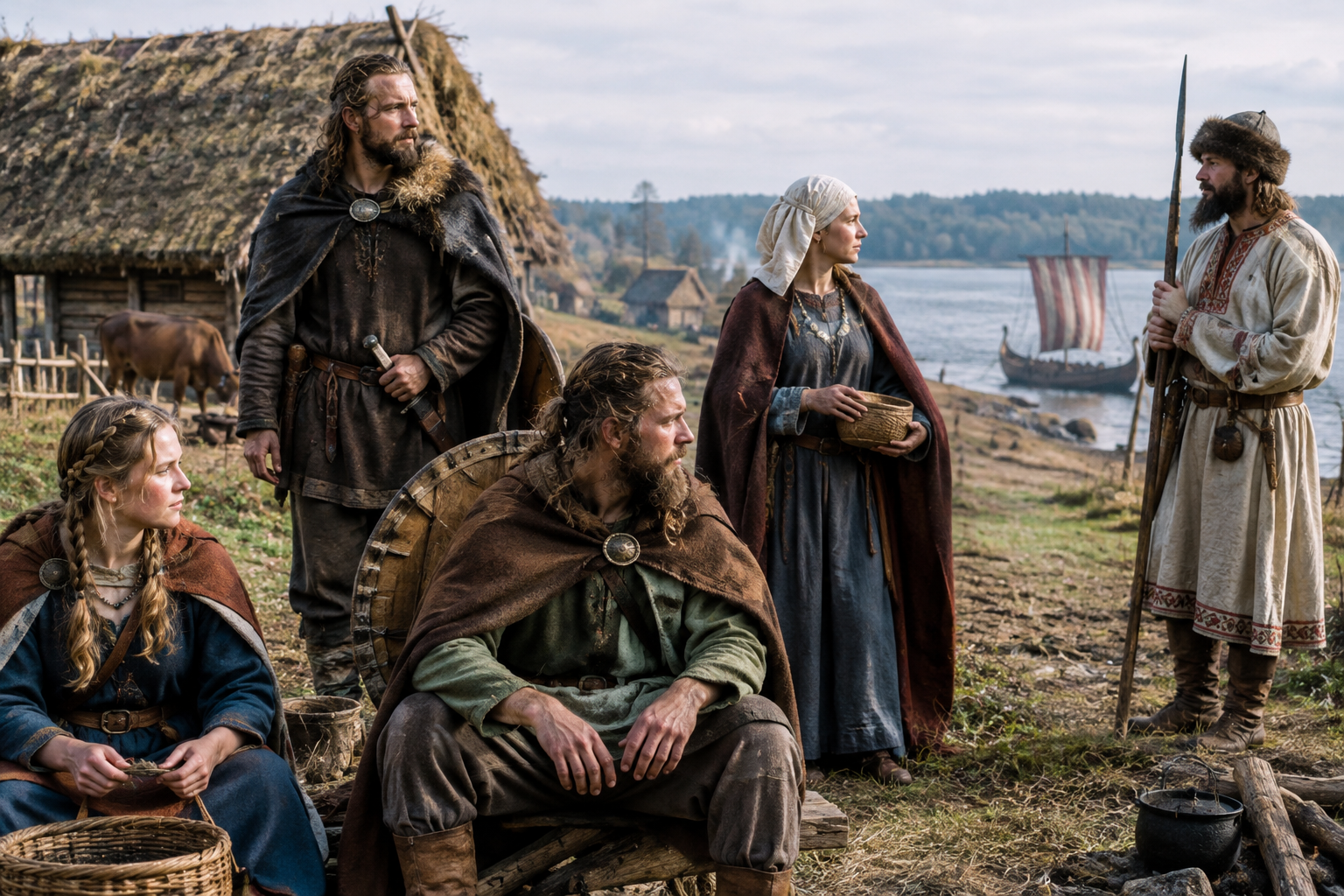
Some Y-chromosome lineages arrive in history with trumpets: royal burials, famous dynasties, neatly labelled migrations. Others come to us more obliquely, in fragments from graves, islands, frontier settlements, and the later landscapes of castles and lordship. The haplogroup R1b1a1b1a1a1c2b2a1b1a4a belongs to that second, more interesting sort. It sits deep within the wider R1b family, one of the major paternal branches in western Eurasia, but this very specific subclade is not something we should treat as a shorthand for an entire people, kingdom, or language.
That is worth saying plainly at the start. Y-DNA haplogroups trace one direct paternal line only: father to father to father across time. They do not describe a person's full ancestry, and they do not by themselves prove descent from a noble house, a medieval tribe, or a named historical individual. What they do offer is something more subtle and, in its way, more revealing: a map of how one paternal branch appears across centuries, across regions, and across the social worlds of archaeology and written history.
This haplogroup is an extremely fine-grained branch within the broader R1b tree. For that reason, one has to be careful. It would be wrong simply to pour the entire prehistory of R1b into the story of this one downstream lineage as if nothing changed along the way. Broadly speaking, R1b lineages became important across much of western and parts of central Europe in later prehistory, especially through major demographic shifts after the Neolithic. But a branch as specific as R1b1a1b1a1a1c2b2a1b1a4a belongs to a much narrower chapter of that longer history.
What the supplied evidence suggests is not a single dramatic origin myth, but a pattern of paternal continuity and mobility around the North Sea and Baltic worlds, reaching into early medieval Germany and, by historical association, into Norman and post-Conquest England. That is a properly medieval story: not pure, not simple, and certainly not confined within modern national borders.
If you want wider background on how ancient DNA changed our ability to trace such paternal lines at all, MyTrueAncestry readers may enjoy this broader introduction to the field.
The most vivid way into this haplogroup's history is through the ancient individuals linked with it in the supplied material. They do not form a tidy family tree, and we should not pretend otherwise. But together they sketch a zone of movement stretching from Denmark and Sweden to northern and central Germany.
Take VK133, from Viking Age Galgedil Funen Denmark, dated to 925 AD. Funen sits right in the Danish heartland, and a sample from there places this paternal lineage firmly in a Scandinavian setting during the Viking Age. Not a saga hero, not a king, just a real man from a real burial ground, carrying one branch of a lineage that could move with traders, settlers, raiders, farmers, or local families.
Then there is VK469, from Viking Age Gotland Kopparsvik Sweden, dated to 975 AD. Gotland is especially evocative because it was one of the great Baltic crossroads. Goods, people, and ideas passed through it in abundance. A paternal lineage found there might reflect local continuity, maritime networks, or movement across the Baltic world. Ancient DNA cannot decide among those possibilities on its own, but it does place the lineage in precisely the kind of connected environment where such movement was routine.
Now shift southward to Germany. ADN002, from a Saxon Grave Lower Saxony Hannover-Anderten Germany, dated to 400 AD, is particularly striking. The label "Saxon grave" places the burial in a world often discussed through migration narratives, but the better lesson is more practical. Northern Germany in Late Antiquity and the early Migration Period was not a museum of fixed ethnic types. It was a region of shifting military loyalties, local communities, and long-standing North Sea contacts. A paternal line present there in 400 AD helps anchor this branch in continental Germanic-speaking territory before the Viking Age samples from Denmark and Sweden.
Finally, SDN003, from Medieval Germany Sachsen-Anhalt Western Slav Settler Steuden, dated to 1050 AD, reminds us how misleading it can be to tie a haplogroup to one ethnic label. By the eleventh century, central Europe was full of overlap: Slavic settlers, German-speaking neighbors, political expansion, church influence, and local continuity all at once. The same paternal branch appearing in a Western Slav setting does not "prove" that the haplogroup was Slavic in essence any more than the Danish or Saxon samples prove it was exclusively Scandinavian or Saxon. It shows, rather sensibly, that paternal lineages can pass through different cultural worlds while remaining genetically recognizable.
Readers interested in that Viking Age Baltic setting may want to look further at Gotland, where archaeology and genetics continue to complicate any simple story of Scandinavian identity.
Discover Gotland's Deep DNA History
Put these four samples together and a pattern emerges. This lineage appears in northern Germany by 400 AD, in Denmark by 925 AD, in Gotland by 975 AD, and in a Western Slavic settlement zone in Sachsen-Anhalt by 1050 AD. That is not proof of a single uninterrupted clan march across Europe. It is evidence that this paternal branch belonged to the broad human traffic of northern and central Europe in the first millennium AD.
This matters because written sources often describe peoples as if they were solid blocks: Saxons here, Danes there, Slavs over there. Ancient DNA keeps interrupting that tidy scheme. Paternal lines do not read ethnonyms. They move through marriage, migration, settlement, conquest, and sheer demographic persistence. One branch can appear in a Scandinavian burial, a Saxon grave, and a Slavic-settler context without contradiction.
That is also why medieval England enters the picture so naturally. The North Sea was not a barrier but a corridor. Movements between continental Germanic regions, Denmark, and England shaped the genetic background of the medieval population long before and after 1066.
For a closer look at how these overlapping ancestries played out around the time of the Conquest, this article on rural Surrey is a useful companion.
This is where the story moves from graves to earthworks. The supplied noble connection is the House of Beauchamp, associated with Elmley Castle in Worcestershire. Here we have to be exact. A historical association between a haplogroup and a noble family is not proof that every Beauchamp man carried this lineage, nor that the family can be securely assigned to this exact subclade from the information given. But the Beauchamps are still historically useful, because they place our genetic discussion into the social world of post-Conquest lordship.
Elmley Castle began as an early Norman motte and bailey fortress, probably built soon after the Conquest. That already tells you what such a site was for. It was not simply a residence. It was a statement planted in the landscape: authority on a mound, timber and then stone above the surrounding countryside, lordship made visible. The Beauchamp family later strengthened it in stone as they became major lords of the area. Damage, rebuilding, adaptation, and eventual decline followed, just as they did for so many castles whose military edge dulled as aristocratic life changed in the later Middle Ages.
What survives now, according to the supplied description, is especially evocative: earthworks and fragments, enough to show how power after 1066 was imposed and then slowly weathered. Nearby village life continued below the hill, as it generally did. Castles can look, in retrospect, like isolated monuments; in reality they sat inside working human landscapes of tenants, fields, roads, memory, and obligation.
That is where a Y-DNA lineage becomes historically interesting. A paternal branch visible in Scandinavian and German burials before 1000 AD belongs to the same broad northern European world from which the Norman and post-Conquest aristocracy emerged, even when the social forms were utterly different. Ancient DNA does not make the Beauchamps descendants of any one of these excavated men. It does, however, help us understand the deeper population background from which medieval lordship arose.
Readers interested in the Beauchamps themselves can continue with the dedicated family article.
Explore the House of Beauchamp
The value of R1b1a1b1a1a1c2b2a1b1a4a is not that it gives us a single, dramatic identity. It does something better. It lets us see one direct paternal line appearing in several connected but distinct historical settings: a Saxon grave in Lower Saxony, Viking Age burials in Denmark and Sweden, and a Western Slav settler context in medieval Sachsen-Anhalt. Then, in a different register altogether, it invites us to think about the later noble landscapes of England, where families like the Beauchamps stood atop centuries of earlier migration, mixing, and continuity.
In other words, genetics and history are doing different jobs. Written genealogy can name a lord, a castle, a succession. Archaeology can show us burial practice, settlement, and material life. Ancient DNA adds a separate line of evidence, tracing biological connections that sometimes align with the documentary record and sometimes cut neatly across it. The important thing is not to confuse a shared haplogroup with proven kinship. Two men can share a broad paternal branch and still be separated by many centuries and many thousands of unrecorded fathers.
That is precisely why this kind of evidence is so compelling. It restores scale. Beneath the named families and ruined castles lie long-lived lineages carried by ordinary and extraordinary men alike, through pagan cemeteries, Christianizing kingdoms, trading islands, settler villages, and conquered shires.
If you have tested your DNA, MyTrueAncestry can help you explore whether your own results show similarities to ancient individuals like VK133, VK469, ADN002, or SDN003, and place your ancestry in a wider historical setting. Those matches do not prove direct descent from a particular ancient person or noble house, but they can open a remarkable window onto the worlds your ancestors moved through.






Comments