Haplogroup R1b1a1b1a1a1c2b1b4d

– 6 min read


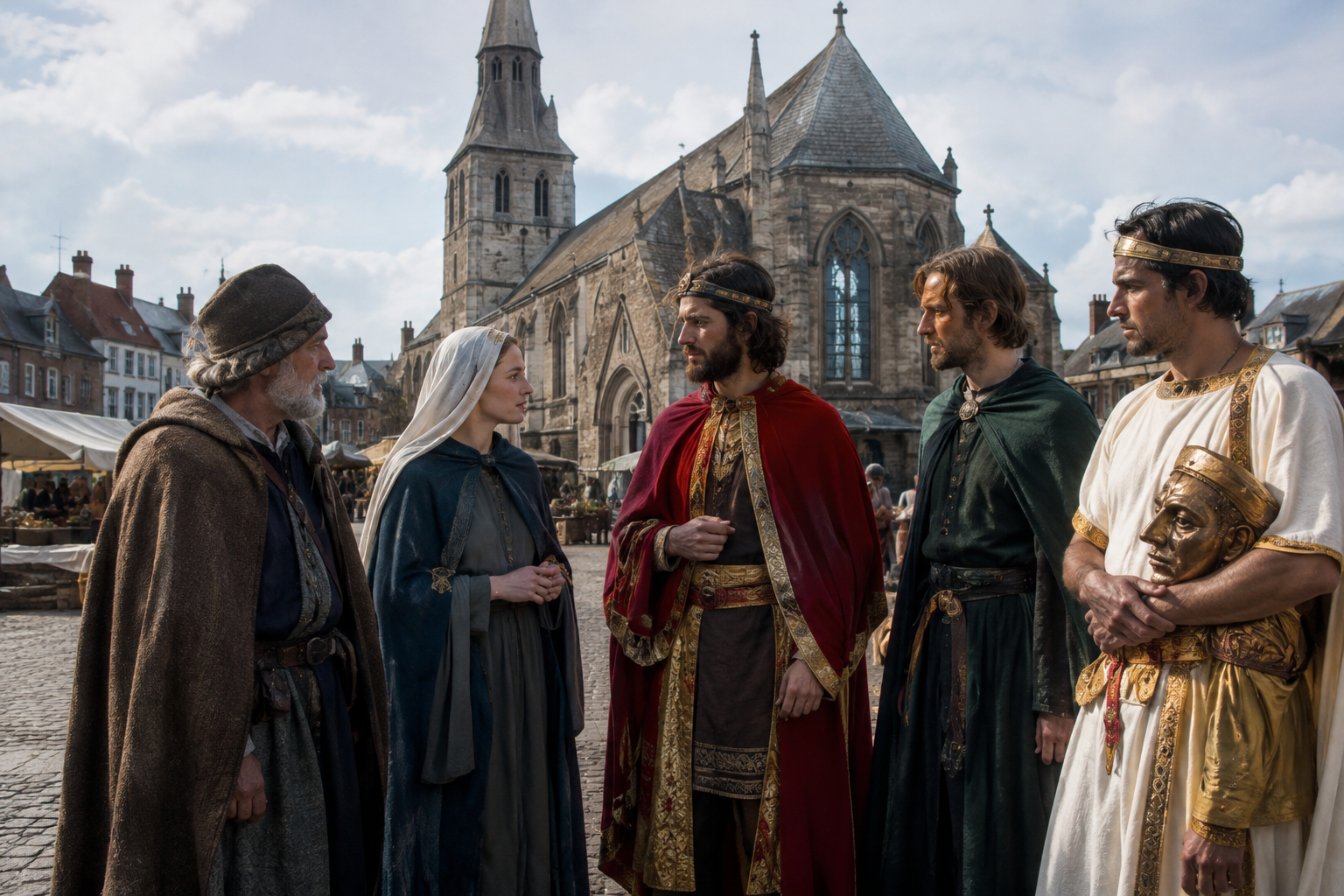
Some Y-DNA haplogroups are so broad that they seem to sit everywhere in European history at once. R1b1a1b1a1a1c2b1b4d is not one of those. It is a very specific paternal branch, a twig on a much larger tree, and that is precisely what makes it interesting. Narrow subclades like this are where the grand sweep of population history starts to brush up against real places, real burials, and occasionally the remembered landscapes of later families and castles.
It is worth pausing over what that means. A Y-DNA haplogroup follows the direct paternal line only: father to son to son across generations. It does not represent a person's whole ancestry, nor does it by itself prove identity with a tribe, kingdom, or noble house. But when a distinctive branch turns up in ancient graves from Macedonia, medieval Belgium, and the northern Low Countries, it gives us something wonderfully concrete: not a myth of pure descent, but a traceable male-line pattern moving through history.
This haplogroup belongs within the wider family of R1b, one of the most discussed paternal lineages in western Eurasian archaeogenetics. The broader R1b story is tied to major prehistoric and later movements across Europe, especially in the Bronze Age and after. But we must be careful here: the history of broad R1b cannot simply be pasted onto one very narrow descendant branch. What we can say, more responsibly, is that this subclade sits within a paternal framework long established across parts of Europe and later visible in historical-era populations.
The supplied ancient samples suggest that this branch, or a very near paternal neighborhood around it, was present in a striking arc from the Balkans to northwestern Europe. That does not automatically tell us where the subclade first formed. It does, however, hint that by the first millennium BC and the first millennium AD, closely related male lines were appearing in very different social worlds: elite burial in ancient Macedonia, churchyard and urban burial in medieval Belgium, and a Carolingian-era individual in Groningen in the Netherlands.
Readers interested in the deeper background to how archaeologists and geneticists reconstruct such paternal histories may enjoy this broader introduction to the field.
Explore Ancient DNA and Archaeogenetics
The most arresting sample in this set is DEM3235, from the Royal Tombs of Aigai Macedonia Elite Tomb I, dated to 400 BC. Aigai is no ordinary backdrop. This was one of the great royal centers of ancient Macedonia, a place associated with courtly power, dynastic display, and the political world that would soon produce Philip II and Alexander the Great. We should not turn one Y-chromosome result into a sweeping claim about Macedonian identity, but this sample reminds us that paternal branches later found farther northwest were already present in high-status contexts in the ancient Balkans.
That southern appearance becomes even more interesting when set beside the medieval cluster from Sint-Truiden in Belgium. Here we have ST1189, described as Medieval Belgium Outsider Sint-Truiden Onze-Lieve-Vrouwekerk and dated to 900 AD, alongside ST2320 from Medieval Belgium Sint-Truiden Onze-Lieve-Vrouwekerk, also dated to 900 AD, and ST2397 from Medieval Belgium Sint-Truiden Groenmarkt, dated to 1050 AD. That is a useful little cluster, because it places related paternal ancestry not in a royal tomb this time, but in the social fabric of a medieval town.
Sint-Truiden in this period sat in a world of churches, markets, landholding, and movement. The label "outsider" for ST1189 is especially suggestive. It implies that medieval communities could contain people whose life histories or burial contexts marked them as different, yet who still shared paternal ancestry with others in the wider region. That is one of the small but important lessons of ancient DNA: human communities are almost never as neatly bounded as later identities might suggest.
For more on this exact medieval setting, the Sint-Truiden material is explored in greater detail here.
Discover Medieval Sint-Truiden DNA
The final sample, GRO023, from Carolingian Era Groningen Netherlands dated to 1090 AD, helps widen the map. Groningen belonged to the North Sea world, connected by waterways, trade, ecclesiastical networks, and shifting political loyalties. By the late first millennium and early second millennium AD, this was a zone shaped by Franks, Frisians, Saxons, merchants, clerics, and local elites. A Y-lineage found both here and in medieval Belgium suggests not a single migration event we can point to with confidence, but a broader pattern of paternal continuity and circulation across northwestern Europe.
That matters because it moves us away from tidy ethnic labels. A haplogroup like this may persist through changed languages, kingdoms, and social orders. The men who carried closely related paternal lines in Macedonia, Belgium, and Groningen did not belong to one timeless "people." They lived in very different political and cultural settings. The power of the evidence lies not in flattening those differences, but in revealing continuity beneath them.
The wider Rhine-Meuse and North Sea zone is one of the most informative regions in Europe for this kind of question. Anyone interested in how ancient ancestry developed there over much longer spans should look at this study of the Lower Rhine-Meuse region.
Explore the Lower Rhine-Meuse Past
So where does this leave us when we turn from graves to castles? The supplied family connection is Clan Cotter and Coppingerstown Castle in County Dublin. The castle was probably built in the late Middle Ages and later became associated with the Coppinger family, part of the wider Anglo-Norman world that spread across Ireland after the twelfth century. It was a small castle or tower house, both a residence and a defended building, standing in a landscape shaped by lordship, agriculture, and local competition.
That description is almost a miniature history of late medieval Ireland in stone. These were not merely military structures. They were also claims about rank, continuity, and belonging. A tower house said: we are established here, we hold land here, and we expect to endure. Coppingerstown Castle later declined, and today survives as a ruin, but ruins have their own historical eloquence. They remind us that family memory often outlasts political systems.
Genetically, we must tread carefully. The presence of this haplogroup in an article associated with Clan Cotter and Coppingerstown Castle does not prove that every Cotter, every Coppinger, or every male occupant of the castle belonged to R1b1a1b1a1a1c2b1b4d. Nor does it allow us to draw a direct paternal line from a Macedonian burial or a Belgian churchyard to a medieval Irish family. What it does allow is a more modest and more interesting point: paternal branches can endure for long periods, reappearing in very different historical frames, while written records and architecture preserve the later chapters of that story.
In that sense, the ruined tower house in County Dublin and the burials of Belgium belong to the same sort of inquiry. Both are fragments of male-line history, though one comes through documentary and architectural survival, and the other through bone and sequence data.
Readers who want to explore the clan context further can continue with MyTrueAncestry's dedicated article on the family.
The most useful way to think about R1b1a1b1a1a1c2b1b4d is not as a badge of fixed identity, but as a narrow paternal thread passing through multiple historical settings. In the evidence supplied here, that thread appears in an elite tomb at Aigai, in medieval burials at Sint-Truiden, and in the Carolingian-era north of the Netherlands. Those appearances suggest a branch with a meaningful European history, visible across both status and geography.
But a haplogroup is not a surname, not a nationality, and not a guaranteed link to nobility. Shared Y-DNA can indicate that two men belong somewhere on the same paternal tree, while still being separated by many centuries and countless undocumented generations. Ancient DNA is at its best when combined with archaeology, history, and a little restraint. It gives us not fairy-tale ancestry, but something better: evidence for how real lineages moved, persisted, and became part of changing societies.
If your own results point toward a lineage like this one, the excitement lies in context. You may be seeing a paternal branch that once appeared in the ancient Balkans, circulated through medieval northwestern Europe, and later existed in the same broad historical world as families who built and occupied places like Coppingerstown Castle. That is already a remarkable story, even without claiming direct descent from any famous tomb or noble house.
Upload your DNA to MyTrueAncestry to explore whether your results show similarities to ancient individuals such as DEM3235, ST1189, ST2320, ST2397, or GRO023, and to place your paternal line in a wider historical setting. These matches can offer fascinating clues about deep ancestry and ancient population history, even when they do not prove direct genealogical descent or membership in a particular medieval family.






Comments