Haplogroup R1b1a1b1a1a1c2b1b

– 6 min read


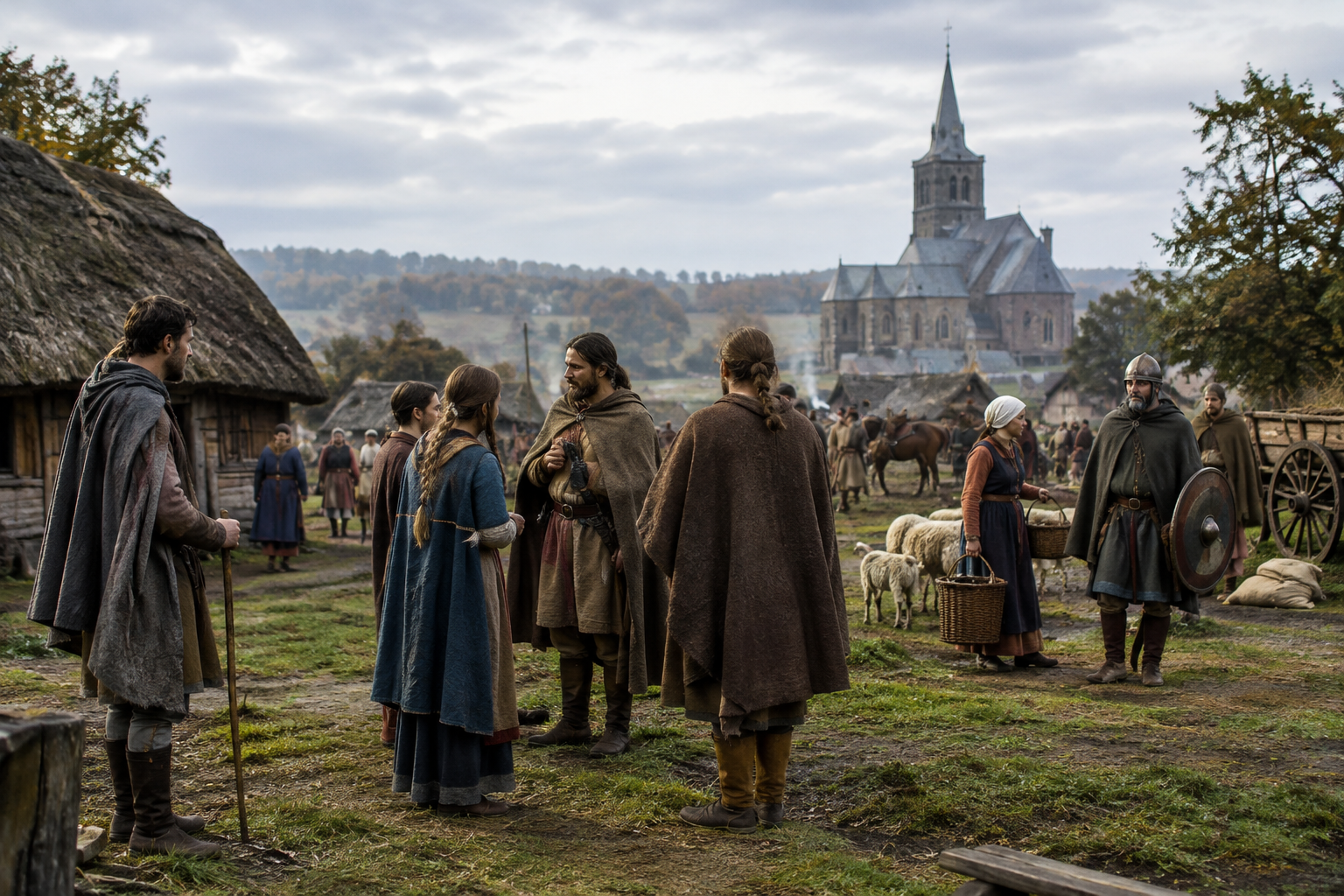
Some Y-DNA haplogroups are famous because they sit under broad and well-known branches. Others are interesting precisely because they are so specific. R1b1a1b1a1a1c2b1b belongs to that second category: a narrow paternal branch inside the vast R1b family, one of the major Y-chromosome lineages in western Eurasia. For family historians, that combination is irresistible. A deep clade like this can feel microscopic on the phylogenetic tree, yet the ancient individuals associated with it appear across a remarkably wide historical landscape: Iron Age Yorkshire, royal Macedonia, Merovingian Germany, Viking Age Denmark, medieval Belgium, and Norway.
That matters because Y-DNA tracks one line only: the direct paternal line, father to son to son. It does not represent a person's whole ancestry, culture, or identity. Still, when the same paternal branch turns up in graves from different centuries and regions, it offers a rare way of watching one male-line heritage move through history. In the case of R1b1a1b1a1a1c2b1b, the story is less about a single tribe or dynasty than about long-term presence in parts of Europe where Celtic, Germanic, North Sea, and medieval Christian worlds all overlapped.
The parent haplogroup R1b has a very large and complicated history in Europe, but we need to be careful not to dump that whole history onto one very narrow downstream branch. What can safely be said is that R1b lineages became important in many parts of prehistoric and historic Europe, and later branched into numerous regional male lines. A subclade as specific as R1b1a1b1a1a1c2b1b is best understood not as "the" lineage of a people, but as one thread within that larger tapestry of paternal descent.
The ancient samples supplied here suggest that this thread was present in several parts of Europe by the Iron Age and remained visible into the early and high medieval periods. The pattern is especially striking around the North Sea and adjacent continental regions: eastern England, Germany, Belgium, the Netherlands, Denmark, Sweden, and Norway. That distribution invites historical questions about continuity, migration, and local elite formation, but it does not by itself prove a single uninterrupted family line.
Readers interested in the bigger prehistoric background to Celtic-speaking expansions may also enjoy this related piece:
Explore Celtic Language Origins
The earliest supplied evidence is already arresting. In Iron Age East Yorkshire, two individuals from Pocklington carry this paternal branch: I21639, described as a Celtic Parisi individual dated to 275 BC, and I21952, a Celtic Briton from the same broader setting dated to 225 BC. These are not abstract dots on a map. They belonged to communities in a region famous for chariot burials, local identities, and strong links across the North Sea and into continental Europe. Their presence reminds us that this lineage was established in Britain well before Rome, and in a specifically Iron Age context that scholars associate with complex local hierarchies rather than isolated villages at the edge of the world.
Another early find appears far to the southeast: DEM3235 from the Royal Tombs of Aigai, Macedonia, Elite Tomb I, dated to 400 BC. This is one of the most intriguing samples in the list because of its elite context. Yet this is exactly where caution is needed. A shared haplogroup branch between an elite Macedonian burial and later northern European samples does not mean a neat dynastic trail. What it does show is that this paternal line, or close relatives within it, had a reach extending into the ancient Balkans. That broadens the historical frame considerably.
By late antiquity and the Migration Period, the branch appears in central Europe with DA119x from Poprad Matejovce, Slovakia, dated to 380 AD. Then it emerges repeatedly in early medieval German contexts: Alh_228 from Merovingian Period Bavaria Altheim, Germany dated to 600 AD, EV7 from Late Merovingian Period Frankish Eltville, Germany dated to 655 AD, and G63 from Early Medieval Merovingian Germany Lauchheim Mittelhofen dated to 700 AD. Taken together, these are powerful evidence that this paternal branch was not a local curiosity of Iron Age Britain. It was also part of the male-line population landscape in Merovingian Europe.
For readers who want more on this frontier world where post-Roman and so-called barbarian communities mixed in practice as well as in burial grounds, this article is a fine companion:
If there is one broad historical setting that suits these samples especially well, it is the connected maritime zone of the North Sea. We can see that in early medieval England with I17274 from Norton Bishops East Mill, Yorkshire dated to 550 AD. We then see it again in Viking Age Scandinavia: VK134 from Galgedil, Funen, Denmark dated to 925 AD, VK290 from Kumle Hoje Grav, Denmark dated to 950 AD, VK324 from Ribe, Jutland dated to 1012 AD, and VK424 from Skara Varnhem, Sweden dated to 1050 AD. The line persists still later in VK117 from Medieval Trondheim, Norway dated to 1200 AD.
That sequence does not prove one mobile dynasty striding from Iron Age Yorkshire to Viking Scandinavia. But it does fit the sort of historical world archaeologists know very well: movement by sea, warrior networks, trade routes, intermarriage, and repeated contacts linking eastern Britain, Frisia, the Low Countries, Jutland, and Norway. In such a world, paternal lineages could persist locally in some places and spread through mobility in others.
The Low Countries also appear in the record. At Sint-Truiden Onze-Lieve-Vrouwekerk in medieval Belgium, three individuals dated to 900 AD are listed: ST1189, identified as a medieval Belgium outsider; ST1237; and ST2320. Another later North Sea sample, GRO023, comes from Carolingian Era Groningen, Netherlands dated to 1090 AD. This cluster suggests that the branch had become part of urbanizing and ecclesiastical medieval populations as well as earlier burial communities.
If you would like to follow that Scandinavian side of the story further, this article on Viking population history is a natural next step:
How, then, do we move from these ancient and medieval burials to later named families? Carefully. Genetics and genealogy are not the same thing. A haplogroup can survive in a region for centuries without allowing us to identify a particular surname-bearing family in the Middle Ages as its definite heirs.
That said, the supplied historical association with Clan Galbraith is a useful reminder that later medieval Scotland sat within this same northern European zone of deep paternal continuity and repeated migration. The Galbraiths were tied to Culcreuch Castle near Fintry in Stirlingshire, a residence that began as a tower house in the late 13th or early 14th century. Over time it developed into a larger lairdly seat, reflecting the familiar Scottish story in which a defended residence gradually became a country house as warfare, status, and architecture changed.
Culcreuch is especially evocative because its history is not one of a frozen medieval fortress. It was linked with the Galbraiths for centuries, then passed through other hands after the family's fortunes declined in the 17th century. Later remodelling and romantic restoration altered the building again, and in modern times its use as a hotel and wedding venue helped preserve it. In other words, the castle itself is a lesson in continuity through change, much like a haplogroup branch that persists while the societies around it are transformed.
What we cannot say is that the castle proves the Galbraith Y-line, or that every Galbraith man belonged to this subclade. Medieval families were shaped by adoption, inheritance through daughters, illegitimacy, remarriage, cadet branches, and plain human complication. But geographically and historically, the Galbraith association belongs to the same broad northwestern European world in which these ancient samples keep appearing.
For readers interested in that clan context, this related profile is the obvious place to continue:
R1b1a1b1a1a1c2b1b shows how ancient DNA can illuminate history without flattening it. The branch appears in Iron Age Britain, an elite burial in ancient Macedonia, Migration Period Slovakia, Merovingian Germany, medieval Belgium and the Netherlands, and Viking and medieval Scandinavia. That is not a simple ethnic label. It is evidence of a paternal lineage moving through a succession of historical worlds.
Traditional genealogy begins with names in documents. Ancient DNA begins with bones in graves. When the two are set beside one another, neither replaces the other. Instead, they offer different scales of history: one personal and recent, the other deep and structural. A clan castle in Stirlingshire and a grave at Pocklington are separated by many centuries, but both belong to the long human story of fathers, sons, communities, and remembered places.
If you want to see how ancient DNA can also help reconstruct medieval towns in the Low Countries, this article pairs especially well with the Sint-Truiden samples discussed above:
If your own Y-DNA belongs somewhere within the wider R1b family, a branch like R1b1a1b1a1a1c2b1b is a reminder that paternal ancestry can connect you, in broad historical terms, to ancient Britons, Merovingian cemeteries, Viking Age Scandinavians, and the later landscapes of clans and castles. MyTrueAncestry lets you explore those ancient DNA comparisons for yourself. The results may reveal fascinating historical connections, even when they do not prove direct descent from a specific ancient individual or noble house.






Comments