Haplogroup R1b1a1b1a1a1c2b1a1a1a

– 5 min read


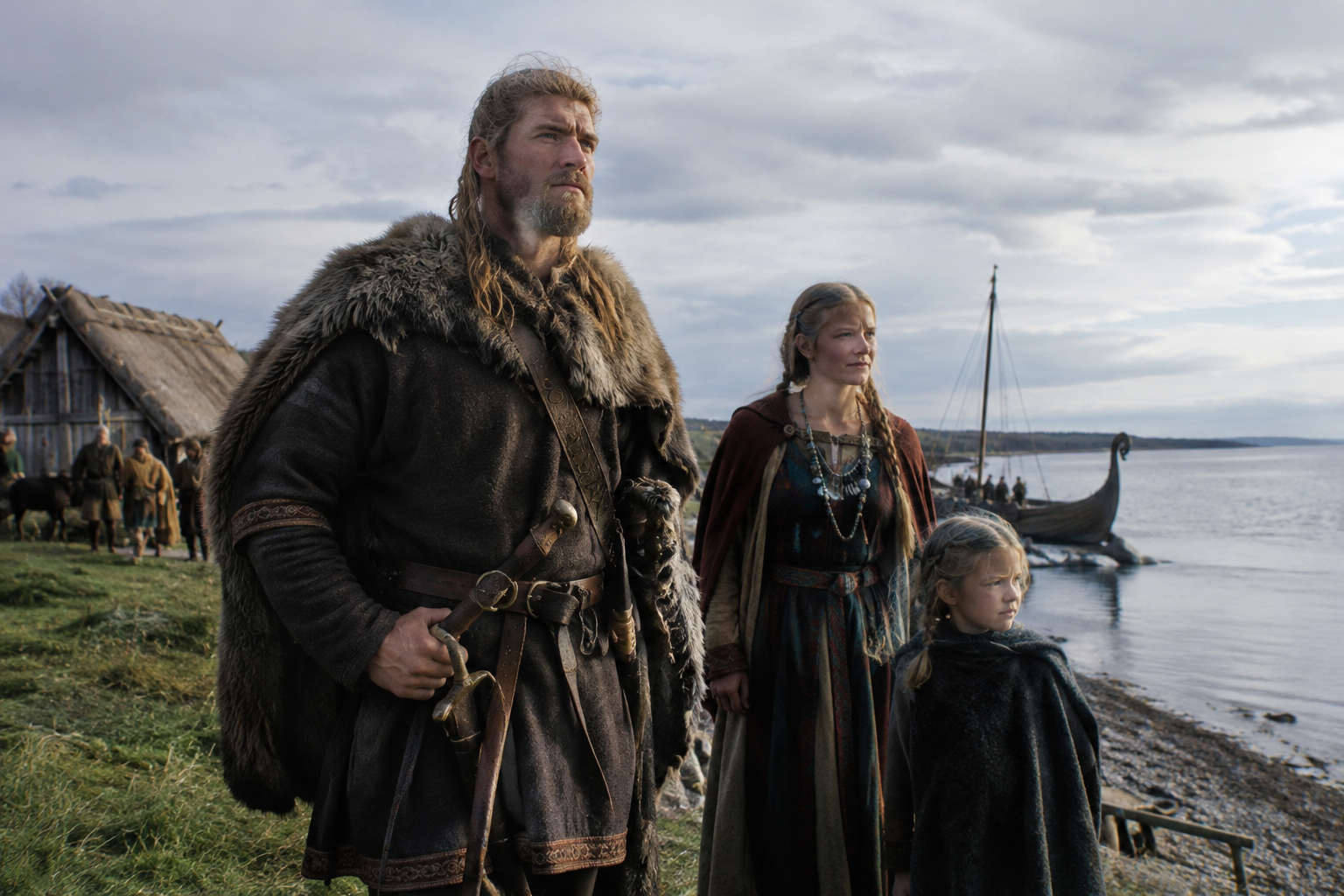
At Hesselbjerg in Jutland, one Viking Age man has become unexpectedly important for anyone tracing the very narrow Y-DNA branch R1b1a1b1a1a1c2b1a1a1a. He is known in the ancient DNA record as VK384, dated to around AD 875 in Denmark. That is already enough to make him interesting: a direct paternal line, carried by a man living in the Scandinavian world at the height of the Viking Age.
It is worth being careful here. Y-DNA follows one line only, from father to father, and says nothing by itself about a person's whole ancestry, language, or identity. But when a precise branch turns up in an excavated ancient individual from a known place and period, it gives that paternal line a solid historical foothold. In this case, the foothold is late 9th-century Jutland.
Jutland in the later 9th century was not some remote fringe. It sat in the middle of a North Sea and Baltic world of exchange, raiding, settlement, and political consolidation. By about AD 875, Denmark was part of a landscape in which local communities, elite networks, and seaborne connections all mattered enormously. A man buried in this setting belongs to a world archaeologists can place with unusual historical clarity, even when the surviving note attached to the DNA sample is brief.
That is why VK384 matters. He is not a legendary king, nor a saga hero retrospectively dressed up by later writing. He is an excavated individual from Viking Age Denmark. For a haplogroup article, that sort of evidence is gold: not because it tells us everything, but because it tells us one thing securely. This paternal branch was present in Jutland during the Viking Age.
An ancient DNA study of Viking Age populations, circulated at this research link, helped establish just how varied and mobile Scandinavian populations could be in this period. Even where a single sample cannot bear grand conclusions on its own, it belongs to a much larger archaeological and genetic effort to place Viking Age people back into their real human settings.
The formidable label R1b1a1b1a1a1c2b1a1a1a is a very narrow twig on the much larger R1b tree. That wider family of lineages has a long and complicated history across Eurasia and later across much of western Europe, but one must not lazily pour that entire story into this tiny terminal branch. The narrower the subclade, the more precise we ought to be, and the less we should pretend to know without direct evidence.
So what can be said responsibly? First, VK384 provides a documented Viking Age occurrence of the branch in Denmark. Second, that places the lineage within a region that was deeply entangled with the movements of people around the North Sea. Third, it raises a perfectly sensible historical possibility: some modern men carrying this branch may descend, through one paternal line among many ancestors, from lineages embedded in the Scandinavian world of the 9th century.
That does not mean every bearer of the branch is "Viking" in any simple cultural sense. It means only that one securely dated ancient carrier lived in Viking Age Jutland, and that is a valuable anchor point.
Jutland was one of the great hinge-regions of early medieval Europe. It linked the Danish islands, the base of the Scandinavian peninsula, the North Sea coast, and the southern approaches toward the Frankish and Saxon worlds. A paternal lineage found there could have remained local for generations, or it might have travelled in one of many directions through trade, warfare, marriage, fosterage, or settlement.
That is exactly the sort of context in which a rare or narrow Y-DNA branch becomes historically vivid. Not because the genetics can narrate a voyage on their own, but because the archaeological setting tells us this was a society in motion. The later 9th century is also a period when Scandinavian connections with Britain, Ireland, the North Atlantic, and parts of continental Europe are well documented from archaeology and texts alike.
For readers interested in the broader linguistic and population background of northern Europe in this era, MyTrueAncestry has also explored how ancient genomics illuminates Germanic-speaking expansions and contacts.
There is a temptation, when only one ancient sample is attached to a haplogroup article, either to overinflate it or to shrug it off. Both reactions are mistaken. A single ancient individual cannot stand for all of Denmark, still less for all Vikings. But one securely placed man can still matter a great deal if he belongs to a precise paternal branch that modern testers now carry.
VK384 gives that branch a date, a region, and a cultural horizon. Instead of floating in a purely modern genetic tree, it appears in a real historical population. That shifts the discussion from abstraction to archaeology. We are no longer speaking only of mutations and branching diagrams, but of one man who lived in a landscape of farms, coastal routes, political rivalries, and expanding Scandinavian horizons.
This is also where restraint is part of good history. We do not know from the brief record whether VK384 was local to Hesselbjerg, whether his immediate paternal relatives were buried nearby, or whether his family had been in Jutland for centuries. Those are fascinating questions, but they remain questions.
Although VK384 belongs to the Viking Age, his presence also sits within a much longer Scandinavian story. Denmark had already seen enormous population changes before the first Viking ships became famous: Mesolithic foragers, incoming Neolithic farmers, later steppe-related ancestry in the Bronze Age, and further regional reshaping through Iron Age and early medieval centuries. By AD 875, any given paternal line was part of a population already layered by millennia of movement and mixture.
That longer background is important because it stops us telling childish stories about "pure" peoples. Viking Age Scandinavians were not genetically uniform, and ancient DNA has repeatedly shown that northern Europe was shaped by both continuity and connection. Denmark, in particular, was never shut off from the continent or the sea-lanes around it.
Seen in that light, the branch R1b1a1b1a1a1c2b1a1a1a is not merely "a Viking lineage". It is a paternal line documented in a Viking Age Dane, within a region whose people had long been shaped by both local continuity and wider northern European contact.
If you belong to R1b1a1b1a1a1c2b1a1a1a, the most distinctive evidence here is straightforward and quite powerful: your direct paternal line has a documented representative in Viking Age Jutland, in the person of VK384 around AD 875. That does not hand you a saga-name, a shield, or a royal pedigree. What it does provide is something better than fantasy: a real archaeological anchor in Denmark at a historically charged moment.
For many people, that is exactly where family history becomes most compelling. Not in inflated claims, but in the sober excitement of knowing that one strand of their ancestry can be placed beside an excavated human life from the Viking world.






Comments