Haplogroup R1b1a1b1a1a1c2b1a1
– 4 min read


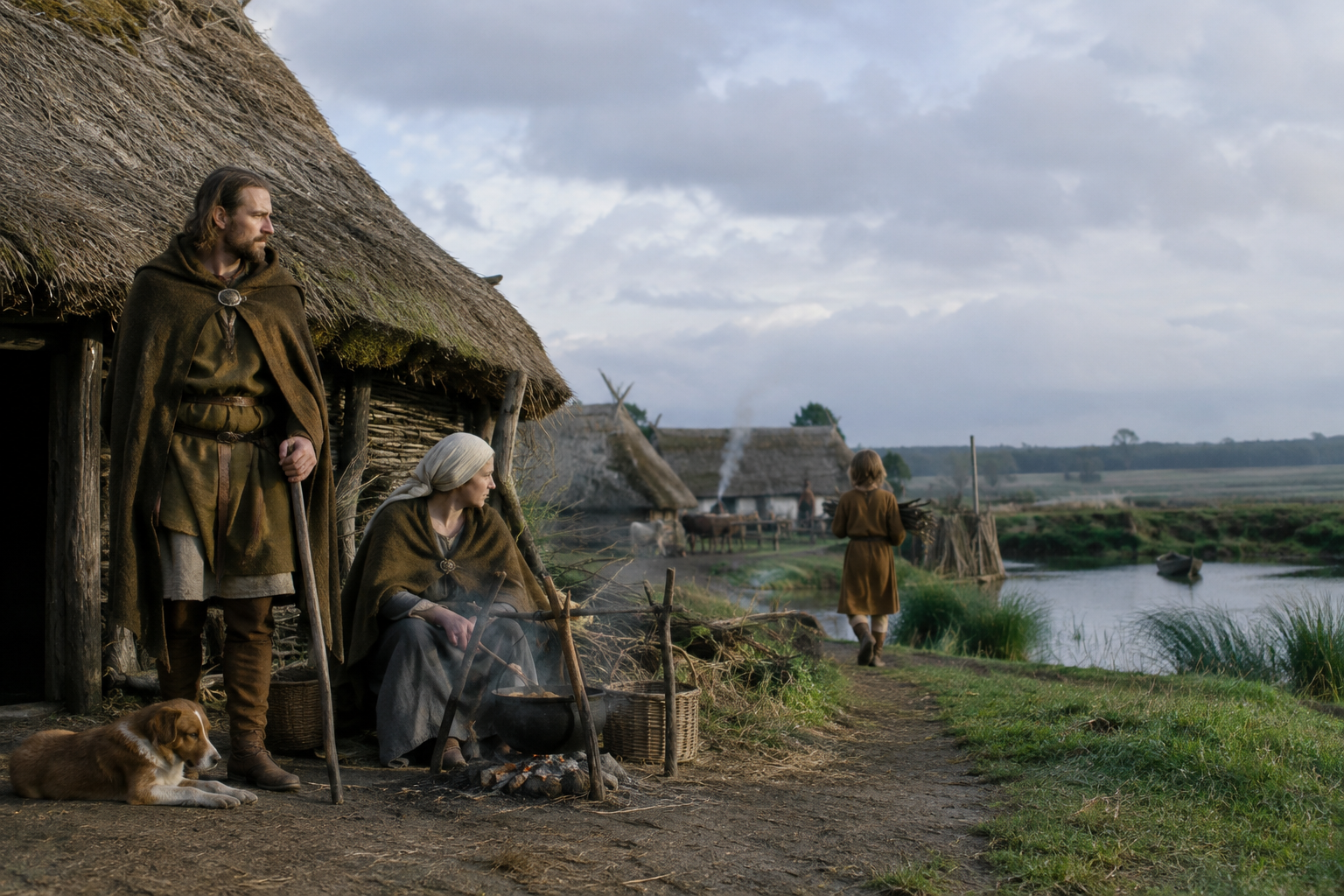
At Lakenheath in Suffolk, one early medieval burial now carries an unexpectedly precise paternal label: LAK007, dated to around AD 650, has been associated with the Y-DNA haplogroup R1b1a1b1a1a1c2b1a1. That sounds forbiddingly technical, but the setting is easy to grasp. We are in eastern England in the centuries after Rome, in a landscape central to the making of early Anglo-Saxon England.
The fascination here is not that one man can somehow stand for an entire people. He cannot. But a sample like LAK007 gives us something rare and solid: a direct paternal line placed in a real place, at a real time, in one of the best studied periods of population change in British history. Y-DNA traces one father-to-son line only, not a person's whole ancestry, yet that single line can still be historically revealing when it appears in a well dated archaeological context.
Lakenheath lies in a region that mattered enormously in the post-Roman centuries. Suffolk and its neighboring counties were part of the zone most closely tied to the North Sea world, where migration, settlement, intermarriage, and shifting political identities shaped the society that would become early England. A burial dated around AD 650 belongs to that mature early Anglo-Saxon phase, when communities were no longer simply newcomers arriving on British shores, but established populations with local histories of their own.
That matters for interpreting LAK007. By the mid-7th century, paternal lines found in eastern England may reflect families with continental roots, families already several generations deep in Britain, or lineages that had become part of mixed local communities. The point is not to force a single origin story onto one skeleton, but to place this haplogroup in the historically charged zone where migration-era ancestry and local continuity met.
An ancient DNA study of this broader period in England, examining the formation of the early English gene pool, has helped show just how substantial North Sea-linked ancestry could be in parts of eastern and southern England, while also making clear that the picture varied sharply by region and community.
The haplogroup name here is very narrow: R1b1a1b1a1a1c2b1a1. Its importance lies precisely in that narrowness. It is not the same thing as speaking loosely about all R1b lineages, which are widespread across western Europe and appear in many different historical settings. A deep subclade is a much more specific paternal twig on a very large tree.
That distinction is worth keeping firmly in view. If LAK007 is assigned to this exact branch in your results, that is a statement about one paternal descent line. It does not by itself tell us the man's language, legal status, ethnicity, or whether he thought of himself in any category recognizable from later chronicles. Archaeology and history provide the setting; Y-DNA gives one line of biological descent moving through that setting.
With a sample set this small, caution is not a nuisance but a virtue. We can say that this paternal branch was present in early medieval Suffolk. We cannot honestly claim, from this evidence alone, that it was common, dominant, noble, or exclusive to any single named people.
Around AD 650, England was changing in ways that are visible both archaeologically and historically. Kingdoms were consolidating, Christian conversion was advancing, and older local identities were being folded into larger political units. East Anglia, not far from Lakenheath, was one of the key theaters of that transformation.
So LAK007 belongs to a moment when paternal ancestry had to live alongside cultural change. A man carrying this lineage may have belonged to a community whose ancestors came from across the North Sea, but by the 7th century those origins were already being reworked into something new and distinctly English. This is exactly why early medieval genetics is so useful: it helps us avoid the cartoon version of history in which one migration simply replaces one people with another overnight.
Instead, what we often see is uneven settlement, local survival, and gradual mixture. The most historically responsible reading of a sample like LAK007 is therefore not "this is the Anglo-Saxon haplogroup," but rather "this is one paternal line present within an early Anglo-Saxon-period community in Suffolk."
Roman to Early Medieval Britain
The larger historical background is hard to miss. Eastern England faced the Continent, and for centuries that meant traffic of all sorts: people, goods, marriage partners, military connections, and ideas. Genetic patterns in this region often make most sense when Britain is viewed not as an isolated island, but as part of a North Sea corridor linking it to the Low Countries, northern Germany, and southern Scandinavia.
That does not mean every eastern English lineage must have arrived in one dramatic migration episode. Quite the reverse. A paternal branch found in Suffolk could have reached Britain through several different movements over time, and once there it could have persisted through families whose identities changed with each generation. The historical lesson is almost Roman in its untidiness: frontiers and seas connect as much as they divide.
This broader perspective also helps explain why genetic evidence has transformed old arguments about "Anglo-Saxon origins." The older debate often asked whether migration happened at all, as if the answer must be yes or no. Ancient DNA has moved the discussion onto firmer ground: migration certainly mattered, but its demographic impact was regionally uneven and socially complex.
Germanic Languages and Genomics
There is a temptation, whenever a detailed haplogroup meets an evocative period, to build too much on too little. Resist that temptation. LAK007 is valuable because he is securely anchored to an early medieval English context, not because he can be pressed into service as the founder of a dynasty or mascot for a whole migration.
Still, even one ancient carrier matters. For people researching the haplogroup R1b1a1b1a1a1c2b1a1, this Suffolk burial is a reminder that the branch was present in the social world of 7th-century eastern England, a world shaped by both continental ancestry and insular development. That is a far more interesting result than any simplistic ethnic label, because it places a paternal line inside the messy, human process by which post-Roman Britain became early medieval England.
If your direct paternal line falls under R1b1a1b1a1a1c2b1a1, LAK007 offers a sober but meaningful point of contact with the past: this branch appears in early medieval Suffolk, in the heartland of the society emerging from Anglo-Saxon settlement and local British continuities alike. It does not promise a famous ancestor, but it does place your Y-line within one of the most important historical transformations in the making of England.






Comments