Haplogroup R1b1a1b1a1a1c2a1c2

– 6 min read


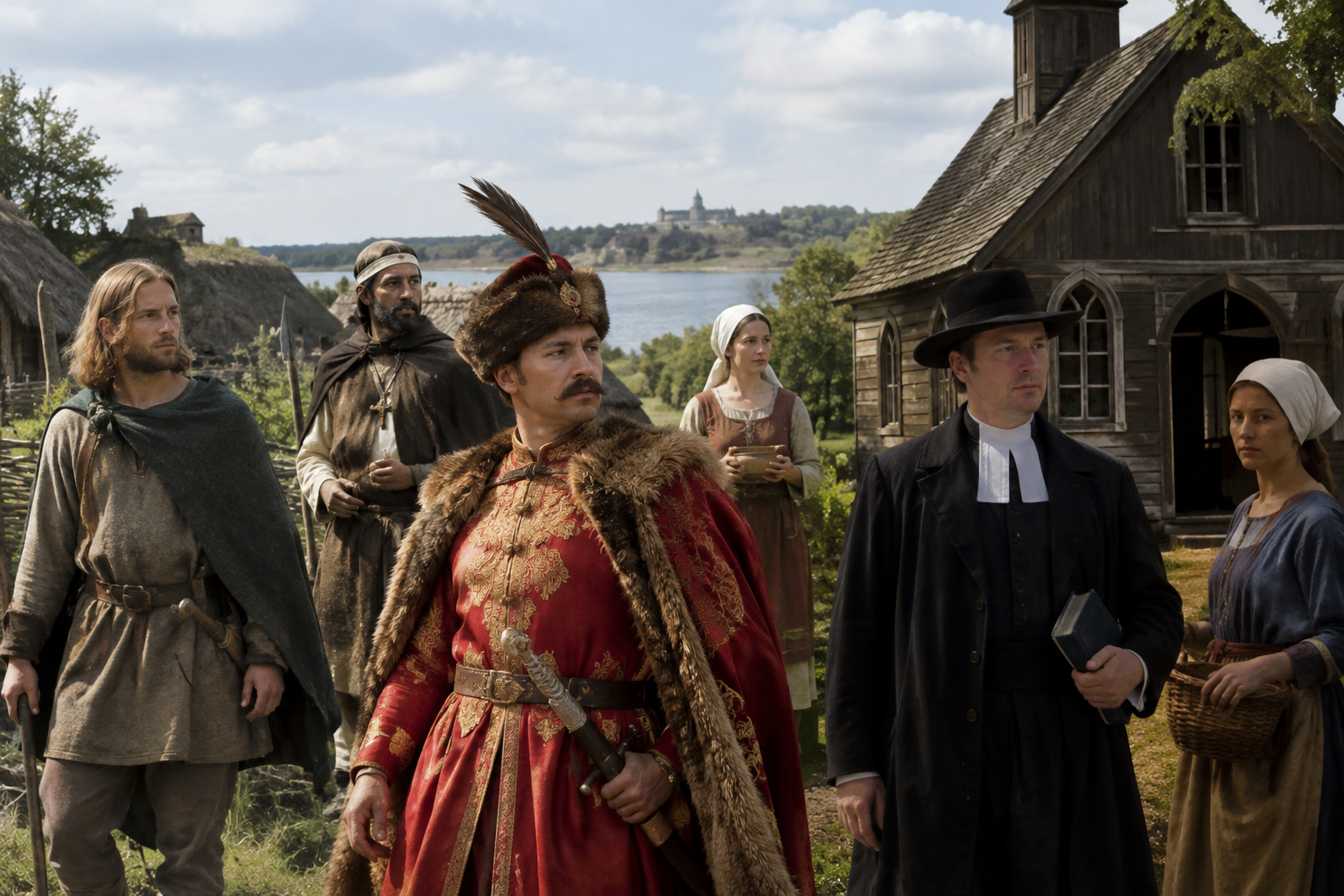
Some Y-chromosome lineages are famous because they are broad and common. Others are interesting because they are narrow, late branches that suddenly appear in the historical record like a half-glimpsed figure at the edge of the trench. Haplogroup R1b1a1b1a1a1c2a1c2 belongs to that second category. It sits deep within the vast R1b family, one of the major paternal lineages of western Eurasia, but this very specific branch matters because it helps pin down something more human than a grand migration map: the survival of particular male lines across medieval and early modern Europe.
That, of course, comes with an important warning. A Y-DNA haplogroup traces only one line of descent: your father's father's father, and so on. It does not describe your whole ancestry, culture, identity, or family story. Still, when ancient DNA places related paternal branches in graves from Poland, Austria, northern Germany, Hungary, and England, it gives us a rare way to watch a lineage move through the worlds of long-distance migration, kingdom-building, noble houses, and confessional change.
The long label R1b1a1b1a1a1c2a1c2 tells us we are dealing with a very downstream branch of R1b, a haplogroup with deep importance in European paternal history. Broadly speaking, R1b lineages became especially prominent in many parts of Europe after later prehistoric population shifts, including movements linked to Bronze Age steppe-derived ancestry. But one must be careful here: the history of a broad parent haplogroup is not automatically the history of every tiny descendant twig.
What we can say more safely is that this branch belongs within a paternal framework that has been widely represented across Europe for a very long time, and that its documented ancient appearances suggest a distribution across central and western Europe in historical periods. The samples supplied here do not begin in the Neolithic or Bronze Age, so we should resist the temptation to invent an early homeland for this exact subclade. Instead, the evidence invites us into a later story: one of mobility across the Roman frontier, post-Roman kingdoms, medieval dynasties, and early modern societies.
Explore Central European Ancient DNA
The earliest supplied anchor is HVN006, described as a Longobard Haeven Mecklenburg-Vorpommern Year:250 AD sample. Even at a glance, this is a tantalising placement. Mecklenburg-Vorpommern lies on the southern Baltic shore, while the label "Longobard" evokes one of the Germanic-speaking groups whose history later stretched far beyond that northern zone. Whether this individual represents a direct ancestral line to later medieval carriers cannot be shown from the supplied information alone. But he does place a related paternal branch in the northern European world of the Roman imperial fringe and the shifting societies beyond it.
Then comes R10665, an Early Medieval Wels Austria Year:740 AD individual. Wels, in Austria, belonged to a region where Roman legacies, Bavarian expansion, and wider post-Roman population movements all overlapped. By the eighth century, central Europe was not a blank space being "settled" by one people after another. It was a crowded historical landscape of old provincial towns, new elites, military networks, and Christian institutions. A lineage found here suggests not a single migration arrow on a map, but continuity and adaptation within that changing world.
The medieval Polish sample PCA0549, from Piast Era Poland Silesia Milicz Year:1100 AD, takes the story into the heart of a kingdom. Silesia in the Piast period was a zone of power, colonisation, ecclesiastical development, and political experiment. A paternal branch appearing here reminds us that dynastic states were built not by abstract "populations" but by men and women embedded in courts, churches, villages, and military retinues. The presence of this lineage in Piast-era Poland is especially interesting because it shows the branch in a clearly medieval political context, not just a migration-period cemetery.
Read About the Piast Genetic Story
The later samples widen the social frame still further. PER04B, listed as Medieval Hungarian Bathory Male Nobility Pericei Year:1500 AD, places the lineage in a noble setting in the Hungarian sphere. This does not prove that every Batory or Bathory male belonged to this exact haplogroup, nor that any modern tester with the branch descends from that family. What it does show is that a related paternal line was present in a documented elite context in late medieval or early modern eastern-central Europe.
Finally, ATP_PSN_873, from Early Modern Period England Providence Calvinist Baptist Chapel Year:1833 AD, reminds us that Y-DNA history does not stop with kings and migrations. By the nineteenth century, we are in a world of chapels, dissenting religion, industrial towns, family burial plots, and ordinary record-keeping. The same paternal branch that appears in frontier and noble settings can also appear in a chapel context in England. That is not a contradiction. It is history. Lineages outlive the political worlds that once carried them.
If we set these samples beside each other, a pattern emerges, though not a simplistic one. Northern Germany around 250 AD, Austria in 740 AD, Silesia in 1100 AD, Hungary in 1500 AD, and England in 1833 AD form a broad corridor through the historical core of Europe. This is exactly the sort of evidence that makes Y-DNA so useful and so maddening. Useful, because it lets us trace recurring paternal branches across centuries. Maddening, because shared haplogroups do not tell us whether two men were cousins, fellow migrants, socially unrelated locals, or members of very different populations who happened to share a deeper paternal ancestor.
Still, the geographical spread matters. It suggests that branches close to R1b1a1b1a1a1c2a1c2 were part of the male-line landscape of central and western Europe across many different historical settings. Ancient DNA therefore complements written history in a rather satisfying way. Chronicles talk about Lombards, Piasts, nobles, reformers, settlers, and subjects. DNA quietly notes that some paternal lines persisted through all of it.
Discover Medieval Hungary's Elite DNA
The supplied family associations bring us to two very different strongholds on the Atlantic edge of this broader European story.
Clan Taaffe is tied to Smarmore Castle in County Louth. The site began as a late medieval tower house, probably built in the fifteenth or sixteenth century by the Taaffe family, part of the Anglo-Norman world in Ireland. That description alone places the castle in a fascinating layer of Irish history: not the first Norman arrival, but the long afterlife of that settlement, when tower houses, landed families, and regional identities had become deeply rooted. Smarmore later passed through war, confiscation, and new ownership under the Foster family, and its later adaptation into a treatment centre gives it an unusually visible biography of survival.
There is a temptation, whenever DNA and castles appear in the same article, to leap to a grand conclusion: this lineage was the bloodline of the house. We must not do that. The responsible point is subtler. A haplogroup like R1b1a1b1a1a1c2a1c2, found in the historical zones from which Anglo-Norman and later British-Irish elites emerged, offers context for how paternal lines could pass through the same landscapes as families such as the Taaffes. The castle preserves the memory of power in stone; DNA preserves fragments of paternal history in bone.
Clan Boyd leads us north to Dean Castle in Kilmarnock, Ayrshire. Founded as the Boyd stronghold in the fourteenth century, it grew into one of Scotland's best preserved medieval castles, with its great tower and later palace range showing changes in aristocratic life over time. The Boyds rose high in the fifteenth century and suffered equally dramatic reversals. There is something apt about discussing a Y-lineage beside a fortress like Dean Castle. Castles suggest permanence, but their history is one of rebuilding, forfeiture, restoration, and reinvention. So too with paternal lines: they continue, but under different names, loyalties, and social ranks.
Explore the History of Clan Boyd
So what does R1b1a1b1a1a1c2a1c2 reveal? First, that even a very specific Y-DNA branch can be historically meaningful when ancient samples place related lines across several centuries and regions. Second, that paternal ancestry often cuts across categories we treat as separate: migration-period peoples, medieval dynasties, noble families, and chapel communities. Third, that castles and surnames are not genetic proof, but they are valuable historical settings in which these lineages lived their later chapters.
Just as importantly, this haplogroup does not prove direct descent from the Bathory nobility, the Piasts, Clan Taaffe, or Clan Boyd. Shared Y-DNA can indicate a distant paternal relationship, but without much more specific evidence it cannot certify membership in a noble house. What it can do is place your paternal line within the same broad historical theatre inhabited by those families and by the ancient individuals recovered from cemeteries stretching from the Baltic to the British Isles.
That is one of the great pleasures of archaeogenetics. It does not replace history; it makes it stranger, more crowded, and more personal. A sample like HVN006 or PCA0549 is not a legend or a heraldic emblem. He was a real man buried in a real place, and his Y-chromosome helps us map one thread of Europe's past.
If your own Y-DNA belongs to a branch like R1b1a1b1a1a1c2a1c2, MyTrueAncestry can help you explore how your paternal line compares with ancient individuals, medieval populations, and the historical regions discussed here. Those matches do not automatically prove direct descent from an ancient sample or a noble family, but they can offer a remarkably vivid window into the older worlds your ancestry once moved through.






Comments