Haplogroup R1b1a1b1a1a1c2a

– 5 min read


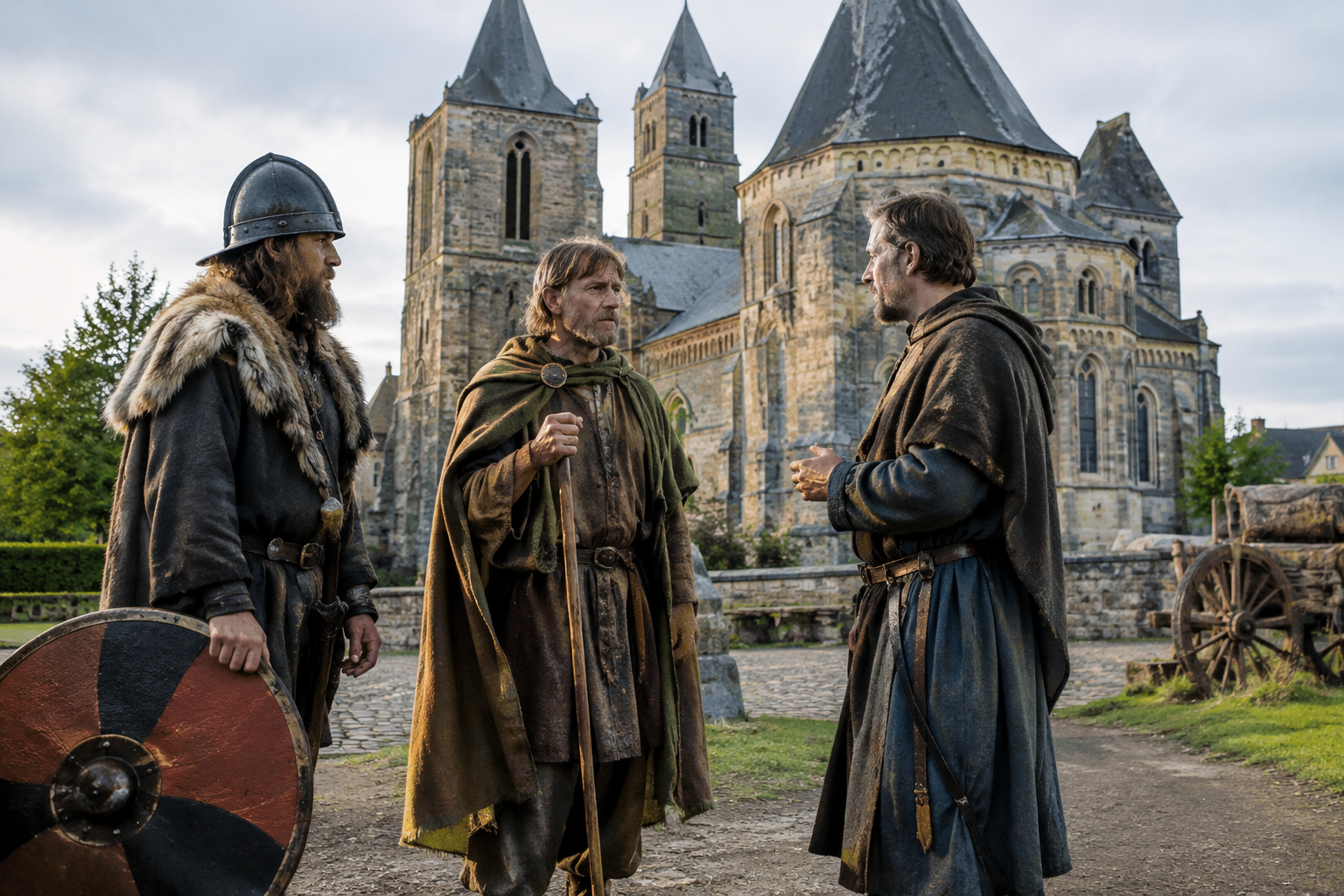
At Sint-Truiden in medieval Belgium, the cemetery of Onze-Lieve-Vrouwekerk offers one of those quietly revealing discoveries that ancient DNA does so well. Among the burials is individual ST0044, dated to around 1090 AD, a man from an urban religious setting in the Low Countries whose paternal line has been associated here with R1b1a1b1a1a1c2a. That sounds forbiddingly technical, but the interest lies in the context: this is not a chieftain in a saga, nor a princely skeleton dressed up by legend, but a medieval person from a church community in a region shaped by trade, pilgrimage, lordship, and constant human movement.
That matters because Y-DNA follows just one line of descent, father to son, and so it can illuminate a very specific thread inside a much larger ancestry. In the case of R1b1a1b1a1a1c2a, the ancient examples supplied here do not point to a single kingdom or a tidy ethnic label. Instead, they place this paternal branch in a strikingly North Sea and northwest European setting: early medieval England, Viking Age Denmark, and high medieval Belgium.
Sint-Truiden was no backwater. By the 11th century it belonged to a densely connected world of abbeys, market exchange, and growing towns across the Meuse and Scheldt regions. A genetic study of the site has helped frame these burials within the wider history of urbanization and population mixing in the medieval Low Countries, and ST0044 sits within that story rather neatly. Rather than suggesting an isolated lineage, his Y-chromosome points to a paternal line present in a place where local continuity and wider regional contacts met each other every day.
For a lineage such as R1b1a1b1a1a1c2a, that is more useful than any romantic fantasy. It shows that by the central Middle Ages, this branch could be found in a Christian burial ground in what is now Belgium, embedded in a settled townscape rather than on some imagined frontier. If you want a modern comparison from the same region, MyTrueAncestry has also explored medieval Sint-Truiden in more detail as a case study in how town life shaped genetic patterns.
The second especially suggestive case is CGG019689 from Kongsted Lyng on Sjaelland, dated to about 958 AD. That places this individual in late Viking Age Denmark, at the very moment when the old Scandinavian world was entangled with Christianization, kingship, maritime exchange, raiding legacies, and settlement networks reaching across the North Sea.
We should be careful here. A Y-DNA assignment does not make a man "a Viking" in the cartoon sense, and it certainly does not turn one burial into proof of a migration event all by itself. But CGG019689 does show that a paternal line associated with R1b1a1b1a1a1c2a was present in Denmark in the late 10th century, which is precisely the sort of period when Scandinavian and North Sea populations were interacting intensely.
That Danish setting becomes more interesting when read alongside broader work on Scandinavian population history. MyTrueAncestry has covered both the deeper background of Denmark's population transitions and the specifically medieval and post-Viking burial world of Scandinavia. Those wider studies do not "prove" this exact branch's history, but they help place CGG019689 in a real human landscape rather than a genetic spreadsheet.
The earliest sample in this small cluster is OAI002, a Jute burial from Oakington, England, dated to around 470 AD. That is a wonderfully awkward period, historically speaking: Roman rule in Britain had ended, new political identities were forming, and the written sources are patchy, partisan, and late. Archaeology does much of the real work here.
To describe OAI002 as "Jute" is to place him within an archaeological and historical discussion about early medieval eastern England and the migration-period communities connected with the southern North Sea. It does not mean that one chromosome can settle the old debate about who the Jutes were, where every family came from, or how they understood themselves. But it does place this paternal line in one of the classic contact zones of post-Roman Europe.
An early ancient DNA study of migration-period England, available at http://biorxiv.org/content/early/2015/07/17/022723, helped establish how transformative genetics could be for this period when combined with cemetery archaeology. Oakington has become part of that wider conversation: not as a magic key to ethnicity, but as a site where burials, chronology, and genomes meet the murky historical record.
This is also where the pattern begins to look more than accidental. When a related paternal branch turns up in early medieval England, then in Viking Age Denmark, and then in medieval Belgium, the important point is not a simplistic tale of one people replacing another. It is the persistence of a male line across the connected shores of the North Sea world.
The long name R1b1a1b1a1a1c2a sits inside the vast R1b family, one of the major paternal groupings in western Europe. But that broader fact is only the beginning. A subclade this specific is not the same thing as the whole of R1b, and it should not be burdened with every sweeping claim ever made about Bronze Age expansions or "Celtic" or "Germanic" origins.
What the present evidence supports is narrower, and in some ways more interesting. This branch appears here in three different but connected settings: an early migration-period burial in England, a late Viking Age individual in Denmark, and a high medieval church burial in Belgium. That is not enough to map its ultimate origin with certainty, but it does suggest that this paternal line was part of the human traffic of northwest Europe over many centuries.
That northwest European pattern also fits the kind of broader historical world these men inhabited. Oakington belonged to the re-making of Britain after Rome. Kongsted Lyng belonged to a Denmark tied into seaborne exchange and political consolidation. Sint-Truiden belonged to the urbanizing Christian landscape of the medieval Low Countries. The same paternal branch, or one reported in association with it, appears in all three worlds.
If there is one trap to avoid, it is imagining that a Y-chromosome branch automatically marks a tribe, nation, or dynasty. Ancient DNA keeps showing the opposite. Burial communities were mixed, identities were historical and local, and paternal lines could persist through enormous cultural change. A man buried as a Jute in 5th-century England, a man buried in Viking Age Denmark, and a man buried beside a church in 11th-century Belgium were not living the same lives, even if one narrow paternal branch linked them.
That is why the North Sea frame is the most sensible one here. The pattern suits a zone of repeated crossings rather than a single dramatic migration. It evokes coasts, estuaries, farmsteads, ports, monasteries, and market towns: the ordinary machinery of European history. MyTrueAncestry's piece on North Sea migrations to Britain gives a wider sense of just how durable those connections were.
For someone researching R1b1a1b1a1a1c2a today, the most grounded takeaway is not a claim to one famous people, but a connection to the long-lived male networks of northwest Europe. The ancient evidence attached to this branch places it, at least in these cases, among real communities in early medieval England, Viking Age Denmark, and medieval Belgium. That is a small sample, but it is a coherent one: a paternal line moving through the working historical world of the North Sea and the Low Countries, surviving changes in language, religion, and political order.






Comments