Haplogroup R1b1a1b1a1a1c1b

– 6 min read


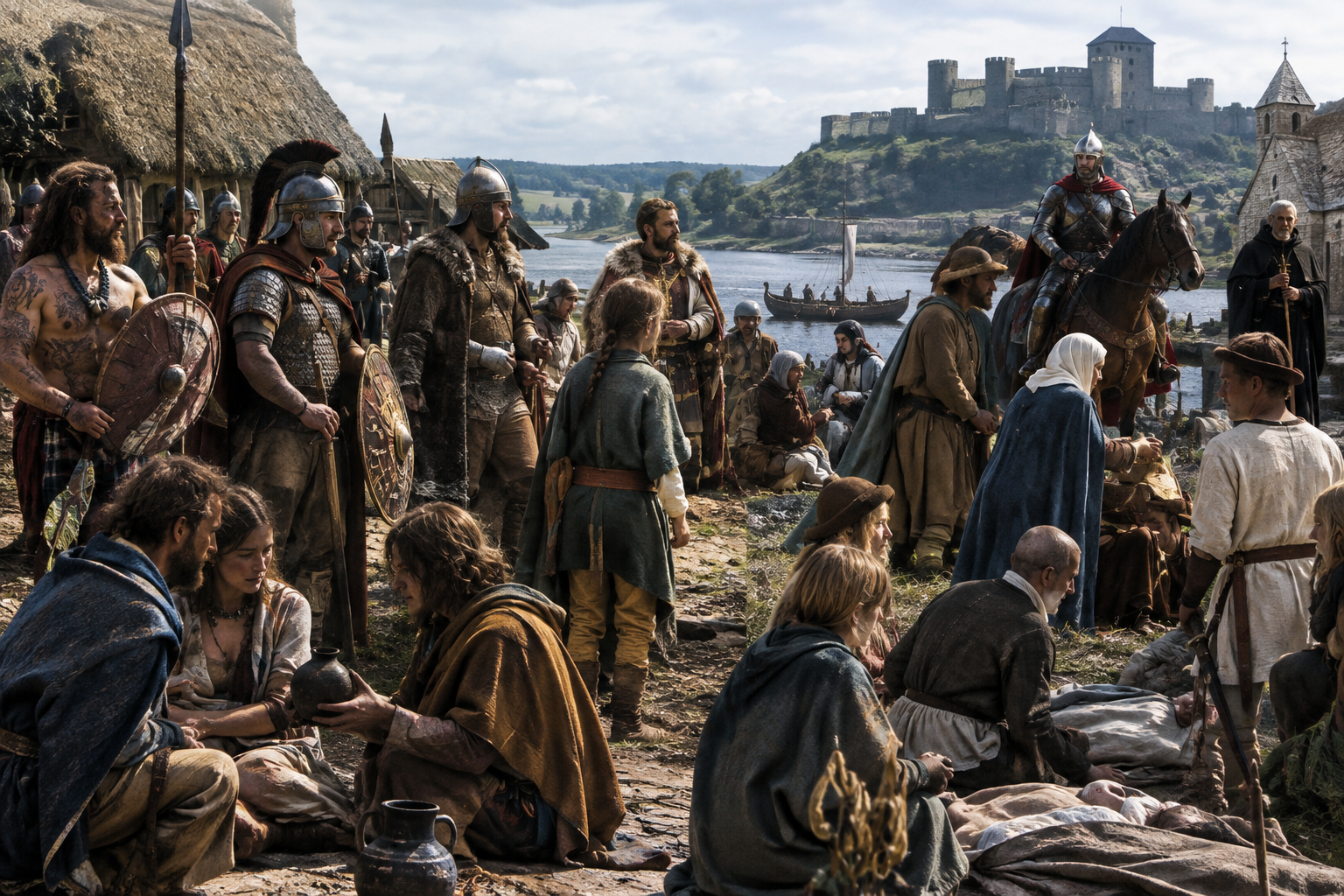
There is something wonderfully awkward, and therefore wonderfully human, about a Y-chromosome lineage with a name like R1b1a1b1a1a1c1b. It does not sound romantic. It sounds like a filing error in a monastery archive. Yet behind that string of letters and numbers lies a very old paternal story, one that appears across Iron Age Celtic contexts, Roman frontier zones, early medieval migration-era burials, and later noble society.
As ever with Y-DNA, a small warning before we get carried away. A Y-haplogroup traces one direct paternal line only: father to father to father. It does not describe a person's whole ancestry, culture, language, or identity. Nor does sharing a haplogroup prove close kinship with every other man in that branch. Still, these paternal markers are remarkably useful. They let us watch particular male lines appear in ancient cemeteries and historical landscapes, and in the case of this branch of R1b, the evidence points toward a story deeply tied to parts of western and central Europe.
R1b is one of the best-known Y-chromosome macro-lineages in Europe, but that broad label covers an enormous span of time and many different branches. With a highly specific subclade like R1b1a1b1a1a1c1b, it is important not to lazily assign the whole history of R1b to this one twig on the tree. What we can say, from the supplied ancient evidence, is that this lineage or very close paternal kin of it appears in a striking spread of contexts from the Low Countries and France through central Europe and into Britain and northern Italy.
The geographical pattern is suggestive. We see early evidence in a Bell Beaker context in the Netherlands, then later samples in Bronze Age and Iron Age northwestern Europe, several in Belgic and Gallic settings, and more in migration-era Germanic and Lombard burials. That does not mean one simple march across the map by a single people. History was messier than that. But it does suggest that this paternal line belonged to the long demographic history of temperate Europe, especially the corridor linking the Lower Rhine, northern France, the Low Countries, central Europe, and eventually Britain.
Explore Celtic Origins in Ancient DNA
One of the earliest supplied anchors is I4070, a Bell Beaker individual from De Tuithoorn, North Holland, dated to 2080 BC. Bell Beaker archaeology has become central to discussions of how paternal lineages expanded across western and central Europe in later prehistory. We should not claim that one man from North Holland explains everything about this subclade, but he does place part of its story in that broad late third millennium BC world of mobility, burial custom, and social change.
Another useful early point is I11972 from Westwoud-Binnenwijzend, Netherlands, dated to the Middle Bronze Age, 1410 BC. Taken together with I4070, this suggests not just a fleeting appearance but some degree of continuity in the wider North Sea and Lower Rhine zone across many centuries. By the Iron Age, the same general paternal background shows up in settings we would more readily recognize from classical history.
At Bucy-le-Long in France, this lineage appears repeatedly among individuals associated with the Belgic Suessiones and related Gallic contexts: CGG022456 (365 BC), CGG022463 (511 BC), CGG022431 (486 BC), CGG022425 (500 BC), CGG022438 (375 BC), and CGG022419 (457 BC). That cluster is important. It does not prove a tribal haplogroup in any crude ethnic sense, but it does show that this paternal line was firmly at home in Iron Age northern France.
It is not just Gaul. We also find 3430 from Pont de Cornaux-Les-Sauges, Switzerland, dated to 200 BC, in a Gallo-Celtic context, and 2909a from Prague, Czechia, dated to 100 BC. Add I11149, an Iron Age Briton from Cambridgeshire, England, dated to 460 BC, and the picture becomes broader still: this was a paternal line present across several parts of Iron Age Europe, especially in regions tied to Celtic-speaking and Belgic worlds.
Discover Late Iron Age Swiss Mobility
Then the Roman period complicates things, as Roman history usually does. Empires move people around, recruit them, bury them far from home, and scramble any tidy map. A telling case is R10659 from the Roman Klosterneuburg Fortress, Lower Austria, dated to 126 AD. Another is CGG107754, a Batavi Germanic Tribe individual from Valkenburg Marktveld, Netherlands, dated to 143 AD. These finds suggest that this paternal line was present both in communities on the Lower Rhine and in the military world connected to Rome's frontier system.
By late antiquity and the early Middle Ages, the lineage turns up in contexts often associated with migration-era groups. HVN005 from Haeven, Mecklenburg-Vorpommern, dated to 250 AD, is identified as Longobard. In southern Germany we have AED106, an Elite Germanic Tribe Warrior from Bavaria, dated to 495 AD. In northern Italy there is a particularly vivid cluster from Collegno: COL_069, COL_069b, and COL_069x, all dated to 580 AD, with two explicitly described as Lombard Warrior Elite.
This is precisely the sort of evidence that makes ancient DNA so useful. Written sources tell us about Lombards, Batavi, and frontier soldiers as categories. DNA reminds us that such communities were made of real paternal lines, some with deeper roots in northwestern and central Europe, appearing again in new political settings. The line did not change its name to suit the historian. The historians changed the labels around it.
Britain also enters the frame again in the early medieval period. Three men from the Early Anglo Saxon Cemetery, West Heslerton, Yorkshire - I20644, I20671, and I20677, all dated to 550 AD - belong to this story, as does S3044 from Lincoln Castle, Lincolnshire, dated to 1100 AD in a Norman Invasion Medieval context. That sequence does not prove an unbroken single family line, of course. But it does show the same paternal background recurring in Britain across Iron Age, Anglo-Saxon, and medieval settings.
Later history gives us another intriguing appearance: PER03-1, identified as Ferenc Bathory, a Hungarian Knight from Pericei, dated to 1589 AD. This does not mean the entire Bathory family can be reduced to one Y-line, but it is a fine example of how ancient and historical DNA can bridge aristocratic record-keeping and biological evidence. The paternal line also appears in ST1232 from Sint-Truiden Onze-Lieve-Vrouwekerk, Belgium, dated to 900 AD, and ELW003, a Post Medieval Plague Victim from Ellwangen, Germany, dated to 1550 AD. These are not kings in crowns. They are townsmen, church burials, plague dead, and local elites. In other words, history as most people actually lived it.
That makes the supplied Scottish clan associations all the more interesting. They should be treated as historical associations rather than proof that every member of every clan carried this exact haplogroup. But they place the lineage in a later landscape of memory, lordship, and strongholds.
Clan MacCallum is linked here with Duntrune Castle in Argyll, on the north side of the Crinan Canal. Duntrune is one of the oldest continuously inhabited castles in Scotland, with roots reaching back to the 12th century. First held by the MacDougalls, then passing to the Campbells in the 13th century after the Wars of Scottish Independence, it became caught up in the bitter Campbell-MacDonald rivalry. Its famous tale of the murdered piper, whose warning tune survived as "The Piper's Warning to His Master," reminds us how castles preserve family legend as well as stone.
Nearby in the same maritime west Highland world stands Castle Sween, associated here with Clan MacMillan. On the east side of Loch Sween, it is among Scotland's oldest stone castles, probably built in the late 1100s by Suibhne, described in the supplied material as an Irish or Norse-Gaelic lord. This is exactly the sort of place where genetic history and political history glance at one another from across the table. Sea routes, not roads, knit this region together. Lords shifted allegiance. Families rose and fell. A paternal lineage found in much earlier continental Europe could perfectly well arrive in such a landscape through centuries of movement and mixing, without needing any fairy-tale claim of a single heroic founder.
Further east, Clan Arbuthnott brings us to Arbuthnott House in Aberdeenshire. Here the tone changes. This is less a frontier fortress than a long-lived estate shaped by aristocratic power, religion, and learning, near the medieval kirk and the famous Arbuthnott Missal. The house itself was largely built and reshaped in the 18th and 19th centuries on an older estate, showing how noble identity could survive even as the architecture softened from defense to residence.
So what does R1b1a1b1a1a1c1b reveal? Not a single tribe, not a pure people, and certainly not a guaranteed claim to a castle. What it reveals is persistence. This paternal branch appears in a Bell Beaker burial in North Holland, in Bronze Age Netherlands, in Iron Age France, Switzerland, Czechia, and Britain, in Roman frontier settings, among Lombard and Germanic-era burials, in Anglo-Saxon Yorkshire, medieval Lincolnshire, Belgium, and later noble and post-medieval contexts in central Europe.
That is the proper excitement of archaeogenetics. It does not flatten the past into slogans. It gives us a series of very precise glimpses of male-line continuity and movement, and then asks us to think historically. Castles, clans, tribal names, kingdoms, and armies all belong to the visible surface of history. Y-DNA sits underneath, not replacing that history but quietly complicating it.
If this haplogroup appears in your own results, MyTrueAncestry can help place that paternal lineage into a deeper archaeological setting. You may find links to ancient individuals from Iron Age cemeteries, Roman frontier communities, or medieval burials discussed here. That does not prove direct descent from a particular knight, clan chief, or castle family. But it may give you something almost as interesting: a clearer sense of the long historical world in which your paternal line once moved.






Comments