Haplogroup R1b1a1b1a1a1c1a1

– 7 min read


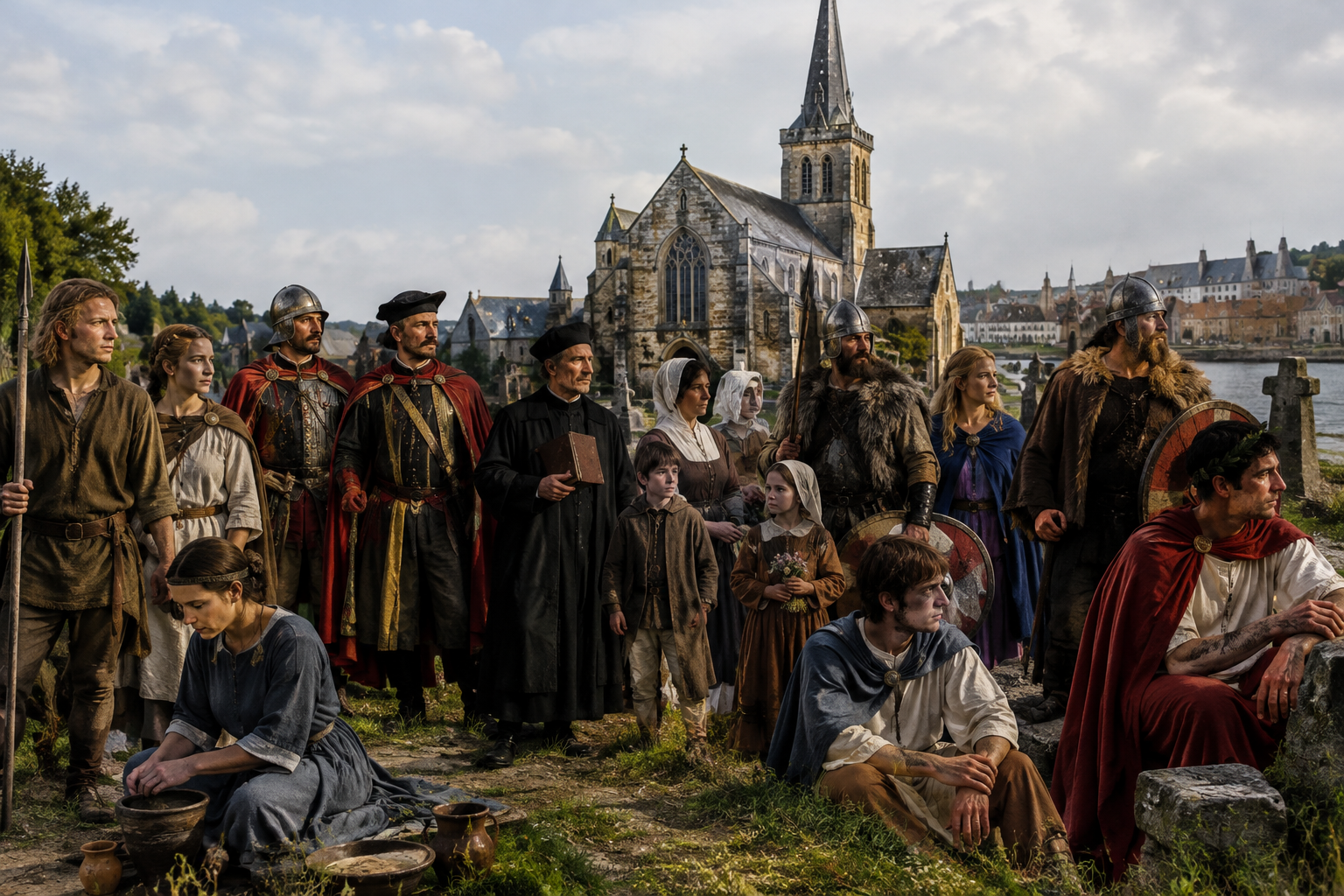
There is something wonderfully stubborn about a Y-chromosome lineage. Kingdoms fall, languages shift, castles are rebuilt, families rise into prominence and vanish again, but one paternal branch can still be detected across centuries of graves. Haplogroup R1b1a1b1a1a1c1a1 belongs to that kind of story: not a neat tale of one people or one dynasty, but a long record of men moving through Iron Age Europe, the Roman frontier, medieval towns, noble households, and even the colonial Atlantic world.
As always, a note of genetic housekeeping first. Y-DNA haplogroups trace a direct paternal line only - father to father to father. They do not describe a person's full ancestry, culture, language, or social identity. And with a highly specific subclade like R1b1a1b1a1a1c1a1, we must be especially careful not to dump the whole sprawling history of broader R1b onto one narrow branch. Still, the ancient DNA supplied here shows that this lineage, or closely related paternal lines, appears across a striking band of Europe, from Bronze and Iron Age central Europe to the Low Countries, Britain, Scandinavia, and later aristocratic and early modern contexts.
The most suggestive pattern for this haplogroup is geographical before it is political. The ancient samples cluster across central and northwestern Europe: Bohemia, Prague, the Low Countries, northern France, England, Lower Saxony, Denmark, Belgium, Poland, Bavaria, and Sweden. That distribution points us not to a single tribe or court, but to a corridor of movement linking central Europe to the North Sea world.
Some of the earliest anchors lie in the Czech lands. I7196, from Bronze Age Prague Jinonice Czech, dated 1950 BC, and I13788, from Late Bronze Age Teplice Bohemia, dated 800 BC, hint that related paternal lines were already present in central Europe long before classical authors began naming Celts, Germans, or Romans. By the Iron Age, that picture becomes more textured: I15950, from Germanic Iron Age Teplice Radosevice Bohemia, dated 435 BC, and 2909a, from Iron Age Czech Prague, dated 100 BC, place the lineage in a region that would repeatedly feed population movement westward and northward.
That does not prove a simple straight-line migration. But it does suggest that central Europe was an important theatre in the earlier history of this paternal branch.
Explore Central European Celtic Origins
One of the pleasures of ancient DNA is that it refuses tidy national histories. Here the same paternal signal appears in archaeological settings that later historians would sort into very different boxes.
Take the Belgic world. At Bucy-le-Long in France, three samples from the Suessiones stand out: CGG022463 dated 511 BC, CGG022431 dated 486 BC, and CGG022438 dated 375 BC. These are important because they show this paternal line, or a very close branch, among Iron Age communities in northern France before Roman conquest. That matters for any discussion of later movement into Britain and the Low Countries, because this was precisely one of the great contact zones of late prehistoric Europe.
Across the water and along the Rhine frontier, we meet the Batavi: CGG107754 from 143 AD, CGG107757 from 175 AD, and CGG107745 from 214 AD, all from Valkenburg Marktveld in the Netherlands. These Roman-era frontier burials show related paternal lines in a region famous for military service, trade, and intense cultural mixing. The Roman Empire did not erase local ancestry; often it simply put local men into new uniforms and moved them along new roads.
England enters the picture early too. I11149, an Iron Age Briton from Cambridgeshire England dated 460 BC, and the early Anglo-Saxon Buckland Dover individuals BUK059 and BUK027, both dated 400 AD, are especially useful together. They remind us that a paternal lineage can persist through major cultural transitions. Shared or related haplogroups across Iron Age and Anglo-Saxon contexts do not make those populations identical, but they do show that later migration and settlement took place in landscapes where earlier paternal lines already existed.
Further north, DUN010 from Saxon Coast Lower Saxony Germany dated 840 AD, CGG100493 from Medieval Jutland Denmark dated 1275 AD, and VK396 from Viking Age Skara Varnhem Sweden dated 1050 AD extend the map into the wider North Sea and Scandinavian sphere. This is not the profile of an isolated lineage. It is the profile of one woven into the making of medieval northern Europe.
Medieval and early modern samples give the lineage a more social face. At Sint-Truiden in Belgium, we have ST1232 and ST0632, both dated 900 AD, ST3006 dated 970 AD, and ST0052 dated 1300 AD. Taken together, they suggest continuity or repeated presence in a medieval urban-religious setting over several centuries. This is exactly the sort of evidence that helps bridge prehistory and documented history: not noble pedigrees, but ordinary and semi-ordinary burials in places where towns were taking shape.
There are also more overtly elite contexts. PCA0193, from Medieval Poland Piast Dynasty Lad dated 950 AD, places the haplogroup in the orbit of one of the formative ruling houses of medieval eastern central Europe. That does not make every later Piast or related nobleman part of this same exact paternal branch, but it does show that this lineage was present in a dynastic setting.
Even more tantalising are the two Bathory samples: PER01, Elek Bathory Hungarian Knight Pericei, dated 1568 AD, and PER03-1, Ferenc Bathory Hungarian Knight Pericei, dated 1589 AD. Here ancient DNA moves from broad regional pattern into named historical individuals. That is powerful evidence - not because it lets us turn genetics into romance, but because it ties a paternal branch to real men in the documented noble world of early modern Hungary.
Once we reach the medieval and early modern centuries, the story is no longer only about burials. It is also about the landscapes of power where paternal lines were remembered, displayed, and sometimes reinvented.
In Germany, Hohenzollern Castle in Baden-Wurttemberg stands as the ancestral seat of the House of Hohenzollern. Its medieval fortress was destroyed, rebuilt, and finally reimagined in the 19th century as a monument to dynastic memory. Much the same can be said, in a different key, of Wettin Castle in Saxony-Anhalt, the seat from which the House of Wettin took its name. These places matter because they preserve the public afterlife of paternal succession: not genetic proof, certainly, but the architecture of lineage itself.
Ehrenburg Palace in Coburg tells another version of the same tale. First a Franciscan monastery, then transformed into a ducal palace, it became one of the residences of the House of Saxe-Coburg, a dynasty whose marriages reached across Europe. Nassau Castle, seat of the House of Nassau, is a still clearer reminder that a seemingly regional stronghold could launch a family of continental importance.
In the British Isles, the settings are different but the logic is similar. Hampton Court Palace embodies royal reinvention in England, passing from Wolsey to Henry VIII and later to the Baroque interventions of William III and Mary II. Hadham Hall in Hertfordshire, associated with the House Capell, offers a more local and rural expression of authority. In Scotland, Wigtown Castle and Craigie Castle evoke the harder-edged politics of frontier lordship, with Clan Currie and Clan Wallace placed in a world of burghs, rebellions, and feudal alliances. In Ireland, Drimnagh Castle, home of the Barnewall family for centuries, places the story in the Anglo-Norman and later Dublin orbit, where fortified residence gradually softened into gentrified seat.
We should be plain here: the association of these noble houses and castles with this haplogroup does not prove that every member of these families carried R1b1a1b1a1a1c1a1, nor that they all shared one recent paternal ancestor. But these castles do place the lineage in the same broad historical world as the medieval and early modern men revealed by DNA - a world of inheritance, landholding, service, and regional power.
Explore the Royal House of Wettin
The later samples show one final twist: this paternal line did not stop at Europe's old frontiers. I35267 from Historic St. Mary City Chapel Field Cemetery Maryland dated 1634 AD and I15305 from the same cemetery dated 1704 AD carry the story into early colonial America. Add ATP_PSN_412, from Early Modern Period England Trinity Church dated 1844 AD, and you can watch the line remain visible in the English-speaking world long after the medieval order had changed beyond recognition.
This is one of the most useful lessons of Y-DNA. Written genealogies usually begin with charters, parish registers, or family memory. Ancient DNA begins much earlier and asks a different question: where do paternal branches appear in the graves of the dead? When the two approaches meet, they do not always produce certainty, but they do produce depth.
For readers interested in how these later movements played out in colonial North America, the St. Mary's material is a fine case study in its own right.
Explore Colonial St. Mary's DNA
R1b1a1b1a1a1c1a1 appears here as a lineage rooted in a broad European zone stretching from central Europe to the North Sea and beyond. The supplied samples place it in Bronze Age Bohemia, Iron Age France and Britain, the Roman frontier in the Netherlands and Austria, medieval Belgium and Poland, Viking Age Scandinavia, named Hungarian noblemen, and colonial Maryland. That is not a single ethnic story. It is a story of persistence through changing historical worlds.
For MyTrueAncestry users, that is exactly what makes a Y-DNA haplogroup interesting. It can connect your direct paternal line not to a fantasy identity, but to real archaeological landscapes: cemeteries, churches, forts, market towns, dynastic courts, and castles that still carry the memory of the men who lived there. Shared haplogroups do not prove direct descent from an ancient sample or membership in a noble family. What they offer is context - sometimes startlingly vivid context - for where a paternal line has been before it reached you.
If you want to see whether your own DNA shows connections to ancient individuals like 2909a, CGG022463, VK396, PER01, or the men of medieval Sint-Truiden and St. Mary's City, MyTrueAncestry can help place your results beside the archaeological record. It is not a shortcut to a castle pedigree, but it can be a remarkable way of seeing how your ancestry fits into the much bigger human past.






Comments