Haplogroup R1b1a1b1a1a1c1a

– 7 min read


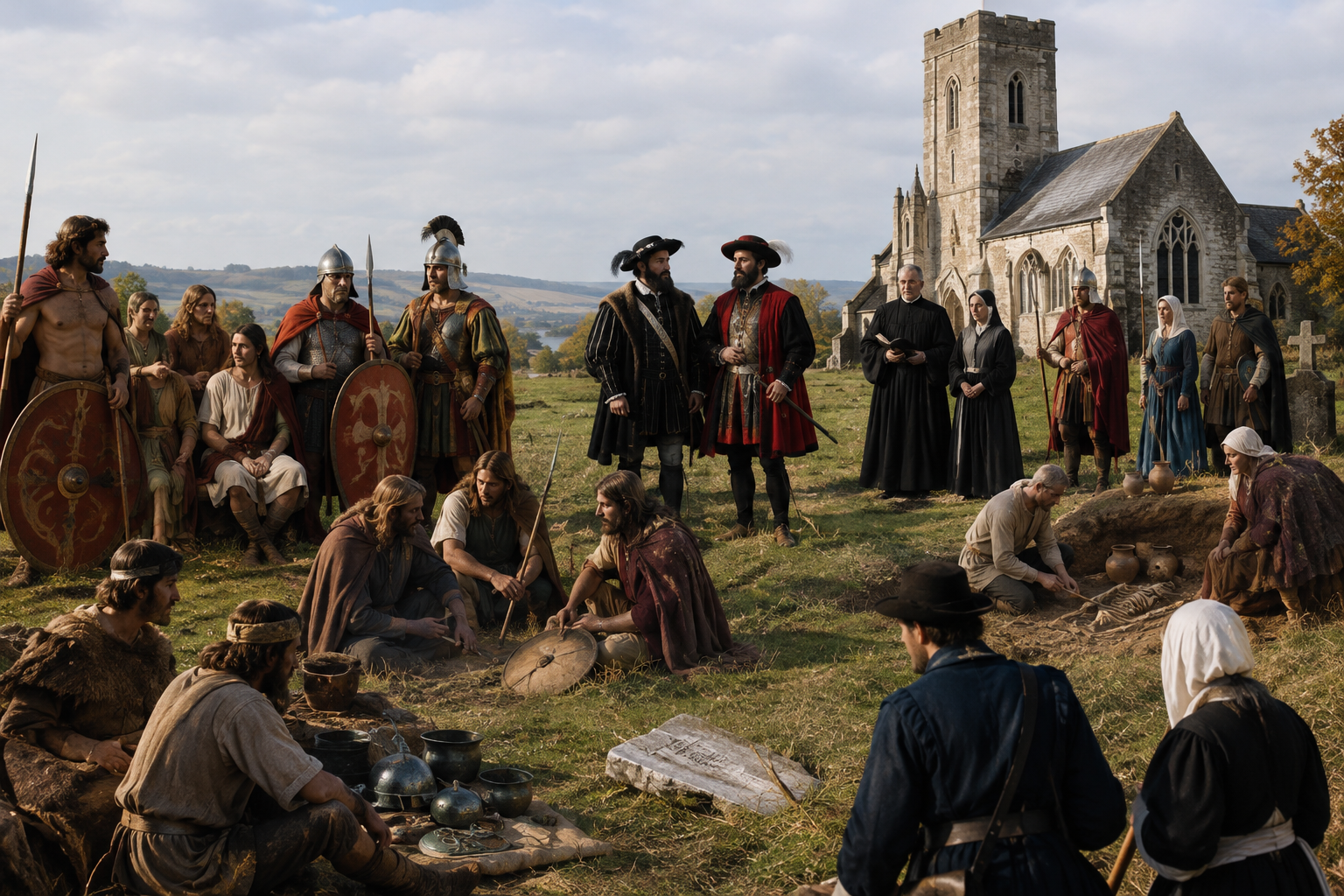
Some Y-DNA haplogroups announce themselves with a grand, famous label. Others arrive like a small clue in an excavation report: a long string of letters and numbers, rather forbidding at first glance, but surprisingly revealing once you follow it through graves, frontiers, churches, and noble houses. Haplogroup R1b1a1b1a1a1c1a belongs to that second category. It is a very specific paternal branch within the wider R1b family, a major Y-chromosome lineage found across much of western Eurasia.
That matters because Y-DNA traces one narrow line only: father to son to son across generations. It does not describe a person's whole ancestry, culture, language, or identity. But used carefully, it can illuminate something written records usually cannot: the deep history of particular paternal lines, and how they appear in different places over long stretches of time. In the case of R1b1a1b1a1a1c1a, the supplied ancient DNA evidence places that story across Iron Age France and Bohemia, Roman frontier communities, early medieval Germanic worlds, Anglo-Saxon England, Poland, Hungary, and beyond.
The wider R1b tree has a long and complicated prehistoric history in Europe, especially after Bronze Age population changes associated with steppe-derived ancestry. But one must be careful here: the deep story of broad R1b is not automatically the story of every later subclade. For a highly specific branch such as R1b1a1b1a1a1c1a, the safest approach is to begin where the evidence becomes tangible - in the archaeological record of later prehistoric and historic Europe.
The samples supplied here suggest a branch with a strong presence in central and northwestern Europe over a long timespan. We see it in Bronze Age and Iron Age contexts in the Low Countries and Bohemia, among Belgic-associated individuals in Iron Age France, in Roman frontier zones on the Rhine, in early medieval Germanic and Anglo-Saxon burials, and later in medieval and early modern central Europe. That does not mean every one of these men belonged to a single close family. It does suggest, however, that this paternal line - or closely related branches around it - was embedded in the population history of the temperate European corridor stretching from the North Sea and Rhine into Bohemia, Poland, and the Carpathian world.
Readers interested in the broader archaeological background to this northwestern European zone may enjoy the Lower Rhine perspective in the MyTrueAncestry article below.
Explore the Lower Rhine and Bell Beaker world
The oldest supplied hints of this paternal history come from prehistoric northwestern and central Europe. Sample I4070, from Bell Beaker De Tuithoorn in North Holland dated to 2080 BC, and I7196, from Bronze Age Prague Jinonice dated to 1950 BC, place related paternal ancestry in two regions that would remain important much later: the Low Countries and Bohemia. Add I11972 from Middle Bronze Age Westwoud-Binnenwijzend in the Netherlands, dated to 1410 BC, and I13788 from Late Bronze Age Teplice, Bohemia, dated to 800 BC, and one begins to see not a single migration event but a durable geographic footprint.
By the Iron Age, the branch appears in strikingly varied settings. In France, Bucy-le-Long yields several individuals linked with the Suessiones and other Gallic contexts: CGG022463 (511 BC), CGG022425 (500 BC), CGG022431 (486 BC), CGG022419 (457 BC), CGG022456 (365 BC), and CGG022438 (375 BC). These are not merely labels on a map. They belong to the world later described as Belgic and Gallic - politically fragmented, locally rooted, and far more connected than older textbooks once allowed.
In Bohemia the lineage also appears in I15950, a Germanic Iron Age individual from Teplice Radosevice dated to 435 BC, and later in 2909a, an Iron Age individual from Prague dated to 100 BC. Meanwhile in Britain we find I11149, an Iron Age Briton from Cambridgeshire dated to 460 BC. Taken together, these finds show the same paternal branch in different cultural zones without requiring us to collapse them into one ethnic identity. DNA is telling us about lineages; archaeology and history must do the rest.
If you want the larger picture of how genetics is reshaping these questions, the following overview is a useful companion.
Read how archaeogenetics changed history
Once Rome expanded into northern Europe, paternal lines did not politely stay in place. They travelled with soldiers, settlers, merchants, and local recruits. Three notable samples from the Batavi context at Valkenburg Marktveld in the Netherlands - CGG107754 dated to 143 AD, CGG107757 dated to 175 AD, and CGG107745 dated to 214 AD - place this lineage on the Roman frontier. That is exactly the sort of zone where identities became messy and interesting: Roman military structures, local communities, and transregional mobility all rubbing against one another.
Something similar appears further east and south. R10659, from Roman Klosterneuburg Fortress in Lower Austria dated to 126 AD, and R10339, from Tarquinii in Italy dated to 150 BC, show that men carrying this paternal branch or related forms could turn up in very different Roman-period settings. The early medieval centuries continue the pattern. There is HVN005, a Longobard sample from Mecklenburg-Vorpommern dated to 250 AD, then the remarkable Collegno burials in northern Italy: COL_069, COL_069b, and COL_069x, all dated to 580 AD and associated with Lombard-era or Lombard warrior elite contexts.
These Lombard and Germanic-era finds are especially suggestive, because they show a paternal line moving through the political upheavals of the post-Roman world. Add AED106, an elite Germanic warrior from Bavaria dated to 495 AD, and early Anglo-Saxon England comes into focus too: BUK027 and BUK059 from Buckland Dover dated to 400 AD, and I20644, I20671, and I20677 from West Heslerton in Yorkshire dated to 550 AD. This is not proof of one tribe carrying one haplogroup. It is evidence that this paternal line was part of the biological landscape of the migration-age North Sea world.
For that early English context, this related article is especially worth exploring.
Explore Anglo-Saxon migration DNA
By the medieval period, the same broad paternal story stretches into places more familiar from written history. Sample PCA0193, from Medieval Poland Piast Dynasty Lad dated to 950 AD, is a particularly important bridge between ancient population history and dynastic Europe. It does not prove direct descent to any later noble house discussed here, but it places this lineage in a region central to the making of medieval Poland.
That makes the later world of the Radziwill family especially interesting in context. Their seat at Nieborow Palace in central Poland began in the late 17th century as a Baroque residence built for Cardinal Michal Stefan Radziejowski and designed by Tylman van Gameren. In the 18th century it became a magnate residence and later passed into close association with the Radziwill family, who preserved it through the partitions of Poland and the upheavals of the 19th century. Nearby, the romantic garden at Arkadia enlarged the estate into a landscape of status as much as power. The palace survives today as a museum, a reminder that elite life leaves buildings long after lineages themselves have become genetically mixed and socially transformed.
In Hungary and the old Kingdom of Hungary's borderlands, the connection is more immediate because the supplied DNA evidence includes named members of the Bathory family: PER01, Elek Bathory, a Hungarian knight dated to 1568 AD, and PER03-1, Ferenc Bathory, a Hungarian knight dated to 1589 AD. Here, at last, we are not merely in the same region as a noble house; we are looking at ancient DNA from historical individuals explicitly tied to that family. Even so, scientific caution still matters: such samples can illuminate a documented paternal line in specific individuals, but they do not license sweeping claims about every Bathory in every branch.
Their most famous stronghold, Cachtice Castle in western Slovakia, began in the 13th century as part of the frontier defenses of the Kingdom of Hungary after the Mongol invasions. Later it became inseparable from the legend of Elizabeth Bathory, though the ruin standing today owes as much to early modern politics and the fire of 1708 during anti-Habsburg uprisings as to later mythmaking. It is one of those places where castle walls preserve memory, scandal, and state power all at once.
For readers drawn to that dynastic story, this is the natural next stop.
Discover the DNA of the Bathory dynasty
The English side of the evidence is quieter, but no less revealing. Alongside the Anglo-Saxon-era material there is S3044, from Norman Invasion medieval Lincolnshire at Lincoln Castle dated to 1100 AD, DUN010 from Saxon Coast Lower Saxony dated to 840 AD, VK143 from the Viking St. Brice Massacre at Oxford dated to 1002 AD, and ATP_PSN_412 from Trinity Church in England dated to 1844 AD. The pattern is familiar by now: not a single ethnic label, but a continuity of paternal presence across changing political worlds.
That makes the Denison family a useful final historical reflection. Ossington Hall in Nottinghamshire, built in the 1840s for John Evelyn Denison, later Speaker of the House of Commons, stood in Italianate grandeur on the site of an earlier hall near the parish church of the Holy Rood. Its landscaped estate, lodges, gardens, and riding school advertised Victorian authority in the countryside. Yet its demolition in 1949, after wartime use and changing fortunes, is a reminder that noble display can vanish much faster than paternal lineages do. A Y-chromosome branch may persist for millennia; a country house may last barely a century in its grandest form.
So what does haplogroup R1b1a1b1a1a1c1a reveal? Not a neat tale of one people marching under one banner, but something truer and more interesting: paternal continuity across shifting worlds. Belgic burials, Roman frontiers, Lombard elites, Anglo-Saxon cemeteries, Piast Poland, Bathory Hungary, and later England all show how a male lineage can persist while languages, loyalties, and kingdoms change around it.
MyTrueAncestry lets you compare your DNA with ancient individuals like 2909a, COL_069, PCA0193, or PER01, and place your ancestry in the wider human past. Those matches do not by themselves prove direct descent from a particular knight, dynasty, or noble house. But they can offer an extraordinary historical perspective on where your deeper ancestry may fit within the ancient populations of Europe.






Comments