Haplogroup R1b1a1b1a1a1c1

– 8 min read


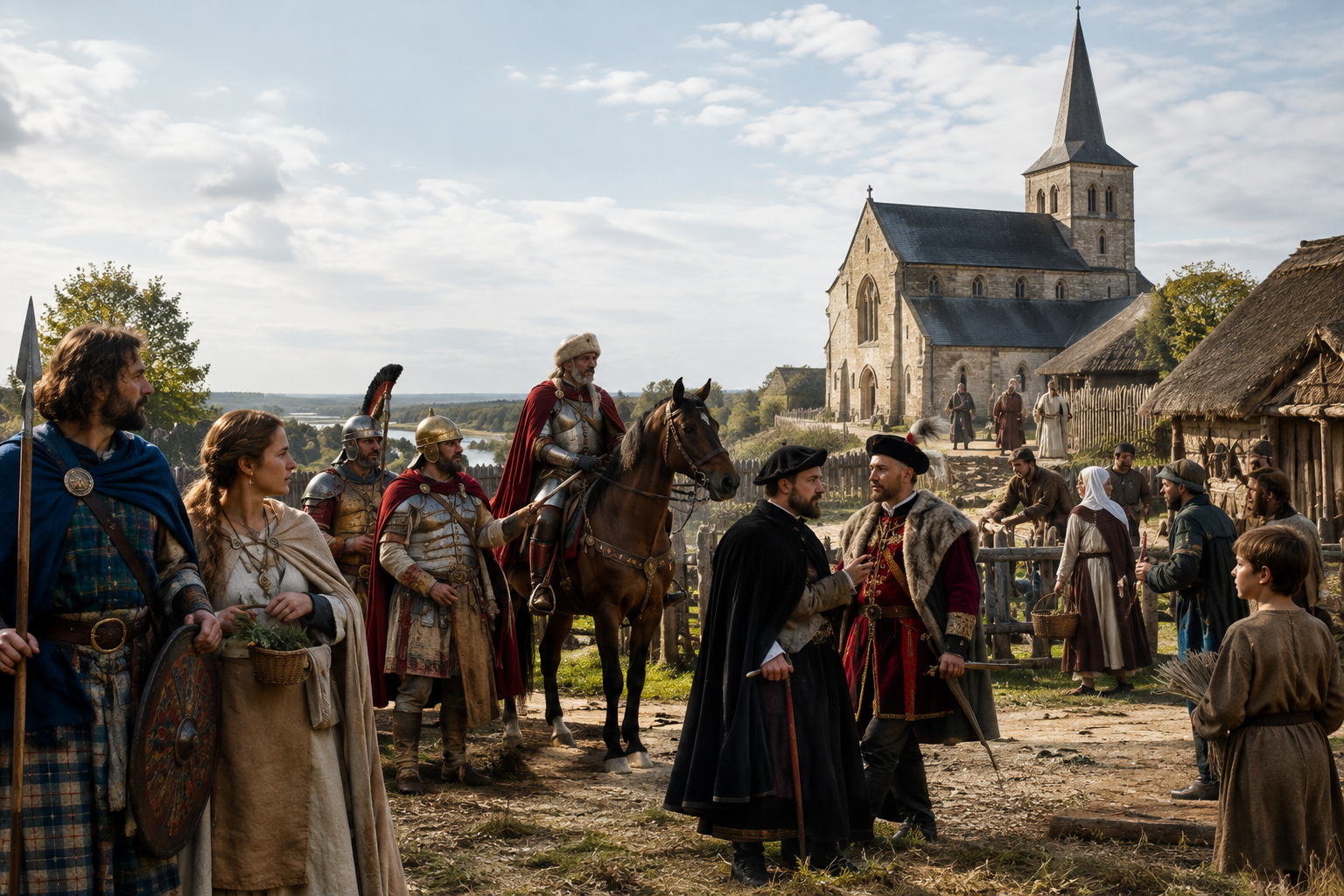
Some Y-chromosome lineages are like great imperial roads: broad, famous, and easy to follow on the historical map. Others are narrower lanes, visible only when enough ancient graves, castle archives, and modern testers begin to line up. Haplogroup R1b1a1b1a1a1c1 belongs to that second category. It sits within the wider R1b family, one of the major paternal lineages in western Eurasia, but this particular branch becomes interesting not because it can be made to explain all of Europe, but because ancient DNA shows it appearing again and again in very different settings: Bronze Age Central Europe, Iron Age Celtic worlds, Roman frontier zones, Migration Period burials, Anglo-Saxon England, Viking Age Scandinavia, medieval Flanders, and even early colonial North America.
That is exactly why Y-DNA matters. A Y-chromosome haplogroup traces one direct paternal line only: father to son, back through time. It does not describe a person's whole ancestry, culture, language, or identity. But when a lineage turns up across many centuries in securely dated archaeological burials, it gives us a remarkable tool for asking historical questions. Not, "Who were these people, once and for all?" but rather, "Where do we find this paternal line, in what contexts, and what does that distribution suggest about continuity, migration, and the reshaping of Europe?"
The wider R1b tree has a deep and complicated history across Eurasia, and many of its branches expanded dramatically in later prehistory. For a specific subclade such as R1b1a1b1a1a1c1, caution is essential: we should not lazily pour the entire history of all R1b into one narrow branch. What the supplied ancient evidence does suggest is that this lineage had a strong presence in Europe, especially across the central and northwestern zones that linked the North Sea, the Rhine basin, Central Europe, Britain, and parts of the Carpathian world.
Some of the earliest anchors are prehistoric. Sample I12902 from Late Neolithic Vlaardingen/CordedWare Netherlands Mienakker, dated to 2682 BC, places the lineage in the Lower Rhine region very early indeed. So too does RISE98, a Battleaxe Sweden L Beddinge 56 individual dated to 2079 BC, and I4070 from Bell Beaker De Tuithoorn North Holland dated to 2080 BC. These are not proof of one single uninterrupted male line from those men to later medieval nobles, but they do show that paternal branches of this kind were already embedded in the societies of northern and northwestern Europe during the late Neolithic and early Bronze Age.
Central Europe is equally important. LEU007, from Bronze Age Unetice Thuringia Leubingen Sommerda Germany, dated to 1950 BC, and I7196, Bronze Age Prague Jinonice Czech, also dated to 1950 BC, show the lineage in the heart of early Bronze Age central European society. That gives this haplogroup a setting not only on the Atlantic-facing edge of Europe, but also in the continental corridor through Bohemia, Thuringia, and beyond.
Explore Central European Celtic Origins
By the Iron Age, the archaeological picture becomes particularly lively. Sample 3430 from Gallo-Celtic Switzerland Pont de Cornaux-Les-Sauges, dated to 200 BC, and CGG101214 from Celtic Iron Age Austria Hallstatt, dated to 550 BC, place this lineage squarely in regions associated with Celtic-speaking societies. Add to that 2909a, Iron Age Czech Prague, dated to 100 BC, and Hung160, Iron Age Hungary Kesznyeten-Szeruskert, dated to 150 BC, and one begins to see a broad swathe from Bohemia to the Alpine world and the Carpathian Basin.
Western Europe offers another cluster. Several Belgic and Gallic burials from Bucy-le-Long in France carry the same paternal signature: CGG022463 dated to 511 BC, CGG022425 dated to 500 BC, CGG022431 dated to 486 BC, CGG022456 dated to 365 BC, CGG022438 dated to 375 BC, and CGG022419 dated to 457 BC. This is not a trivial pattern. It suggests that this branch, or very near paternal relatives within the tree, was well established among Iron Age communities in what became northern France.
Then Rome enters the scene, and with Rome, movement. The haplogroup appears in sample I15527 from Imperial Roman Viminacium Serbia Pecine Necropolis, dated to 100 AD, in R10659 from Roman Klosterneuburg Fortress Lower Austria dated to 126 AD, in R11121 from Imperial Roman Era Isola Sacra dated to 200 AD, and in R10339 from Etruscan Roman Republic Tarquinii Italy dated to 150 BC, alongside the earlier Etruscan sample TAQ013 dated to 400 BC. That does not make the lineage "Roman" in any simple sense. Rather, it reminds us that the Roman world was a machine for shuffling men, families, soldiers, merchants, and local populations across provincial boundaries.
The Rhine frontier and adjacent Germanic zones tell a similar story. The Batavi samples CGG107754 dated to 143 AD, CGG107757 dated to 175 AD, and CGG107745 dated to 214 AD from Valkenburg Marktveld in the Netherlands show the lineage among a famous frontier people. So too does OSIJ003, a Roman-period Germanic Warrior from Mursa Croatia dated to 260 AD. It is exactly the sort of paternal line one would expect to encounter in the messy overlap between imperial administration and local male kin groups.
Read About the Roman-German Frontier
The centuries after Roman power weakened are especially rich in evidence for this haplogroup. In Pannonia and neighboring regions, we find GYS029 from Germanic Late Antique Pannonia Arrabona Szechenyi Square Hungary dated to 425 AD, SZL050 and SZL051 from Longobard Period Pannonia Savaria Szeleste Barbaricum Hungary dated to 525 AD, and SZL076 from the same region and date. Northern connections appear in HVN003, HVN004, and HVN005 from Haeven Mecklenburg-Vorpommern dated to 250 AD, associated with Celto-Longobard and Longobard contexts, while Italy contributes the striking Collegno burials: COL_069, COL_069b, and COL_069x, all dated to 580 AD, including a Lombard Warrior Elite burial in northern Italy.
Here the line looks less like a single ethnic badge than a paternal thread passing through several related worlds of post-Roman mobility. Longobards, frontier communities, and local groups in the Danube zone all seem to have included men from this branch. The same broad pattern reaches Britain. We see it in EDI064c, Anglo-Saxon Edix Hill Cambridgeshire dated to 545 AD; in OAI006 and OAI013 from Oakington dated to 470 AD; at Buckland Dover in BUK007, BUK012, BUK027, BUK059, BUK060, BUK064, and BUK070, all around 400 AD; and at West Heslerton in I11583, I11584, I20644, I20652, I20671, and I20677, dated to 500 AD and 550 AD.
That is a remarkable concentration. It suggests that this paternal lineage was not rare in parts of the early Anglo-Saxon world. But again, this is evidence for presence, not a certificate of ethnicity. The same haplogroup also appears in I11149, an Iron Age Briton from Cambridgeshire dated to 460 BC, which warns us against too simple a story of total replacement. Ancient DNA often insists on a more complicated picture: newcomers arriving, local lineages persisting, and old paternal branches being folded into new political identities.
Explore Anglo-Saxon DNA in England
The lineage does not disappear into the mist after the Migration Period. It continues in Viking and medieval contexts: urm160x from Viking Age Sigtuna Sweden dated to 935 AD, VK396 from Viking Age Skara Varnhem dated to 1050 AD, CGG106724 from a Danii Tribe context in Denmark dated to 175 AD, CGG100493 from Medieval Jutland Denmark dated to 1275 AD, and SWG001 from Post Viking Age Hedeby dated to 1140 AD. In Flanders and Belgium it appears repeatedly: WPK005 from Post Carolingian Flanders Wulpen dated to 1162 AD, and a notable cluster from Sint-Truiden including ST2969 dated to 795 AD, ST1232, ST0323, ST0632, and ST0786 dated to 900 AD, ST3006 dated to 970 AD, ST0024 dated to 1090 AD, and ST0052 dated to 1300 AD.
That long medieval continuity makes the jump to later named families feel less fanciful, though still not genealogically proven. In England, the supplied historical association with the House of Cavendish brings us to Chatsworth House in Derbyshire. Beginning as a Tudor house built by Bess of Hardwick and Sir William Cavendish in the 1550s and 1560s, it was later transformed into one of the greatest seats of the Cavendish family after their elevation as Dukes of Devonshire in 1694. The present house, largely rebuilt from the 1680s by the 1st Duke, became a monumental statement of aristocratic power, patronage, libraries, sculpture, and art. Mary Queen of Scots was held there in custody for periods in the sixteenth century. In a haplogroup story, Chatsworth is not genetic proof of anything; it is historical theatre of a different kind, showing where later paternal lineages, estates, inheritance, and social memory became anchored in stone.
Far to the north and west, the supplied association with Clan MacArthur leads to Dunstaffnage Castle near Oban in Argyll. Built in the 13th century by the MacDougalls, lords of Lorn, it later passed to the Scottish crown in 1308 after Robert the Bruce's victories and became a royal stronghold guarding western sea routes. Later held by royal keepers and the Campbells, it saw sieges, repairs, and seventeenth-century conflict before surviving as one of the great medieval monuments of the western Highlands. For a lineage found across North Sea and British contexts, Dunstaffnage offers a reminder that the later medieval world preserved regional identities that ancient DNA can illuminate only indirectly. Haplogroups may outlast kingdoms; castles preserve the names of those kingdoms' later players.
Discover the House of Cavendish
One especially intriguing late thread comes from Hungary. The lineage appears in early medieval and conquest-era contexts such as I18184 from Early Medieval Hungary Holt-Tisza-part dated to 650 AD, K3per13_GE from Hungarian Late Conqueror dated to 800 AD, K3per1_GE from Hungarian Conqueror Karos III dated to 900 AD, and HUNper2 from Hun Nobility Hungary Kecskemet-Mindszentidulo dated to 450 AD. Later still, the branch is found in named noble individuals: PER01, Elek Bathory Hungarian Knight Pericei dated to 1568 AD, and PER03-1, Ferenc Bathory Hungarian Knight Pericei dated to 1589 AD.
These are exactly the kind of finds that tempt people into overstatement. The proper conclusion is not that every Batory or every noble connected to the region shared the same exact paternal line. The proper conclusion is better, because it is real: ancient DNA can sometimes bring a named historical family into the same evidential frame as prehistoric and early medieval burials. That is astonishing enough.
R1b1a1b1a1a1c1 appears, from the evidence supplied here, to be a distinctly European paternal branch with a long footprint across Central Europe, the Low Countries, Britain, Scandinavia, northern Italy, and the Carpathian Basin. It turns up in Bell Beaker and Bronze Age settings, in Iron Age Celtic and Belgic worlds, in Roman and frontier communities, among Migration Period groups including Lombard-associated burials, in Anglo-Saxon England, in Viking Age Scandinavia, in medieval Flanders, and in later noble contexts.
That does not give us a fairy-tale pedigree from one Bronze Age warrior to one duke in one stately home. What it gives instead is something more useful: a sober, vivid sense of how a paternal lineage can persist through cultural change. Languages shift. Kingdoms rise and vanish. Noble houses build palaces or lose castles. But a Y-chromosome branch may pass quietly through all of it, occasionally surfacing when archaeology and genetics are lucky enough to catch it.
If this haplogroup appears in your own results, MyTrueAncestry may help you place that direct paternal line beside ancient individuals such as LEU007, 3430, EDI064c, COL_069, or WPK005. Those comparisons do not prove direct descent from a particular ancient man, still less membership in a noble house like Cavendish or a Highland clan such as MacArthur. But they can offer a fascinating historical perspective on where your paternal line has appeared before, and in what worlds it once moved.
Upload your DNA to explore how your ancestry connects with ancient Europe, medieval populations, and the buried men whose Y-chromosomes still help historians ask better questions.






Comments