Haplogroup R1b1a1b1a1a1b1a

– 6 min read


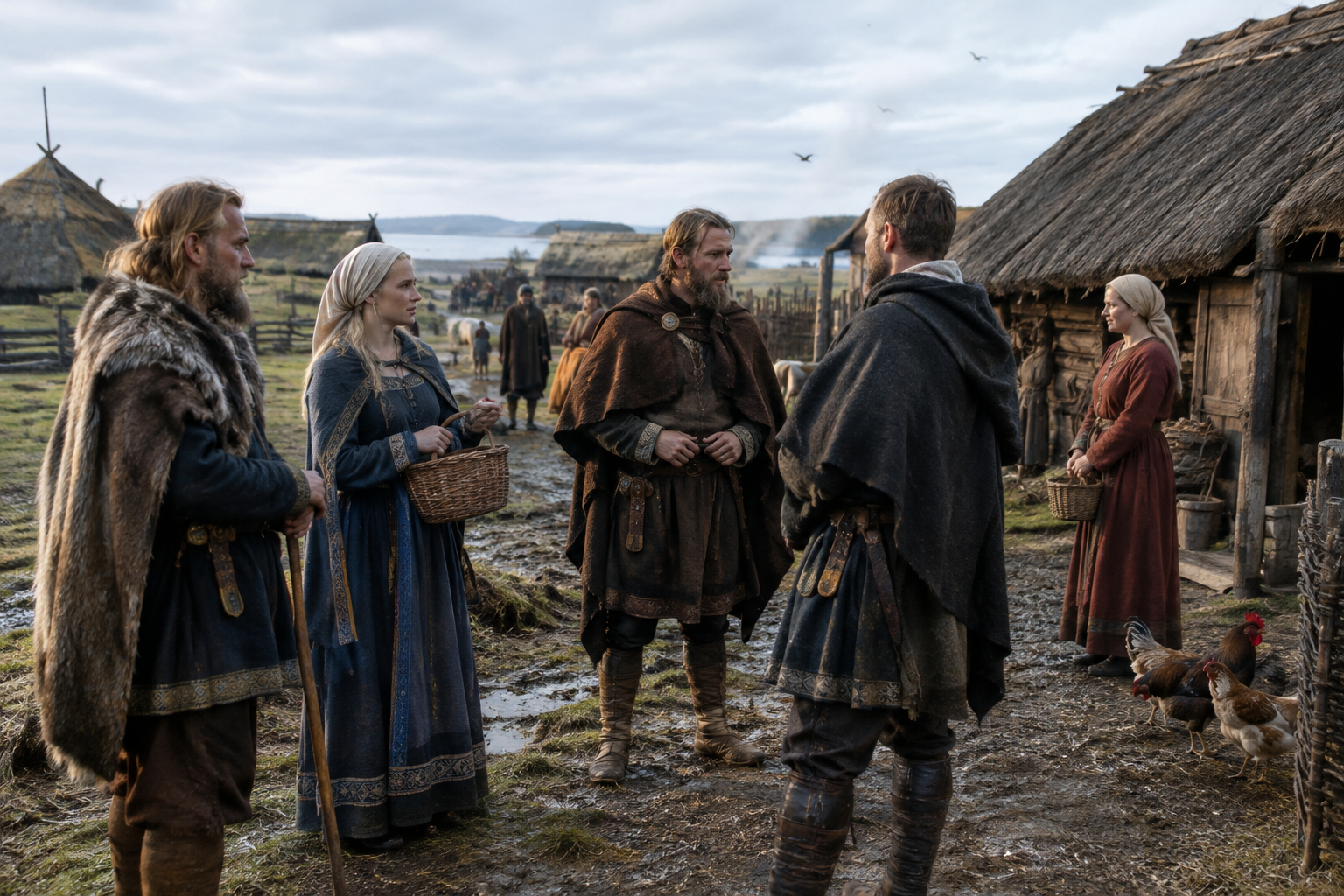
Some Y-DNA lineages announce themselves not through one grand royal tomb, but through repeated appearances across centuries and coastlines. Haplogroup R1b1a1b1a1a1b1a is one of those lineages. In the evidence supplied here, it turns up in Neolithic and Bronze Age Denmark, in Iron Age southern Scandinavia, among individuals connected with Gothic and other early medieval worlds on the Continent, and later in Viking Age and medieval settings reaching Britain, Orkney, Iceland, and Norway. That distribution makes it historically interesting not because it proves a single tribe, dynasty, or people, but because it lets us watch a paternal line move through some of the best documented transformations in northern European history.
As always, a reminder worth making plainly: Y-DNA traces one direct paternal line only - father to father to father. It does not describe a person's full ancestry, culture, language, or identity. Still, when ancient DNA places related paternal branches in archaeological contexts across time, it gives us something unusually vivid: a way of following one narrow line of descent through changing worlds of farmers, seafarers, war bands, kingdoms, and castles.
This subclade sits within the wider haplogroup R1b tree, one of the major Y-chromosome branches in western Eurasia. For a very specific subclade like R1b1a1b1a1a1b1a, caution matters. We should not lazily paste onto it the entire history of broad R1b. What the supplied ancient evidence does support, however, is a strong association with northern Europe, especially Scandinavia and the North Sea-Baltic zone.
Some of the earliest supplied anchors come from Denmark. A Neolithic Denmark Sjaelland Lillevasby individual dated to 2035 BC, sample CGG107465, suggests that a paternal line in this broader cluster was already present in southern Scandinavia by the late Neolithic. The pattern continues into the Nordic Bronze Age with CGG106705_CGG106706 from Karlstrup, Denmark, 1954 BC, CGG106708 from Karlstrup, 1961 BC, and CGG106744 from Rorslokke Mose Tryggelev, 1561 BC, alongside CGG100212 from Kalvehavegaard, 1444 BC.
None of these men can be turned into "founders" of later historical peoples by magic wand. But together they matter. They show that paternal ancestry connected with this branch was not a late Viking novelty. It was part of a much older Scandinavian biological landscape.
Explore Denmark's Deep Genetic Past
By the Iron Age, the sample list becomes almost crowded, and that is historically revealing in itself. We have multiple individuals from Sjaelland and nearby Danish regions: CGG107446 from Danii Tribe Denmark Northwest Sjaelland Kirkeby Bogebjerg, 175 AD; CGG107411 from Eastern Sjaelland Varpelev, 146 AD; CGG107419 from Hastrup, 256 AD; CGG107423 from Kirkebjerggaard, 391 AD; CGG107489 and CGG107494 from Mosede Mose, 175 AD; and CGG107495 from Mosede Fort, 175 AD. The Simonsborg and Slagelse material - CGG106720, CGG106722, CGG106728, and CGG106730 - strengthens the same picture.
What does that tell us? Not that all Iron Age Danes belonged to one paternal lineage, obviously. But it does suggest that this branch, or very near relatives of it, had real staying power in the Danish islands across several centuries. That continuity is one reason the haplogroup later appears so naturally in Viking Age and North Sea contexts.
The Baltic side of the story is just as striking. Sample PCA0485, from Iron Age Pommerania Gdansk Wielbark, 200 AD, and PCA0531, from Early Goth Pommerania Czarnwko Lebork County Wielbark, 200 AD, place the lineage in a region often discussed in relation to Gothic archaeology. These burials do not prove that a haplogroup equals "the Goths." That would be bad history and worse genetics. But they do show that men carrying this paternal branch were present in the southern Baltic world at precisely the period when communities there were tied into the movements and identities later described in Roman and post-Roman sources.
From there the trail continues southward and westward. GYS049, from Gothic Pannonia Arrabona Szechenyi Square Hungary, 425 AD, places the branch in the late antique Carpathian Basin. That is a reminder that the Migration Period was not just a story in texts; it was also movement visible in graves.
Read About Goths and Ancient DNA
The early medieval record broadens the map. In Germany, we have OBM025 from Thuringii Tribe Germany Obermoellern, 500 AD, and two Merovingian-period Frankish burials from Moemlingen, Mln27 and Mln42, both dated to 650 AD. In the Netherlands, GRO007 from Carolingian Era Groningen, 1010 AD adds a later North Sea mainland point. This does not define a single ethnic package. Rather, it shows a paternal line distributed across the Germanic-speaking and post-Roman political world from Denmark to central Europe and the Low Countries.
England also enters early. BUK025 from Jute Early Anglo Saxon Period Buckland Dover England, 400 AD and HAD006 from Early Anglo Saxon Period Hatherdene Close Cambridgeshire England, 500 AD fit the pattern of North Sea connections between southern Scandinavia, Jutland, and early medieval Britain. Later, ATP_PSN_496 from Medieval England Cambridge Benet Street, 1250 AD shows that such lines were not fleeting visitors. They became part of the settled medieval population.
The Viking Age evidence is even more expansive: gam872 from Uppsala Gammelbyn Brstil, Sweden, 1025 AD; VK308 from Skara Varnhem, Sweden, 1050 AD; VK204 from Orkney Newark for Brothwell, 950 AD; VK170 from Viking Ship Burial Balladoole Isle of Man, 900 AD; VK168 from Viking St. Brice Massacre Oxford, 1002 AD; and VDP-A7 from Viking Gaelic Boat Burial Iceland, 925 AD. Add VK259 and VK449 from Viking Invader Ridgeway Hill England, 998 AD, and one can see the maritime arc clearly enough: Scandinavia to the British Isles and across the North Atlantic.
Again, the scientific point is not descent from Vikings in some cartoon sense. It is that this paternal branch appears repeatedly in Viking Age contexts across the very routes associated with raiding, settlement, alliance, and trade.
By the medieval and early modern periods, genetics must be handled with even more care, because surnames, lordships, and castles belong to documented family history, not to automatic haplogroup assignment. Still, the supplied noble associations place this lineage in an evocative regional setting: the Norse-Scottish north, the Anglo-Norman Midlands, and the Norwegian royal coast.
Clan Gunn belongs to the far north of Scotland, and Gunn Castle in Caithness captures that world beautifully. It was a late medieval tower house, built in a region where chiefs needed to command land and sea routes in an age of feud, raiding, and brittle loyalties. The ruined structure still speaks of a coastal lordship shaped by the same northern waters that had linked Norway, Orkney, Caithness, and the Isles for centuries. That matters in context, because the ancient DNA trail for this haplogroup repeatedly passes through Norway, Orkney, and Viking-era Britain.
In Norway, the Adelslekta Skanke association draws us to Bergenhus Fortress in Bergen, one of Norway's oldest and best preserved strongholds. Its roots go back to the high medieval royal center of Bergen, with Hakon's Hall and later additions such as the Rosenkrantz Tower. As a royal residence, harbor fortress, and symbol of crown authority, Bergenhus belonged to a Norway deeply connected to the North Atlantic and North Sea world in which this paternal lineage appears repeatedly in the ancient record.
Then there is House Ferrers and Tutbury Castle in Staffordshire. Here the setting is different: a Norman motte-and-bailey that became a major stone stronghold of the Midlands, later associated with John of Gaunt and the Duchy of Lancaster. Mary Queen of Scots was imprisoned there; Civil War fighting later shattered it. Tutbury reminds us that by the high and late Middle Ages, paternal lines once visible in Scandinavian and migration-period cemeteries had long since become part of the layered aristocratic and regional populations of Britain. But that is context, not proof that a named house and an ancient burial share a documented paternal chain.
Explore the History of Clan Gunn
If we stand back from the individual burials, a coherent picture emerges. R1b1a1b1a1a1b1a appears in the supplied evidence as a distinctly northern European paternal line with deep roots in Scandinavia, strong visibility in Iron Age Denmark, presence in the Baltic world associated with Wielbark and Gothic-era contexts, and continuity into early medieval Germany, the Low Countries, Britain, Norway, Orkney, Iceland, and Viking-age maritime networks.
That is valuable precisely because it is not a fairy tale of one pure people marching unchanged through time. The line persists while cultures change around it: Neolithic communities, Bronze Age Scandinavians, Iron Age Danes, Gothic-associated burials, Merovingian Franks, Anglo-Saxons, Vikings, and medieval townspeople. Ancient DNA shows paternal continuity and movement; archaeology shows how people lived and were buried; written history gives names to some later families and fortresses. Put together, they illuminate one another, but they are not the same thing.
For readers whose own Y-DNA falls near this branch, that is the excitement. Not a guaranteed link to a castle or clan chief, but a chance to place one narrow paternal line within some of the best documented human movements of northern Europe.
If you want to explore whether your own DNA shows connections to ancient individuals like PCA0531, GYS049, VK204, or ATP_PSN_496, MyTrueAncestry can help you compare your results with archaeological samples from across the ancient world. Those matches do not by themselves prove direct descent or membership in a noble family, but they can offer a remarkably concrete view of where parts of your ancestry may have stood in history.






Comments