Haplogroup R1b1a1a2a1a2b1c1b6

– 5 min read


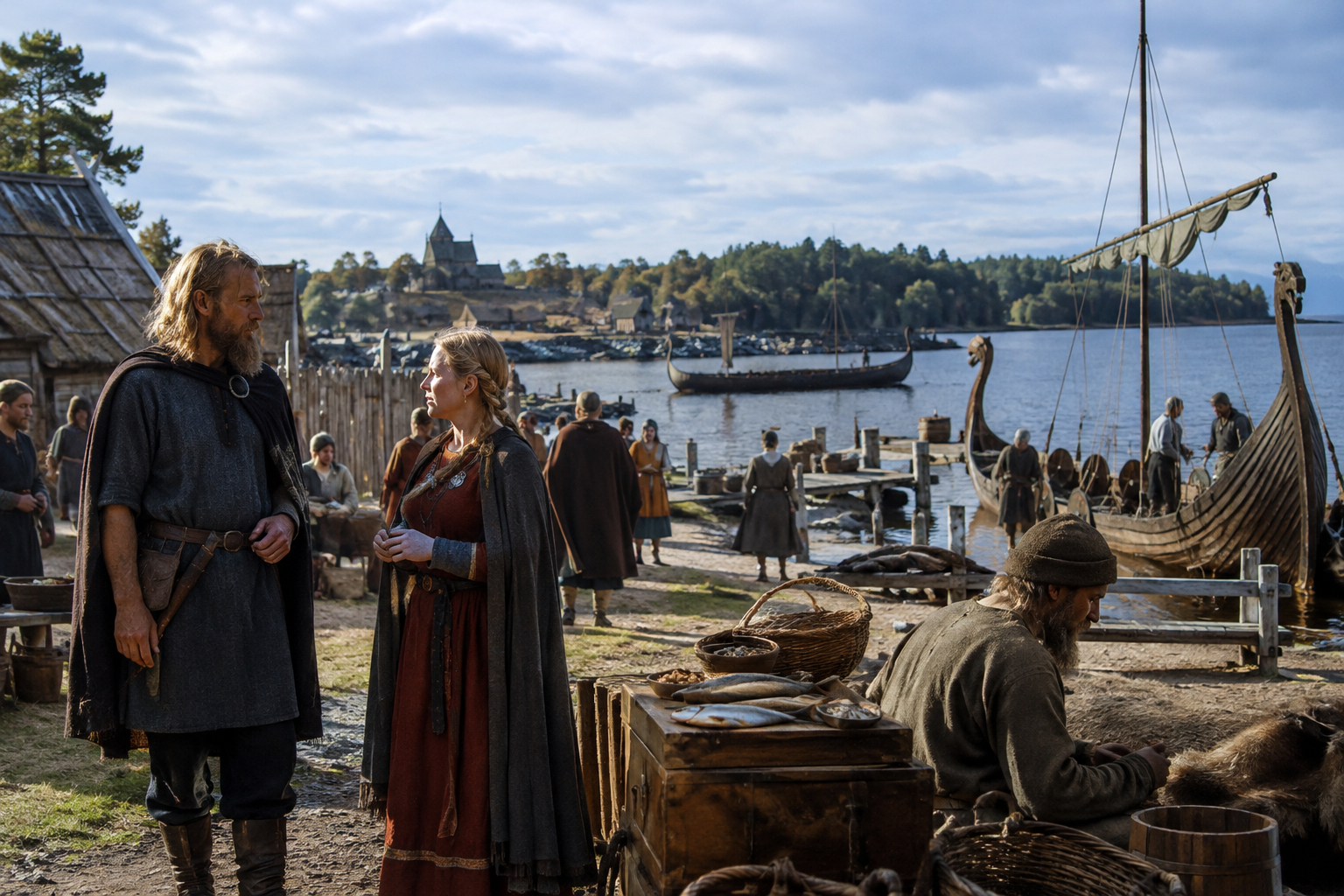
In around AD 935, a man buried at Sigtuna in Sweden entered the genetic record as sample urm160. Sigtuna was one of the great early towns of Viking Age Scandinavia: a place of trade, royal ambition, Christianization, and movement across the Baltic and North Sea worlds. That matters here because R1b1a1a2a1a2b1c1b6, the Y-DNA branch linked to this individual, turns up not in some abstract map of "Viking blood," but in one specific urban life at a specific moment when Scandinavia was being remade.
That is the useful scale for thinking about a haplogroup like this one. Y-DNA follows a direct paternal line only, not a person's whole ancestry, language, or social identity. But when a branch appears in an archaeological context as vivid as Viking Age Sigtuna, it gives us something far better than legend: a documented male line anchored to a real historical town.
Sigtuna was founded in the late 10th-century world of emerging Swedish kingship, though the wider settlement sequence and its cemeteries bridge the late Viking Age and the first Christian centuries in central Sweden. It was not a remote farmstead. It was one of the places where coinage, crafts, trade, ecclesiastical power, and royal politics met. A burial from this setting therefore sits at the heart of a social transformation, not at the margins of it.
Sample urm160, dated here to around AD 935, belongs to that world. Even when a single Y-chromosome result seems narrow, its historical setting broadens the picture. A paternal line found at Sigtuna could belong to a merchant household, an established local family, a newcomer integrated into town life, or the descendant of earlier mobility around the Baltic. What the evidence gives us securely is the place and period: Viking Age Sweden, in an urban environment where identities were layered and movement was normal.
An ancient DNA study of Viking Age populations published in Cell helped show just how varied the genetic background of people in the wider Scandinavian world could be. That larger context is important. It warns us against imagining every paternal lineage in Viking Age Sweden as uniquely "native" or as carrying a single cultural label across centuries unchanged.
The haplogroup name R1b1a1a2a1a2b1c1b6 is a very fine-grained branch inside the much larger R1b family, one of the major Y-chromosome lineages in western Eurasia. That broader family has a long and complicated prehistoric and historic spread, but one must be careful here: the history of the parent R1b umbrella is not automatically the history of this exact terminal branch.
What can be said responsibly is that this subclade's appearance in a Viking Age burial at Sigtuna places it within the male-line diversity of medieval Scandinavia. It does not, by itself, prove that the branch originated in Sweden, nor that every man carrying it was ethnically Norse, spoke Old Norse, or belonged to a single kin group. Y-DNA is precise in one sense and narrow in another: it can identify a paternal thread, but not the whole fabric.
That distinction matters especially in Viking Age settings, because Scandinavia was tied into routes reaching England, Ireland, the North Atlantic, the Slavic coast, the Frankish world, and beyond. A paternal branch found in Sigtuna is therefore best understood through networks, not stereotypes.
There is a temptation, whenever a Viking Age sample appears, to imagine a war-band, a ship burial, or some saga-worthy figure. Sigtuna points us elsewhere. This was a town, and towns reveal something more historically durable than raiding alone: settlement, exchange, religion, law, and family continuity. The men buried there were part of a society learning how to live with new institutions as much as with old customs.
For a lineage such as R1b1a1a2a1a2b1c1b6, that makes the evidence particularly valuable. A paternal branch preserved in an urban cemetery suggests not just movement but rootedness. By the 10th century, the Scandinavian world was no longer defined only by outward expansion. It was also producing permanent centers where different ancestries could be absorbed into local communities and carried forward.
This is one reason Sigtuna matters so much in the archaeology of Sweden. It offers a stage on which gene flow, belief, and political change all overlap. A lineage found here belongs to a human setting in which "Viking" was not simply an ancestry label, but a historical condition of mobility and adaptation.
Sigtuna did not stand alone. It belonged to a wider east Scandinavian landscape that included older power centers, burial grounds, trading places, and maritime links across the Baltic. By the 10th century, central Sweden was connected to territories that are now Finland, the eastern Baltic, and the river routes running deep into eastern Europe. A man from Sigtuna might be local for generations, or he might stand only a few generations removed from migration. In practice, either possibility still makes him part of Scandinavian history.
That is where this haplogroup becomes interesting for family historians. If your direct paternal line falls within R1b1a1a2a1a2b1c1b6, the strongest anchor offered here is not a mythic founder but a Scandinavian urban context in the late Viking Age. It is evidence for presence in a region where trade, royal power, and Christianization were all drawing people together.
The wider Baltic zone also reminds us that lineages can travel without leaving obvious written records. Archaeology often sees towns before chronicles see families. DNA then adds another dimension, showing that the male lines inhabiting these places were not monolithic.
With only one ancient individual explicitly tied here to the branch, caution is essential. A single sample cannot map the full range, age, or social profile of R1b1a1a2a1a2b1c1b6. It cannot tell us whether this line was common or rare in Sigtuna, whether it had deep roots in the region, or whether it arrived there recently.
But a single sample from the right place can still be historically substantial. urm160 is not from an anonymous "northern Europe" label or a vague medieval assignment. He comes from one of the defining settlements of Viking Age and early medieval Sweden. That gives the lineage a solid archaeological foothold in a famous landscape of transition.
It also places this branch in a period increasingly illuminated by Scandinavian ancient DNA, where burials can sometimes reveal kinship, local continuity, and the varied backgrounds of people living side by side. Sigtuna fits neatly into that broader picture of medieval northern Europe as a zone of both continuity and contact.
For this haplogroup, the clearest historical signal is a male line documented in Viking Age Sigtuna, around AD 935, at a moment when Sweden was becoming more urban, more connected, and more politically concentrated. That does not make every modern carrier "a Viking" in the popular sense. It does something better: it ties the branch to a real man in a real Scandinavian town at a historically important moment.
If you descend along this paternal line, the most responsible takeaway is that your Y-DNA belongs to a branch present in the mixed, mobile, and fast-changing world of late Viking Age Sweden. That is already a rich inheritance: not a costume-drama fantasy, but a place in the archaeology of one of medieval Scandinavia's formative communities.






Comments