Haplogroup R1b1a1a1
– 5 min read


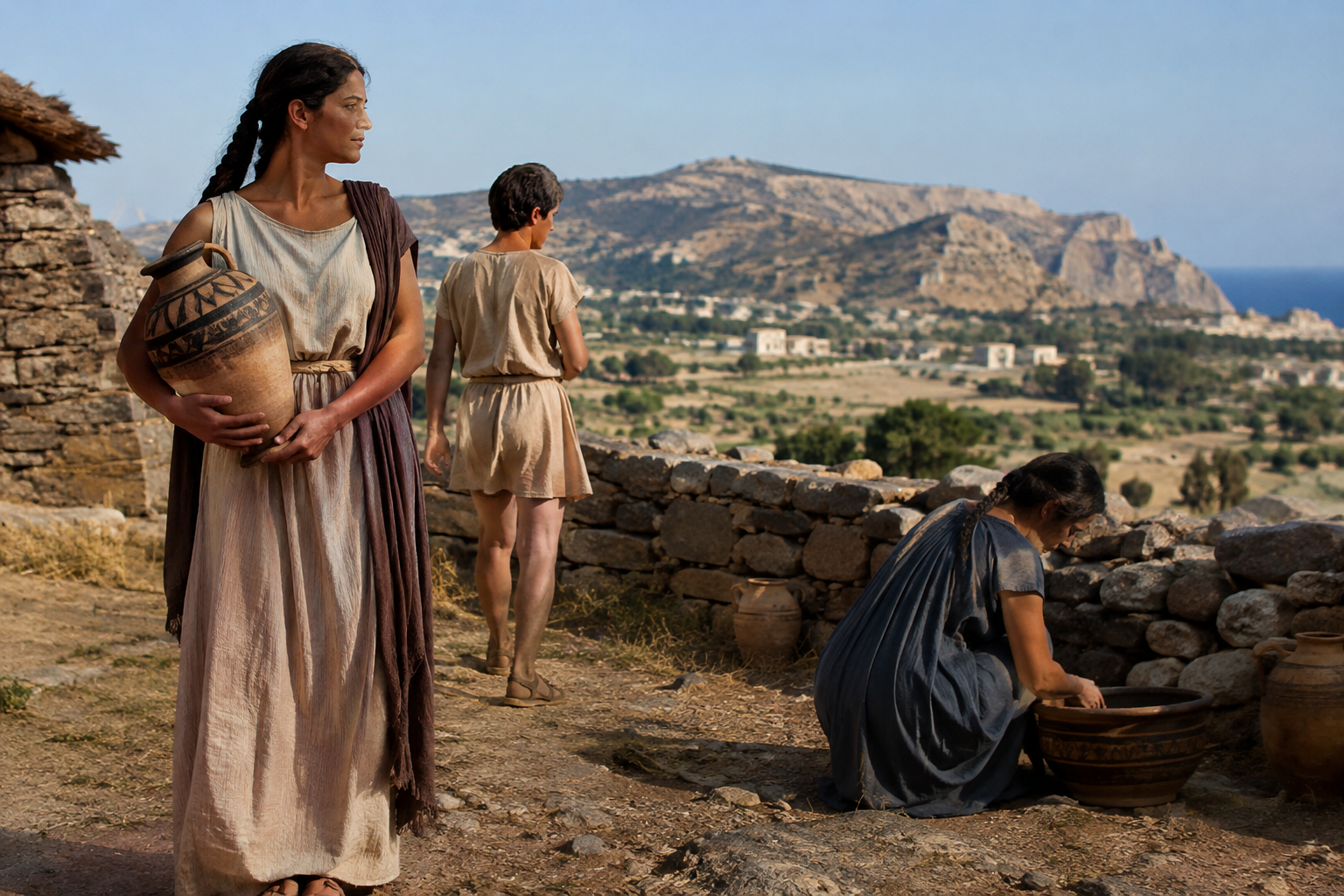
At Glika Nera in Attica, one ancient man dated to around 1600 BC carries a surprisingly large historical weight. The sample, identified as GLI002, belongs to the Mycenaean world: the era when mainland Greek palace societies were taking shape, long before the Classical city-state and centuries before the Parthenon dominated the Athenian skyline. In this case the Y-DNA assignment connected with him is R1b1a1a1, a paternal line that immediately places him in a much wider Eurasian story.
That matters because Mycenaean Greece sits at a crossroads in both archaeology and genetics. It is one of those places where local Aegean traditions, contacts across the eastern Mediterranean, and deeper movements from the north all meet. A single Y-chromosome does not tell us a person's whole ancestry or identity, but it can preserve one direct paternal line with remarkable stubbornness. In GLI002, that line offers a glimpse into how broad Bronze Age male lineages became embedded inside the emerging elites and communities of southern Greece.
Glika Nera lies in Attica, the region later centered on Athens, but in 1600 BC we are looking at a very different political landscape. This was the early Mycenaean period, when mainland communities were developing richer burials, stronger regional hierarchies, and wider exchange networks. The world of Linear B tablets still lay in the future, yet the foundations of Mycenaean society were already forming.
Sample GLI002 is therefore valuable not because he can be turned into a heroic figure from legend, but because he is securely anchored in a real archaeological horizon. He represents a man living in southern Greece at the beginning of the Mycenaean age, carrying a paternal lineage classed here as R1b1a1a1. That places this haplogroup inside an Aegean context where ancient DNA has repeatedly shown a mixture of local continuity and outside connections, rather than any simple story of replacement.
A research presentation focused on Aegean genetic evidence, available through the European Association of Archaeologists repository, offers context for the wider population background in which such individuals are being studied: https://submissions.e-a-a.org/eaa2021/repository/preview.php?Abstract=2323.
R1b1a1a1 is not a nickname for a people, a language, or a kingdom. It is a point on the Y-chromosome tree, and in this article it refers specifically to the paternal branch assigned to the featured sample. That is important, because broader R1b lineages are famous for their enormous spread across Europe and parts of western Eurasia, but one should be careful not to dump that entire history wholesale onto a narrower branch in one Mycenaean individual.
Still, the wider context is hard to ignore. By the Bronze Age, lineages within R1b were already strongly associated with many populations shaped by earlier movements from the steppe into Europe. In the Aegean, however, those lineages do not appear in a vacuum. They arrive in populations that also preserve substantial ancestry from earlier farmers and older local Mediterranean communities. So GLI002 is not evidence for a one-note invasion tale. He is better understood as part of a Mycenaean population in which several older strands had already been woven together.
This is where the archaeology becomes more interesting than the slogan. The Mycenaeans were unmistakably of the Aegean, yet ancient DNA has shown that they were not genetically identical to the earlier Bronze Age populations of the islands and southern mainland. One of the recurring findings is that mainland groups absorbed an added component related to populations further north or northeast, while still remaining deeply tied to earlier Aegean ancestry.
A Y-chromosome such as R1b1a1a1 fits neatly into that pattern of selective continuity and change. Paternal lines can shift more dramatically than the rest of the genome, especially in times when social systems favor the expansion of some male lines over others. That does not mean every man with this lineage was an immigrant, nor that a single branch defines Mycenaean identity. It means that the making of Mycenaean Greece included paternal histories that linked the Aegean to larger Bronze Age transformations across Europe.
Attica is a particularly telling setting for this. Later history tempts us to read everything through Athens, democracy, drama, and philosophers in sandals. But in the sixteenth century BC, Attica was part of a patchwork of developing centers. A man like GLI002 belongs to that earlier chapter: regional, aristocratic in some places, competitive, and increasingly tied into the mainland systems that archaeologists call Mycenaean.
It is fair to say that one sample cannot stand in for all of Mycenaean Greece. But one sample can still matter greatly when it sits in the right place and time. GLI002 comes from a formative period in southern Greece, and his paternal assignment helps document that lineages associated with wider Bronze Age European expansions were present within the Mycenaean sphere.
That point is especially useful because discussions of ancient Greece often slip into two extremes. At one end is the old fantasy of total cultural purity, as if the Aegean developed in splendid isolation. At the other is an equally misleading habit of reducing every change to abrupt migration. Ancient DNA keeps spoiling both tidy stories. What we see instead is movement, mixture, persistence, and local adaptation. The Mycenaean world was connected, but not erased by those connections.
In practical terms, R1b1a1a1 in a Mycenaean from Attica suggests that this paternal branch had already become part of the southern Greek population by the early Late Bronze Age. That is a sober conclusion, but quite a powerful one. It places this lineage not in some vague pan-European nowhere, but in a historically recognizable society with palatial ambitions, warrior imagery, and strong ties across the Aegean.
The deeper importance of finds like GLI002 is that they help connect prehistoric population processes to later Mediterranean history without pretending there is a neat straight line from one man to a modern nation. The Mycenaean period helped shape the demographic and cultural foundations of later Greece, even though centuries of upheaval, mobility, colonization, and empire followed.
For that reason, anyone carrying R1b-related paternal ancestry today should resist the temptation to jump directly from a modern haplogroup match to a legendary ancestor. Ancient DNA works better when used modestly. A sample such as GLI002 shows that this paternal branch, or a closely related placement under that broad designation, was present in Mycenaean Attica around 1600 BC. That is not a personal family tree, but it is a real historical foothold.
The most distinctive thing about R1b1a1a1 in this case is not that it proves heroic descent or a single grand migration route. It is that it appears in a documented Mycenaean individual from Attica, sample GLI002, at a key moment in the formation of mainland Greek civilization. For someone researching a paternal line, that offers a grounded historical possibility: one branch of this wider Y-chromosome family was already present in southern Greece during the Bronze Age, inside the real human communities from which later Greek history emerged.






Comments