Haplogroup R1a1a1b2a2a1

– 6 min read


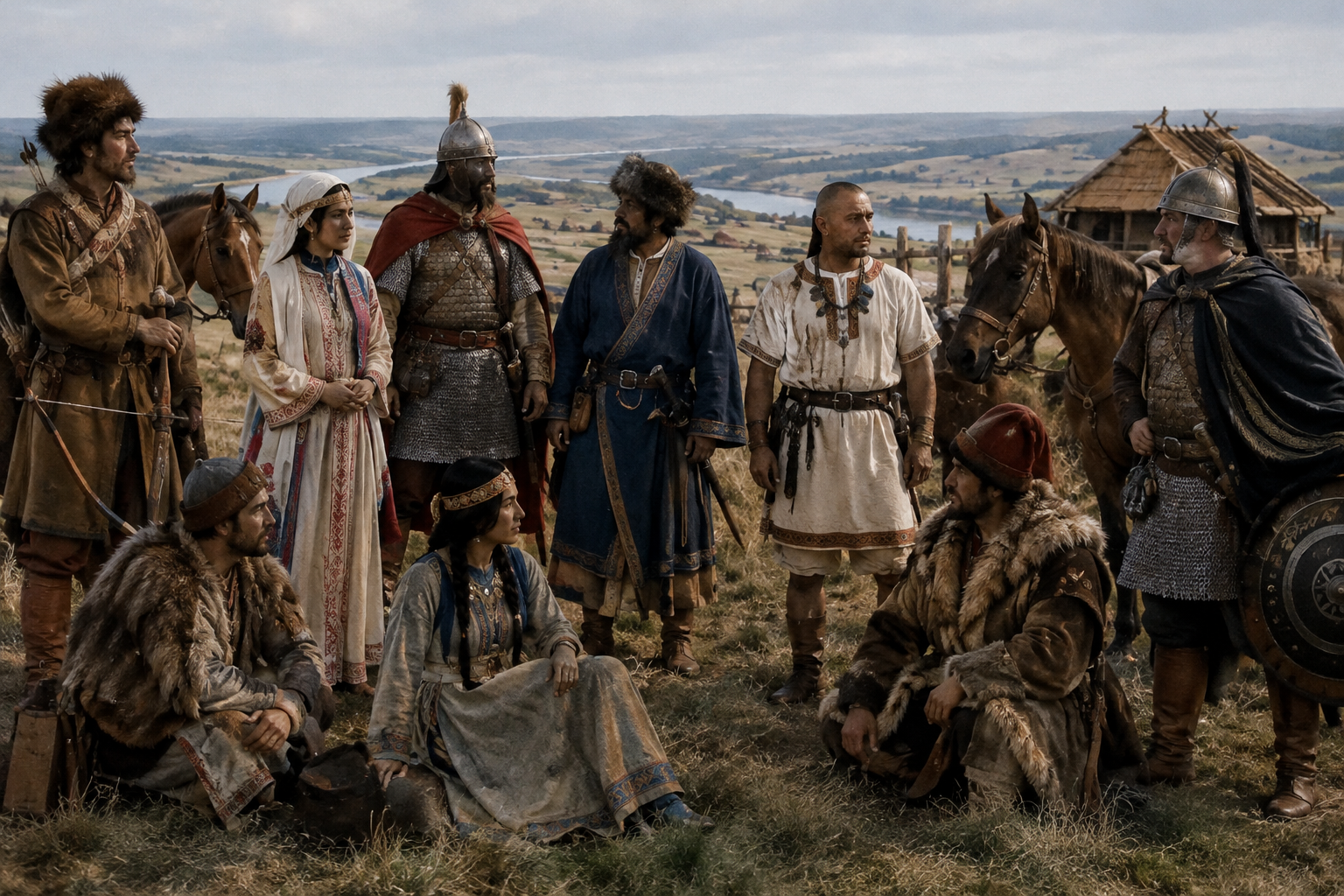
Some Y-chromosome lineages are easy to trap inside modern labels. This one is not. Haplogroup R1a1a1b2a2a1 appears across a striking sweep of time and space: Bronze Age Germany, the Eurasian steppe, Iron Age Saka and Scythian burials, late Roman and post-Roman sites in the Balkans, medieval Hungary, and even into the documented world of the Arpad kings. It is the sort of lineage that reminds us that paternal history was rarely tidy. Men moved with herds, armies, trading networks, and courtly households long before later kingdoms tried to pin identities down on a map.
As always, a caution worth stating plainly: Y-DNA tracks one direct paternal line only, father to father to father. It does not describe a person's whole ancestry, still less their language, culture, or nationality. But when ancient DNA places the same paternal branch in graves separated by centuries and continents, it offers a valuable historical clue. In the case of R1a1a1b2a2a1, the clue points toward a story deeply entangled with steppe mobility, Bronze Age expansion, and the making of medieval eastern and central Europe.
R1a1a1b2a2a1 sits within the broader R1a family, a major Y-chromosome lineage long associated in archaeogenetic research with large parts of Eurasia. That broad parent lineage has often been linked, with varying degrees of confidence depending on the branch, to steppe-connected expansions in later prehistory. But one of the first rules of good genetic history is not to dump the entire story of R1a onto every downstream twig. A specific subclade like R1a1a1b2a2a1 has its own, narrower history, and we can only follow it where the evidence allows.
What the supplied ancient samples show is not a single homeland neatly preserved in amber, but a corridor of appearances stretching from the Urals and Kazakhstan to central Europe and the Carpathian Basin. The pattern strongly suggests that this paternal branch, or close relatives within the same part of the tree, participated in the long networks that connected steppe and forest-steppe societies with Bronze Age and later populations farther west.
Explore Southern Ural Connections
One of the most revealing early anchors is I1053, a Bronze Age Urals Sintashta Culture individual dated to 1850 BC. Sintashta has become famous in discussions of steppe warfare, chariot technology, and the movement of peoples across the inner Eurasian world. No single sample can stand for an entire culture, of course, but the presence of this lineage in that setting places it firmly within an important Bronze Age horizon.
From there, the trail does not vanish eastward. It turns up repeatedly in Bronze Age Germany: RISE434 from Tiefbrunn dated 2680 BC, RISE436 from the same site dated 2649 BC, and later individuals such as RISE440 at Wolkshausen dated 2387 BC, RISE473 at Regensburg-Dechbetten dated 1448 BC, RISE478 at Schoegeising dated 1338 BC, and RISE556, RISE558, and RISE560 around 1300 BC from Manching-Oberstimm and Augsburg.
That is an impressive run of central European appearances. It suggests that paternal lines in this part of the R1a tree were not fleeting visitors, but participants in Bronze Age societies west of the steppe as well. Whether through migration, elite exchange, marriage networks, or longer settlement history, the result is clear enough: by the Bronze Age, this lineage was already part of the human landscape of central Europe.
The same broad zone of connection is visible farther east in I0507 from the Andronovo Bayan-Zherek Mountains dated 1750 BC, and in I11540, I11541, and I10111 from Andronovo contexts dated between 1300 BC and 1150 BC. Together with the Sintashta sample, these finds help frame R1a1a1b2a2a1 within the world of Bronze Age steppe and steppe-related populations rather than any one later ethnic label.
Read About Late Bronze Age Central Europe
By the Iron Age, the lineage appears in exactly the sort of archaeological settings that make historians sit up. There is BIR007 from a Scythian Grave Tasmola Iron Age burial at Birlik, Pavlodar, Kazakhstan dated 781 BC. There is DA17 from the Eurasian Steppes Saka Scythian world dated 780 BC. Then come KOT001, an Elite Saka Iron Age individual from Koktubek II, East Kazakhstan dated 650 BC, SHI009 from a Scythian Grave Tasmola Iron Age site at Shilikty, East Kazakhstan also dated 650 BC, ESZ010 from Eleke Sazy, East Kazakhstan dated 267 BC, and CGG021496 from Aymyrlyg, Southern Siberia dated 209 BC.
This is not proof that all Scythians or all Saka belonged to one paternal line; far from it. Ancient DNA has repeatedly shown that steppe confederations were genetically mixed. But these samples show that R1a1a1b2a2a1 was present among populations occupying the great horse-and-kurgan world of Iron Age Inner Eurasia. That matters, because the Scythian and Saka horizons linked the steppe from the Black Sea to the Altai, creating routes by which paternal lineages could spread, survive, and reappear in later regions.
The eastern range continues into Mongolia with ARS026 from Arbulag Soum dated 1060 BC, UGU010 from the Uguumur Uul Xiongnu Period dated 50 AD, UGU005 from the same site dated 650 AD, TAV011 from Late Medieval Xiongnu Tavan Tolgoi dated 1300 AD, and ZAM001 from Zambaga Khairkhan dated 1400 AD. That does not mean a single unbroken noble bloodline stretching from Sintashta to medieval Mongolia. It does mean this branch occupied the wider zone where steppe empires rose and fell for more than a millennium.
Discover Iron Age Scythian Elites
Late antiquity brings the lineage into a more familiar historical world. In Serbia, I15520 from the Late Roman Empire Viminacium Serbia Vise Grobalja Necropolis is dated 200 AD. Later still, I27196 from Gothic Era Serbia Kormadin Jakovo dated 450 AD and I27296 from the Post Roman Gepid Period Serbia Jakovo-Kormadin Belgrade Sur dated 511 AD show the branch in the turbulent centuries when Roman frontiers, Gothic groups, Gepids, Huns, and other peoples met and collided in the Balkans.
Hungary adds more crucial points: A181028 from Gepidic Era Hajdunanas-Furj-halom-dulo dated 400 AD, HUNper3 described as a Wealthy Hunnic Male from Arpas-Szeruskert dated 450 AD, SZ1 from Bronze Age Szolad Hungary dated 1000 BC, and K2per61_GE from Hungarian Conqueror Karos II dated 900 AD. These finds do not collapse Hunnic, Gepid, conqueror, and local Carpathian histories into a single paternal tribe. What they do show is repeated presence in the Carpathian Basin across very different political eras.
Most striking of all are the royal burials: SZTL, King Ladislaus I Hungary, dated 1095 AD; BelaIII, King Bela III Arpad Dynasty, dated 1196 AD; and HU52, Prince Andras Arpad Dynasty, dated 1234 AD. Here the paternal story enters the world of chronicles, saints, and dynastic politics. This is not merely an archaeological pattern now, but a lineage documented in medieval kingship.
That makes the Arpad connection historically important, but scientific caution still matters. A genetic association with identified Arpad rulers does not prove that every later claimant, cadet branch, or associated noble carried the same Y-line. Medieval dynasties were social institutions as much as biological ones. Still, ancient DNA gives us something written sources never could: a direct look at a royal paternal line.
If you want a stone monument to the later historical world in which this lineage appears, Buda Castle is the obvious place to stand. Set on Castle Hill above the Danube in Budapest, it is associated here with the Arpad Dynasty, though the visible building is the product of many later rebuildings. Its story begins in its royal form in the 13th century, after the Mongol invasion, when King Bela IV sought stronger defenses. That alone is a vivid reminder that dynasties were never just family trees; they were also fortifications, recoveries, and political improvisations.
Later rulers expanded the complex, and under Sigismund and Matthias Corvinus it became one of central Europe's grand courts, with late Gothic and Renaissance grandeur. Then came Ottoman conquest in 1541, long neglect and war damage, Habsburg reconquest in 1686, Baroque rebuilding in the 18th and 19th centuries, and severe destruction again during the Second World War. What stands there now is not a pure Arpad survival. It is something far more interesting: a building layered by conquest, reinvention, and national memory.
That layered quality suits the haplogroup story rather well. A Y-line can persist while languages change, courts fall, palaces burn, and kingdoms are remade. Genetics does not replace history here; it thickens it.
R1a1a1b2a2a1 looks, from the evidence supplied, like a paternal branch with deep ties to the Eurasian steppe and a durable presence in central and eastern Europe. It appears among Bronze Age populations in Germany, in steppe-linked Bronze Age cultures such as Sintashta and Andronovo, in Iron Age Saka and Scythian contexts, in the late Roman and post-Roman Balkans, and in medieval Hungary's ruling house. That is not a simple tale of one people becoming another. It is a reminder that paternal lines often outlast the names historians give to the societies carrying them.
For MyTrueAncestry users, this is where the subject becomes especially compelling. A haplogroup match does not make someone a Scythian horseman, a Gothic warrior, or an Arpad prince. But it may place one direct paternal line inside the same broad historical stream. Ancient DNA lets us compare family history, archaeology, and the written record in a way that would have seemed impossible not long ago.
If you want to explore whether your own DNA shows connections to ancient individuals such as BelaIII, SZTL, K2per61_GE, or the many Bronze and Iron Age men who carried related paternal lines, MyTrueAncestry can help you place those results in historical context. These comparisons can be fascinating windows into the past, even when they do not prove direct descent from a king or membership in a noble house.






Comments