Haplogroup R1a1a1b1a3a1b3e4

– 5 min read


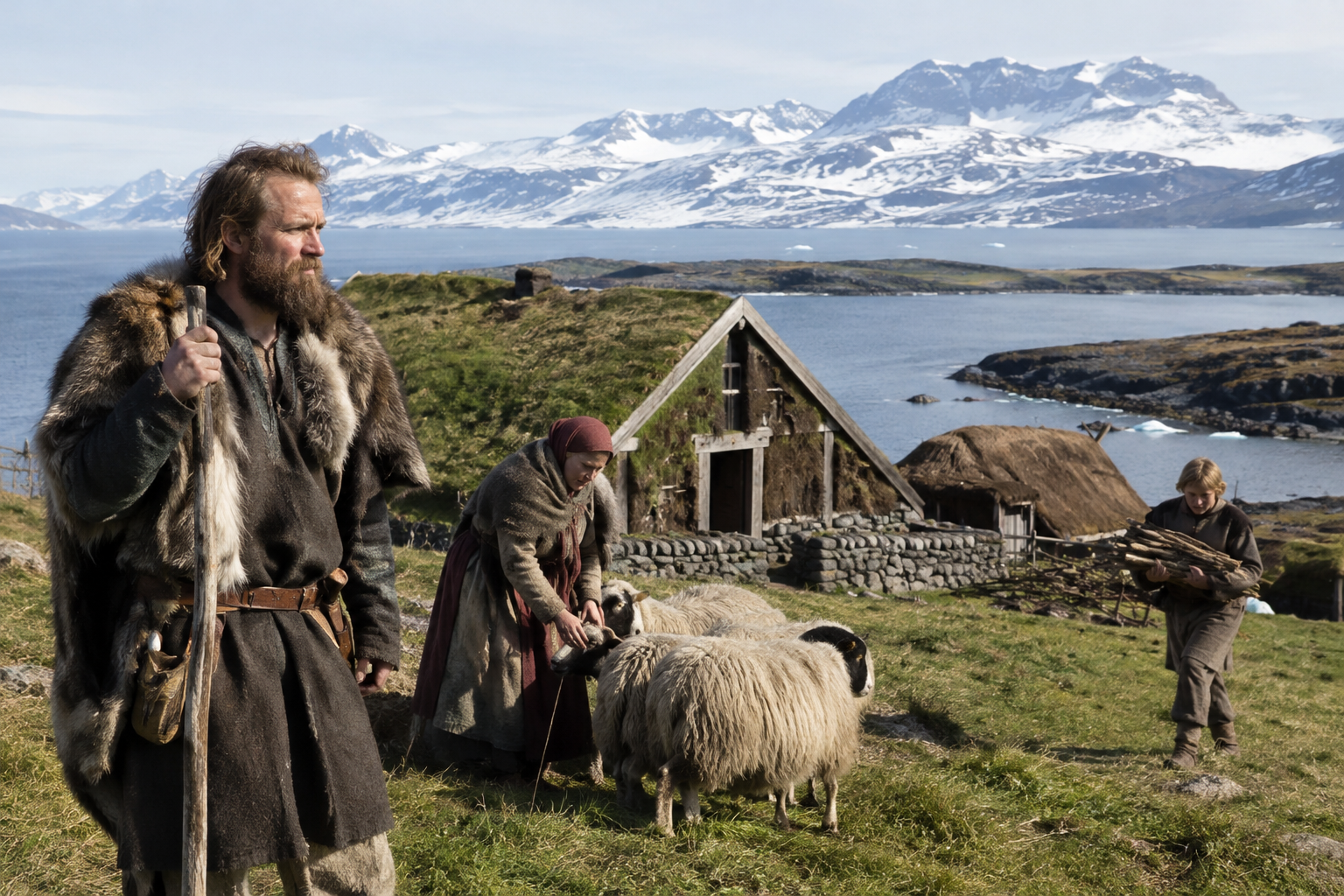
At Brattahlid in Greenland, around AD 990, one Viking settler left behind more than the traces of a farm at the edge of the known world. The ancient individual identified as VK184, from the Norse settlement landscape associated with Erik the Red's colony, is linked here with the Y-DNA haplogroup R1a1a1b1a3a1b3e4. That long string of letters and numbers is highly specific, but the setting is immediately human: a man living in one of the first European farming communities in the North Atlantic Arctic.
This is exactly the sort of case that makes ancient DNA so useful. A Y-chromosome lineage follows one direct paternal line only, not a person's whole ancestry, but when that lineage turns up in a documented Viking-Age colonial site, it helps anchor family history in a real archaeological landscape. In this case, the interest lies less in claiming a grand migration story for the precise branch itself, and more in seeing how a paternal line associated with the broader R1a world appears in a Norse frontier settlement that depended on ships, livestock, and stubborn persistence.
Brattahlid, in the Eastern Settlement of Greenland, is one of the most famous places in North Atlantic archaeology. It was not a raiding camp or a passing anchorage, but a settlement zone of farms, churches, byres, and households trying to make a Scandinavian way of life work in a harsher environment than Iceland or Norway. To place VK184 there is to place this paternal line inside one of the boldest colonial ventures of the Viking Age.
That matters because Greenland was settled by people already shaped by movement. The colonists who established these farms had roots in the wider Norse world, and that world was itself genetically mixed across Scandinavia and the North Atlantic. A reported connection between VK184 and R1a1a1b1a3a1b3e4 therefore should not be read as "the Viking haplogroup" in any simplistic sense. Rather, it is one paternal branch found within a mobile Norse population whose members carried many different Y-lineages.
For the archaeology of Greenland's first settlers, one helpful point of entry is MyTrueAncestry's discussion of Erik the Red and the first Viking settlers of Greenland, which sets the colony in its proper historical frame.
Greenland's First Viking Settlers
The exact branch name here, R1a1a1b1a3a1b3e4, is a narrow twig on the much larger R1a tree. That distinction is important. The broader R1a lineage has a deep and complicated history across Eurasia, appearing in many populations over long stretches of time, but it does not follow that every small downstream branch shares the full geographic story of the parent haplogroup in any neat or recent way.
So the responsible historical approach is modest and useful at once. This branch marks one paternal descent line present in a Viking-Age Greenlander. It does not by itself identify language, ethnicity, social rank, or nationality. Yet it does place a direct male-line ancestry signal into a very particular colonial environment: Norse Greenland at the moment when Scandinavian expansion had reached the western edge of the Atlantic world.
That bigger context of movement around the North Sea and Atlantic has been explored in broader genomic terms in MyTrueAncestry's piece on the spread of Germanic languages using ancient genomics. The point is not that one Y-line proves a language shift, but that paternal markers can sit inside much larger stories of migration, settlement, and cultural transmission.
When people imagine Greenland's Viking settlers, they often picture a single homogeneous group, as though the colony were simply Norway transferred west. The archaeology has always suggested something more complicated. The Greenland settlements were founded out of the Icelandic and Norwegian orbit, but those populations had already formed through earlier movements across Scandinavia, the British Isles, and the North Atlantic.
In other words, VK184 belongs to a colonial society, not a sealed village. Farms in Greenland were tied to sea routes, trade, ecclesiastical contacts, and family networks extending back eastward. A paternal lineage like R1a1a1b1a3a1b3e4 could arrive in Greenland not because Greenland generated it, of course, but because the settler population already contained lineages accumulated through centuries of contact and migration before the colony was founded.
That is one reason Viking-Age genetics has become so useful to historians. It complicates the old habit of treating "Norse" as if it were a purely biological category. Research on Viking and Viking-associated populations has repeatedly shown mobility and mixture on a large scale. A genetic study of Viking-world populations helped bring that wider picture into public view, even if any one sample still has to be treated carefully on its own evidence.
There is another reason VK184 is such a striking anchor for this haplogroup: place. Many Y-DNA articles must work from broad regional patterns, but Brattahlid is not vague. It is one of the best-known names in Norse Atlantic history, associated with the first generation of Greenland settlement and with the fragile success of farming life in a marginal landscape.
A paternal line found there belongs, historically speaking, to a community living at the limit of medieval European expansion. These were people building turf farms, managing livestock, and maintaining social life in a place where survival depended on careful adaptation. The colony was connected to Iceland and Norway, yet also increasingly exposed to distance, climate stress, and changing trade conditions.
That makes a sample like VK184 more than a technical label. It is a reminder that lineages now found in modern family testing can sometimes be tied to moments when history took a distinctly adventurous turn. Not every branch comes with such a dramatic but well-documented setting.
Readers interested in later North Atlantic population history may also want to compare this with MyTrueAncestry's article on Iceland's pangenome, which shows how island populations preserve both continuity and complexity.
Although this article rests on one ancient individual, that does not make the evidence trivial. Single well-placed samples can be historically eloquent when the site is important and the context is clear. Brattahlid is one such site. It tells us that this paternal branch, or a reported association with it, belongs within the Norse Atlantic sphere by the late 10th century.
That should encourage a sensible sort of imagination. If you belong to R1a1a1b1a3a1b3e4 today, you are not being told that your direct male line was "Viking" in every generation, nor that it came from Greenland specifically. What you can say is narrower and stronger: this branch is represented in a man from the earliest Norse farming world of Greenland, one of the most remarkable expansion zones of medieval Europe.
For a related Scandinavian perspective, MyTrueAncestry's piece on early medieval Finland is useful precisely because it shows how northern Europe was never genetically simple, even when later histories tried to make it so.
The most distinctive thing about R1a1a1b1a3a1b3e4 here is not an abstract origin story, but its appearance in VK184 from Brattahlid, around AD 990. It places a direct male-line marker in the very real setting of Greenland's first Norse settlements, where archaeology and history meet in a landscape of farms, sea routes, and hard limits. For anyone researching this haplogroup today, that is a valuable clue: your paternal line belongs to a human past that could reach all the way to one of the boldest settlements of the Viking Age.






Comments