Haplogroup R1a1a1b1a3a1b3
– 5 min read


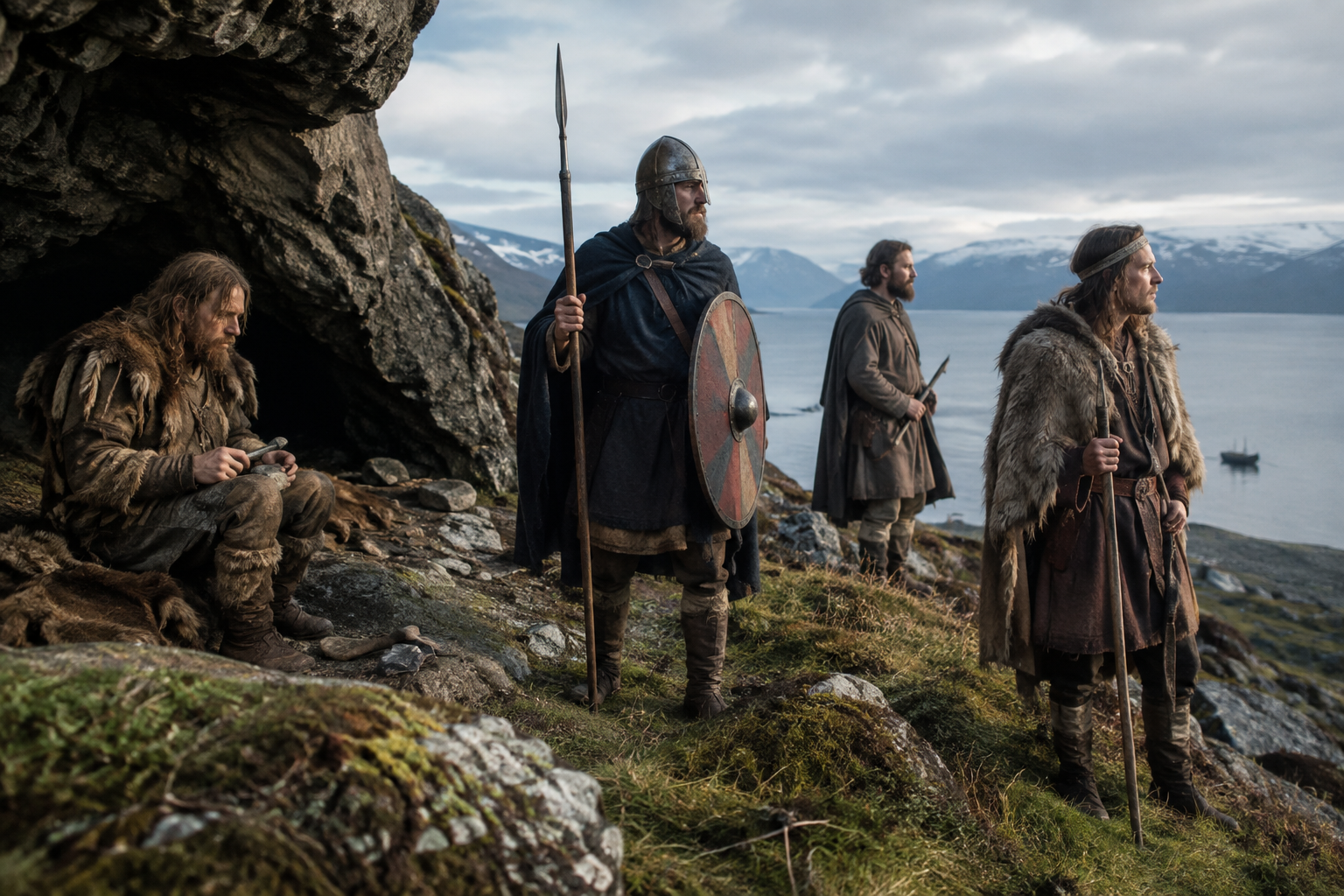
At Skongeneshelleren on the west coast of Norway, archaeologists and geneticists have been able to place one branch of Y-DNA into a very specific early medieval landscape. The individual labeled CGG107009, dated to around AD 550, belongs to the paternal line identified here as R1a1a1b1a3a1b3. That is an arresting find not because one skeleton can explain a whole people, but because it places this lineage in coastal western Norway just before the Viking Age fully took shape.
That date matters. Around the sixth century, Norway was not yet the world of longships raiding monasteries in written history, but it was already a maritime society of regional power, exchange, and mobility. A Y-chromosome lineage like R1a1a1b1a3a1b3 traces one direct paternal line only, not a person's whole ancestry, yet when the same broader male heritage also appears in later Scandinavian contexts, it begins to sketch a pattern of continuity across the centuries.
The Skongeneshelleren sample is the earliest of the three ancient individuals linked here, and that gives it special weight. Western Norway in the centuries around AD 550 was a place of sea routes rather than isolation. Coastal communities were tied together by fishing, voyaging, exchange, and local rivalries, and the region would later supply many of the men who entered the historical record as Vikings.
What makes CGG107009 useful is not that it can be turned into a saga hero, but that it anchors this paternal branch in a real pre-Viking population. A genetic study of ancient Scandinavians and related populations, available at https://www.biorxiv.org/content/10.1101/2025.02.28.640770v1, is part of the wider research context for such finds. Even without embroidering the burial with details we do not have, the sample shows that this line was present in Norway before the famous outward expansion of the Viking centuries.
A second Norwegian individual, VK390, comes from Iron Age Telemark and is dated to around AD 500. Telemark is not western coastal Norway, but inland and southeastern districts like this were hardly cut off from the wider Scandinavian world. They sat inside the same broad orbit of exchange, political competition, and shifting local identities that shaped the later Viking Age.
Taken together, VK390 and CGG107009 are a useful pair. They suggest that the paternal branch associated here with R1a1a1b1a3a1b3 was not confined to a single fjord or one isolated settlement. Instead, it appears in more than one Norwegian setting in the late Iron Age, hinting at a wider Scandinavian distribution before raiding, settlement, and state formation made the region much more visible in written sources.
This is exactly where genetics is at its most helpful when kept on a short leash. It does not tell us that these two men were close relatives, nor that they belonged to one tribe, dynasty, or language community in any narrow sense. What it does show is that one paternal branch was already established in Norway on the eve of the Viking world.
The third sample changes the scene dramatically. VK172 comes from the St. Brice's Day massacre at Oxford and is dated to AD 1002. Here the archaeological and historical setting is very different: not a Norwegian regional burial context, but one of the most chillingly documented episodes of anti-Scandinavian violence in early medieval England.
In 1002, King Aethelred II ordered the killing of Danes in England, though the scale and local enforcement varied. At Oxford, the dead recovered from St. John's College have become one of the clearest archaeogenetic windows onto that event. If VK172 is associated with the same paternal branch discussed here, then R1a1a1b1a3a1b3 was not merely present in pre-Viking Norway; it was also part of the wider Scandinavian world active across the North Sea by the early eleventh century.
That does not mean VK172 came directly from either Telemark or Skongeneshelleren, still less that one can draw a neat arrow from one grave to another. But the pattern is historically coherent. A line present in Norway around AD 500-550 later appears in a Scandinavian-linked individual caught up in events in England at the height of Viking-age entanglement.
North Sea migrations to Britain
The important thing here is precision. R1a1a1b1a3a1b3 is not the same as talking loosely about all of haplogroup R1a. R1a is a very broad and historically widespread paternal umbrella found across large parts of Eurasia. The narrower branch in this article is much more specific, and it should not automatically inherit every grand migration story ever told about R1a as a whole.
That caution is especially important in public discussions of ancient DNA. It is tempting to jump from a technical subclade name to sweeping claims about Indo-Europeans, Vikings, Slavs, steppe warriors, or royal houses. But subclades are finer branches within a much older tree, and their local histories can be quite different. What these three individuals support most clearly is a Scandinavian and North Sea story in the first millennium AD, not an all-purpose theory of Eurasian origins.
Another point worth stressing is that sample-level resolution can vary. In ancient DNA work, some individuals are assigned securely to a tight terminal branch, while others are linked more cautiously to a broader parent line or a reported downstream association. For readers exploring their own paternal ancestry, that distinction matters: a shared high-level haplogroup does not automatically mean a close genealogical relationship to any ancient person.
It would be easy to treat the two Norwegian samples as the "real" story and Oxford as an afterthought, but that would miss the historical force of the evidence. Oxford places this paternal line inside the Viking diaspora, or at least inside the population movements created by it. By AD 1002, Scandinavian mobility had transformed the North Sea into a connected political arena, with warriors, traders, settlers, and families moving between Norway, Denmark, the British Isles, and beyond.
Research on Viking-era and early medieval populations, including work connected to https://www.biorxiv.org/content/10.1101/703405v1, has helped clarify just how mixed and mobile these communities could be. The value of VK172 lies in grounding that history in a named event. This was not abstract movement on a map. It was movement that led to settlement, suspicion, political tension, and in this case, massacre.
Ancient DNA in post-Roman Britain
So what do these three samples amount to? Not a dynasty, not a clan roll, and not proof of a single family stretching from one site to the next. What they offer is something better grounded: the repeated appearance of a specific paternal branch in late Iron Age and Viking-linked Scandinavian contexts, with one of those contexts extending into England during a moment of brutal historical visibility.
For someone whose Y-DNA falls under R1a1a1b1a3a1b3, the most responsible takeaway is that this lineage has an ancient footprint in Norway before the Viking Age and remains visible in the wider Scandinavian sphere by the early eleventh century. That does not hand you a saga ancestor by name, but it does place your direct paternal line in one of the most consequential maritime worlds of early medieval Europe.






Comments