Haplogroup R1a1a1b1a3a1a9

– 6 min read


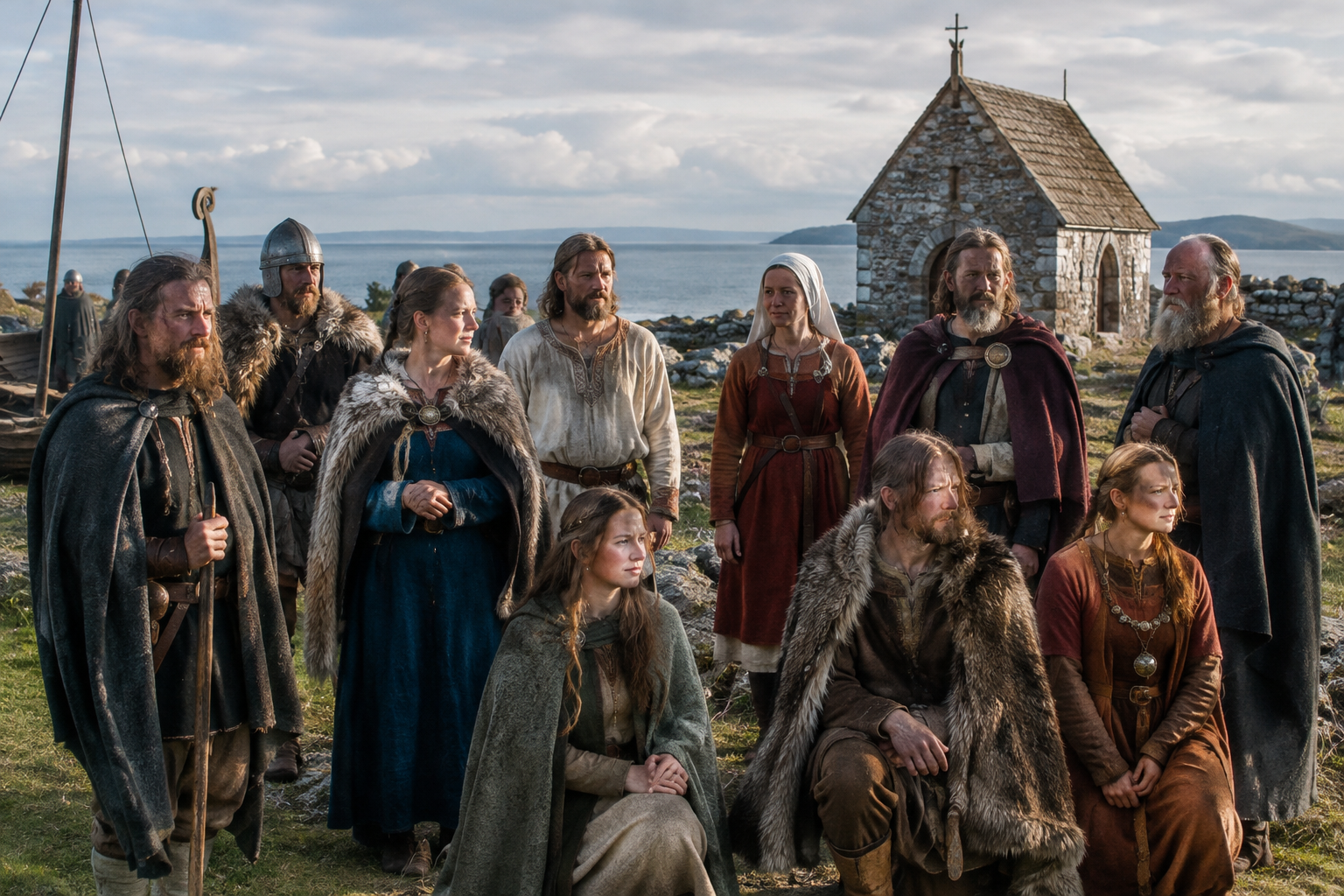
Some Y-chromosome lineages are famous because they are broad and widespread. Others are interesting precisely because they are narrow, technical-looking, and easy to miss unless you stop and ask what such a lineage is doing in the archaeological record. R1a1a1b1a3a1a9 belongs to that second category. It is a very specific branch within the wider R1a family, and that matters because the deeper one goes down the Y-DNA tree, the closer we get to tracing not humanity at large, but particular paternal histories moving through real places and periods.
That said, caution first. Y-DNA haplogroups trace one direct paternal line only: father to father to father. They do not describe a person's total ancestry, culture, language, or identity. Nor does sharing a haplogroup prove close relationship. What makes this branch compelling is not that it gives us a neat badge - Viking, Anglo-Saxon, Norse, noble, colonial - but that the ancient samples associated with it appear across northern Europe and the North Atlantic world in ways that illuminate long-running male-line continuity, mobility, and settlement.
R1a as a major Y-DNA lineage has deep importance in Eurasian population history, and it appears in many discussions of steppe-related expansions and later populations across Europe and Asia. But one should be careful not to pour the whole history of broad R1a straight into a highly specific downstream branch like R1a1a1b1a3a1a9. What we can say more responsibly is that this subclade sits inside a paternal family whose later history is strongly visible in northern and eastern Europe, and in this dataset it turns up especially in Scandinavia, the British Isles, the North Atlantic islands, and eventually colonial North America.
In other words, this is not a branch that lives only in theory on a phylogenetic chart. It appears in bodies buried in churchyards, boat-warrior contexts, early medieval cemeteries, and colonial settlements. That gives it historical texture. It suggests that by the early medieval and Viking periods, lineages within this branch - or very near it - were part of the male population of the North Sea world.
Explore Archaeogenetics and Ancient DNA
The supplied ancient individuals sketch an intriguing map. In northern Norway, CGG107022, from Adogit Pre-Viking Northern Norway Nesna Tomeide, dated 256 AD, hints that this paternal line, or one very close to it, was present in the far north well before the Viking Age proper. That is important. It reminds us that Viking expansion did not spring out of nowhere in the late 8th century; it was built on older populations already established along the Scandinavian coasts and sea-lanes.
A few centuries later, another northern Norwegian sample, CGG107030 from Viking Age Halogaland Holm, dated 798 AD, places the lineage in exactly the kind of maritime setting from which Scandinavian mobility became historically conspicuous. Halogaland was no romantic edge of nowhere. It was part of a connected seaborne world stretching along the Norwegian coast and outward into the Atlantic.
Then there is VK551, from Vendel Age Saaremaa Salme II-U, dated 725 AD. Saaremaa, in the eastern Baltic, is one of those places that regularly turns up when archaeology punctures old tidy stories about fixed peoples staying put. This was a contact zone of warriors, traders, raiders, and local communities. A paternal lineage appearing there fits a world of movement around the Baltic rather better than a world of neatly bounded ethnic blocks.
The British evidence is equally revealing. SED006, from Anglo-Saxon Sedgeford England Norfolk, dated 600 AD, and POH006, from Early Medieval Polhill Kent England, also dated 600 AD, show this paternal signature in early medieval England. That does not make the haplogroup "Anglo-Saxon" in any exclusive sense, but it does show that branches of this northern European male-line cluster were present in communities forming post-Roman England. Norfolk and Kent, both deeply tied to North Sea exchange, are exactly where one might expect such evidence to surface.
Read About Anglo-Saxon Genetic Legacy
By the Viking and post-Viking centuries, the pattern broadens. VK35, from Viking Age Skara Varnhem Sweden, dated 1050 AD, and KPN002, from Post Viking Era Denmark St Clemen Zealand Denmark, dated 1100 AD, keep the branch firmly anchored in Scandinavian society into the Christian middle ages. These are not merely raiding centuries now, but centuries of consolidation, conversion, dynastic politics, and settlement continuity.
Further west, the island evidence becomes particularly vivid. GTE-A1, described as Viking Gaelic Mix Iceland and dated 935 AD, captures something essential about the North Atlantic colonies: they were not ethnically pure outposts but mixed communities. The phrase "Viking Gaelic Mix" matters because Icelandic settlement drew together people with Scandinavian and Gaelic backgrounds in ways both saga literature and genetics continue to reveal.
VK244, from Medieval Age Faroe Islands Sandoy Church, dated 1600 AD, shows this paternal line persisting in the Faroes long after first settlement. That is useful evidence for continuity in a small island population. Likewise, VK546 from Iron Age Islandbridge Dublin Ireland, dated 725 AD, places the lineage in Ireland before or around the beginnings of the Viking Age transformations that would later reshape Dublin into a major Hiberno-Scandinavian center.
Finally there is I15285, from Historic St. Mary City Chapel Field Cemetery Maryland, dated 1634 AD. Suddenly the story is not only Scandinavian, Anglo-Saxon, or Viking Age. It is Atlantic. A paternal line seen earlier in Norway, England, Denmark, Sweden, Ireland, Iceland, and the Faroes appears again in the early colonial Chesapeake. This does not prove one tidy chain of descent from any particular ancient man. But it does show how a northern European male line could pass through centuries of migration until it surfaces in the colonial Americas.
Discover Colonial St. Mary's City DNA
The later historical association supplied here is not with a medieval warrior dynasty but with the House of Newton Barrs Court in Warmley, South Gloucestershire. That is useful in a different way. Barrs Court began as a grand house built in the 1570s for Anne Smyth; her husband, Henry Smyth, was a Bristol merchant and mayor. The estate later passed by marriage to the Barrs family, and much of the house eventually fell into ruin, though important Elizabethan portions and traces of formal gardens survived.
There is a temptation, when discussing Y-DNA and historic estates, to leap straight from haplogroup to house and declare a paternal dynasty unveiled. History is usually less obliging. The supplied material does not prove that every male in the Smyth or Barrs family carried R1a1a1b1a3a1a9, nor that the house itself is some genetic monument. What Barrs Court does provide is a setting in which to think about how paternal lines moved into the early modern British elite and merchant classes: through trade, office, property, and marriage.
And Barrs Court carries another important reminder. The wealth that built such houses was not innocent. The estate's history includes trade, colonial ventures, and links to slavery. So if this haplogroup's story reaches from early medieval North Sea populations to 17th-century Maryland and an ambitious Gloucestershire house, it also reaches into the moral realities of empire. Genetics can connect periods; it does not excuse them.
What makes R1a1a1b1a3a1a9 historically interesting is not a claim to glamour, but its distribution across a recognisable northern maritime zone. The ancient evidence supplied here links Norway, Sweden, Denmark, England, Ireland, Iceland, the Faroes, and colonial Maryland. That is a remarkable geographical arc. It suggests a paternal lineage at home in the worlds shaped by the North Sea and North Atlantic: migration-period settlements, Viking-era mobility, medieval island communities, and early colonial expansion.
Just as important is what the evidence does not do. It does not prove that a modern tester with this haplogroup descends from CGG107030 or GTE-A1. It does not prove descent from the Smyths, the Barrs family, or any noble or gentry house. Ancient DNA and written genealogy answer different questions. Genealogy tells us who documents say your forebears were. Ancient DNA shows that your paternal line belonged to populations moving through certain landscapes long before surnames, parish registers, and heraldry.
For readers interested in the wider Scandinavian and island setting, the Faroese angle is especially worth pursuing, because later island continuity can sometimes preserve lineages that help us understand earlier settlement patterns.
If your Y-DNA belongs to R1a1a1b1a3a1a9, you are looking at one paternal thread in a much larger historical fabric: one that appears in pre-Viking northern Norway, early medieval England, Viking Age Scandinavia, Atlantic island communities, and the colonial Chesapeake. That is not a complete identity, but it is certainly a historical clue worth following.
MyTrueAncestry lets you compare your DNA with ancient individuals and populations from the archaeological record, offering a more grounded sense of where your deeper ancestry may fit into human history. Those matches do not necessarily prove direct descent or membership in a later noble family, but they can place your family story beside real excavated people from the past.






Comments