Haplogroup R1a1a1b1a3a1a7a
– 5 min read


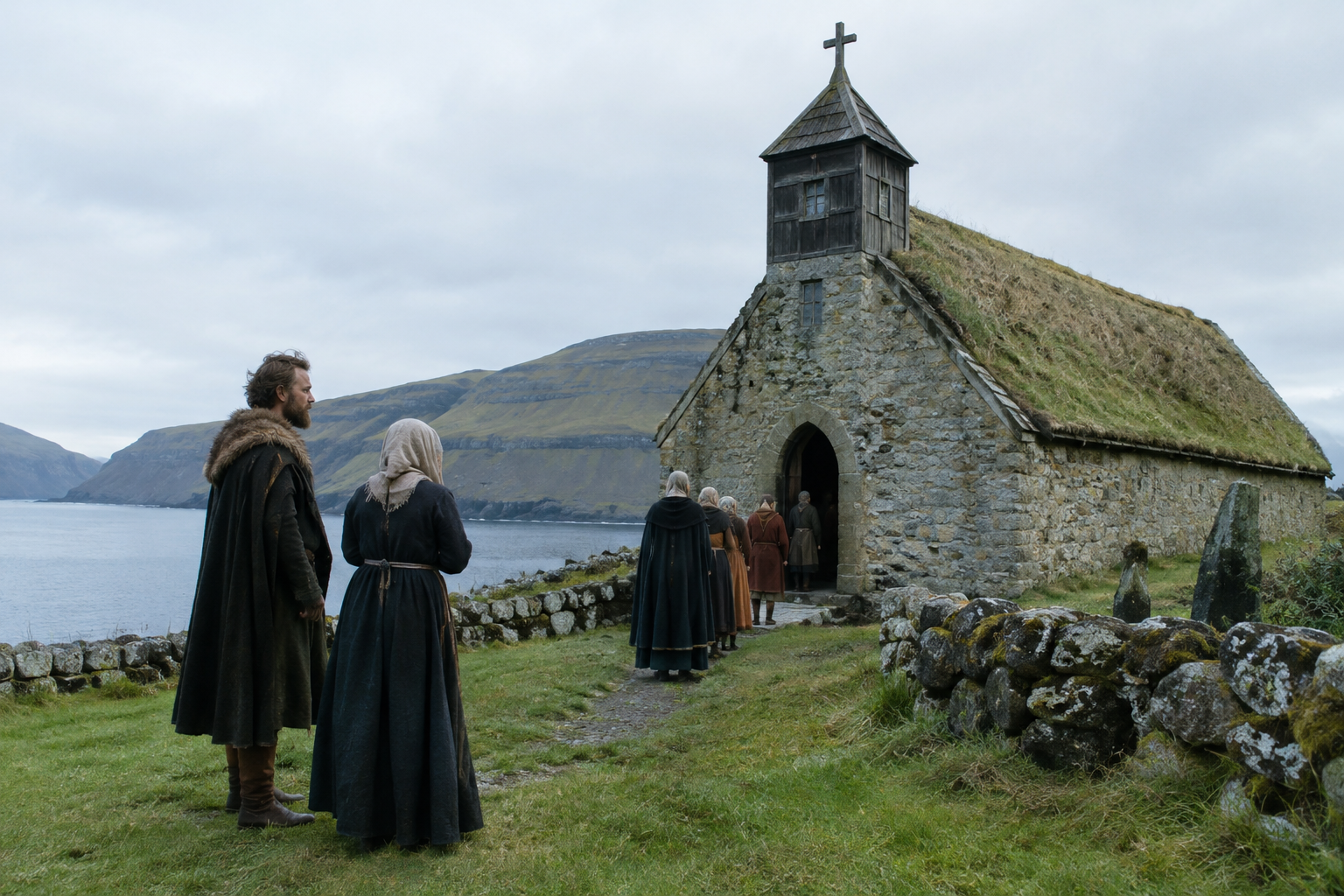
At Sandoy Church in the Faroe Islands, one ancient Y-chromosome result stands out for the way it turns a tiny island burial into a much larger North Atlantic story. The individual known as VK237, dated to around AD 1600, has been associated here with the Y-DNA haplogroup R1a1a1b1a3a1a7a - a very specific branch nested inside the much wider R1a family.
That matters because the Faroe Islands are one of those places where archaeology, history, and genetics are always in lively conversation. The islands were settled within the Viking world, shaped by movement across the Norwegian Sea, and later folded into a Christian, North Atlantic society that was never isolated in any simple sense. A paternal lineage found in a medieval or early modern Faroese burial does not tell us everything about that person's ancestry, but it does preserve one direct male line across centuries of migration, marriage, and island life.
The site itself is important before we even get to the haplogroup. Sandoy is one of the southern Faroese islands, and church burials belong to a landscape already transformed by Christianity, parish life, and Scandinavian political connections. By about AD 1600, this was no longer the first age of settlement; it was a mature island community with deep local roots and long overseas ties.
VK237 therefore should not be treated as a "Viking founder" in any crude sense. He is later than the first Norse colonization by several centuries. Yet that is precisely what makes the sample useful: it shows that paternal lines linked to the wider R1a world were still present in the Faroes long after the initial settlement period, surviving into an early modern Christian context.
An ancient DNA study on Faroese material and population history has helped frame these broader questions about ancestry and continuity in the islands, and the preprint associated with this sample can be found here: https://www.biorxiv.org/content/10.1101/703405v1. The key point for readers is a modest one: VK237 is valuable not because he single-handedly explains Faroese origins, but because he adds one documented paternal line to a region where even a single well-contextualized burial can sharpen the picture.
The exact label R1a1a1b1a3a1a7a is a fine-resolution branch name, and that precision is both useful and potentially misleading if handled carelessly. Useful, because it places a paternal line on a narrower twig of the Y-chromosome tree. Misleading, because readers may be tempted to attach the entire ancient history of all R1a lineages to one late Faroese man. That would go too far.
The broader haplogroup R1a is well known across large parts of Eurasia, with different sub-branches appearing in very different historical settings. Some are prominent in eastern and central Europe, some in Scandinavia, some much farther afield. A late sample such as VK237 cannot by itself tell us when this exact branch first arrived in the Faroes, nor whether it came through Norway, the British Isles, or later North Atlantic movement within the Danish-Norwegian realm.
Still, the result is historically suggestive. In a North Atlantic island population famous for its mixed settlement history, this branch fits the wider truth that paternal ancestry in the region was never made up of one single line. The Faroes were connected to Norway most obviously, but also to the British and Irish seas, and to later maritime networks that tied remote communities into a wider kingdom and economy.
Popular imagination tends to freeze the Faroes in the age of longships. The archaeology is more interesting than that. Church sites, later burials, and changing settlement patterns remind us that island history did not stop when the saga age ended. By AD 1600, the Faroes had lived through Christianization, ecclesiastical organization, plague-era demographic shocks, commercial change, and the steady pressures of North Atlantic weather and politics.
That is the world to which VK237 belonged. His haplogroup sits not in a heroic founding moment, but in a community that had already been local for generations. If your own paternal line falls under R1a1a1b1a3a1a7a, the real historical lesson is not that you descend from one famous raider, but that your line may have participated in the layered, ordinary, persistent history of North Atlantic settlement.
This is one reason Faroese genetics has attracted so much interest. Island populations can preserve unusual combinations of continuity and mobility. They are small enough for founder effects to matter, yet connected enough that outsiders, marriages, trade, and clerical or administrative movement continue to reshape the population over time.
The Faroes are especially relevant to discussions about how language, identity, and ancestry interact. Old Norse and its descendants became dominant in the islands, yet the people who carried that language were not genetically uniform. Ancient and modern research across the North Atlantic has repeatedly shown that Scandinavian expansion involved mixture, not a neat transfer of one people into empty lands.
That wider theme is explored in related work on how genomics can illuminate the spread of Germanic languages. For the Faroes, the value of VK237 lies in adding a paternal data point within that larger world of Scandinavian-speaking expansion and regional blending. A Y-chromosome branch can travel with a language community, but it does not define that language community on its own.
That distinction matters because the Faroes are often presented as "Norse" in a way that sounds simpler than the evidence really is. They were Norse-speaking, certainly. But the formation of island populations across the Viking and post-Viking North Atlantic involved people of different backgrounds entering new social worlds, adopting shared institutions, and leaving descendants whose genes do not sort neatly into medieval labels.
It is easy to dismiss a single sample as too slight to say anything worthwhile. But ancient DNA does not work like a saga in which one hero explains the whole plot. Its strength is cumulative. A burial like VK237 becomes meaningful because it can be set beside archaeology, settlement history, and broader regional genetic work.
In that sense, VK237 gives us a glimpse of continuity rather than spectacle. He shows that the paternal branch represented here was present in the Faroe Islands in a documented burial context around AD 1600. That is a real historical anchor. For descendants and family historians, such anchors matter because they connect a lineage not merely to an abstract map of haplogroups, but to an inhabited place: a church, an island, and a lived community in the North Atlantic.
For this haplogroup, the most distinctive evidence here is not an emperor, a saga hero, or a royal dynasty, but a named individual from Sandoy Church: VK237, living in the Faroes around AD 1600. That makes R1a1a1b1a3a1a7a part of the documented human history of the North Atlantic islands, in a period when Viking settlement had long since become local society. If this is your paternal branch, the responsible takeaway is a strong connection to the layered Scandinavian and North Atlantic past - one shaped by continuity, mixture, and island life rather than by a single dramatic origin story.






Comments