Haplogroup R1a1a1b1a3a1a3b2

– 5 min read


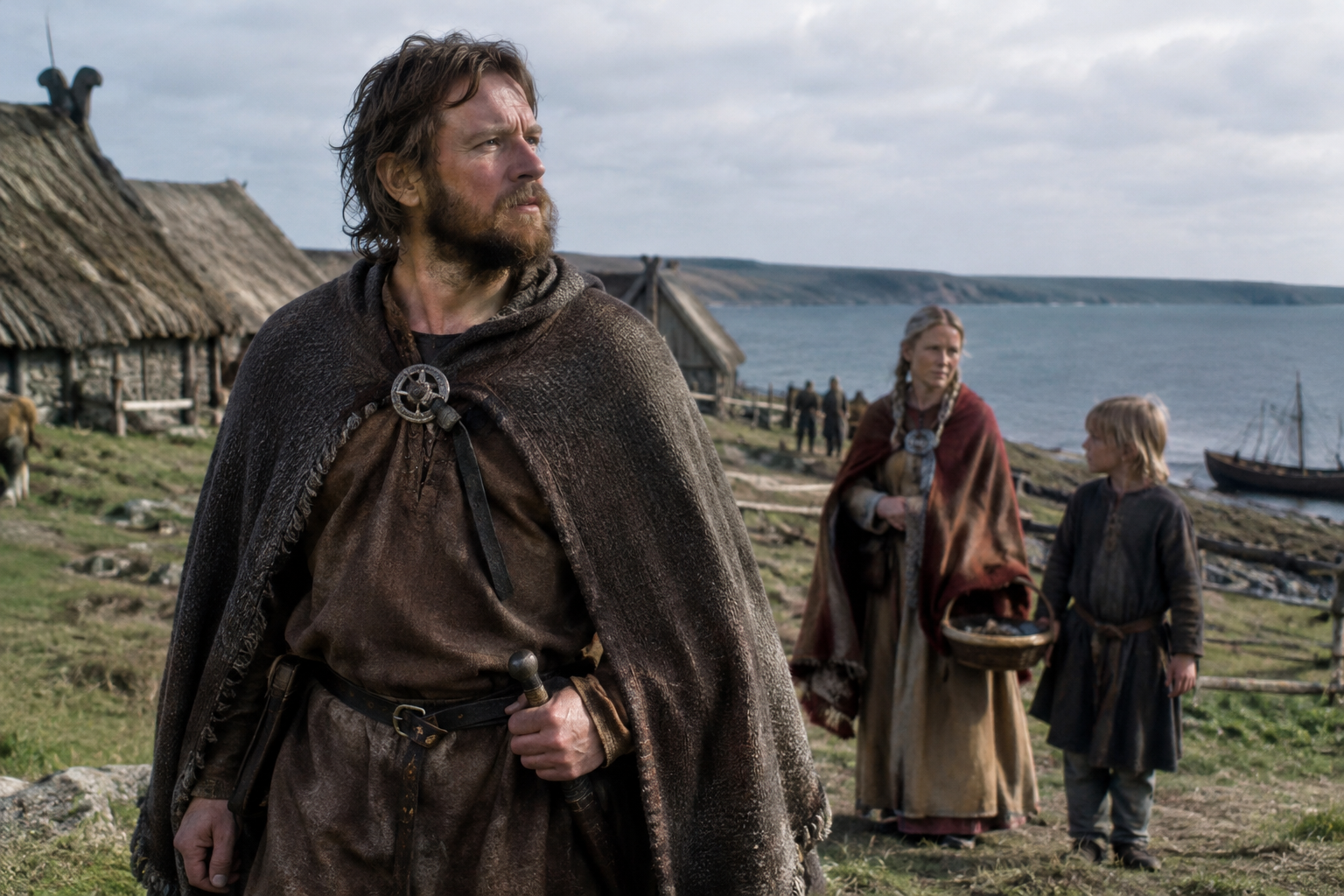
At Newark Bay on Orkney, one Viking Age burial has become unexpectedly important for the history of a very specific paternal line. The individual known as VK205, dated to around AD 935, places the Y-DNA haplogroup R1a1a1b1a3a1a3b2 in a Norse world that was anything but neatly Scandinavian in a modern national sense. Orkney in the 10th century was a maritime crossroads: politically tied to the Viking sphere, geographically rooted in northern Scotland, and connected by sea to Norway, Ireland, the Hebrides, and beyond.
That matters because a Y-DNA haplogroup is a record of one direct paternal line only, not a person's whole ancestry or identity. Even so, the appearance of R1a1a1b1a3a1a3b2 in a Viking Age Orkney burial is historically suggestive. It places this lineage in one of the most mobile and culturally entangled regions of early medieval Europe, where family lines could move with traders, raiders, settlers, and local elites across the North Sea zone.
The sample VK205 comes from Newark for Brothwell in Orkney and is assigned here to the Viking Age, around AD 935. That date sits in the heart of the Norse period in the islands, when Orkney was part of a wider seaborne polity that linked northern Britain to Scandinavia. In historical terms, this was the age of the earls of Orkney, but archaeology keeps reminding us that the population was broader, more local, and more mixed than saga stereotypes suggest.
Ancient DNA studies of the Viking world have been especially useful here because they show that "Viking" is not the same thing as a single genetic type. Research on Viking Age populations, including work circulated at https://www.biorxiv.org/content/10.1101/703405v1, helped establish that communities operating within the Norse cultural sphere could contain varied ancestries and multiple paternal lineages. That wider context makes VK205 interesting: not as a lone hero of a saga, but as evidence that this branch of R1a was present in the lived population of Viking Orkney.
The full label R1a1a1b1a3a1a3b2 is a very narrow terminal branch inside the much larger haplogroup R1a. That distinction is crucial. R1a as a whole has a long and complicated prehistoric and historic distribution across Eurasia, but those broad patterns should not be lazily pasted onto every tiny downstream branch.
For a lineage this specific, the sensible question is not "where did all R1a come from?" but "where do we see this branch turning up in actual dated people?" In the evidence given here, the key securely described appearance is Viking Age Orkney. That does not prove the branch originated there, nor does it prove every later carrier descends from a Norse settler. It does, however, anchor the lineage in a real early medieval North Atlantic context.
Orkney is often imagined as remote, but in the Viking Age it was more like a busy pier than a distant edge. Ships moved constantly between western Norway, the Northern Isles, Caithness, the Irish Sea, and the North Atlantic colonies. People married, fostered children, built alliances, and shifted allegiance across these waters.
That setting is exactly why a paternal lineage from Orkney can matter out of proportion to the number of samples. A male line found here may reflect movement from Scandinavia into Britain, from Britain into a Norse-controlled island society, or a family that had already been mixed and mobile for generations before burial. The islands were not simply colonized and frozen; they were continuously connected.
Recent work on Britain's first millennium has repeatedly shown how misleading older ethnic labels can be when treated as biological categories. Ancient genomes from Roman and early medieval Britain point instead to local continuity mixed with real but varied migration. Orkney's Norse-period burials belong in that same conversation.
Roman to early medieval Britain
Within popular genealogy, R1a is sometimes treated as though it automatically signals one particular people. Archaeology is less romantic and more useful. In the Viking Age, paternal lines associated with R1a appear in several northern and eastern European settings, and that fits what historians already know about Norse expansion: it involved networks reaching into the Baltic, the North Atlantic, and river routes far into eastern Europe.
That broader picture helps explain why a branch like R1a1a1b1a3a1a3b2 in Orkney should catch the eye. The Viking world was never only westward-looking. Scandinavian communities had eastern connections too, and their lineages could circulate widely before appearing in places like the Northern Isles. The presence of this haplogroup in VK205 therefore sits comfortably within a Viking Age world of long-distance mobility rather than a sealed island population.
This is also where language and lineage must be kept separate. A man buried in Viking Age Orkney may have spoken Old Norse, a local Brittonic language, Gaelic, or lived in a multilingual household. His Y-DNA traces one paternal line; it does not by itself tell us what language he used, how he dressed, or whether he thought of himself primarily as Norse, Orcadian, or something more local and situational.
Germanic languages and genomics
Orkney's archaeology matters because it preserves the overlap of older island populations and incoming Norse rule. By the 10th century, burial evidence, settlement patterns, and material culture all point to a society shaped by Scandinavian influence but not emptied of its earlier inhabitants. Genetic results from northern Scotland and the islands increasingly support this picture of blending rather than replacement.
That makes VK205 especially valuable as a point of comparison for anyone whose paternal line falls within R1a1a1b1a3a1a3b2. The sample does not offer a simple badge reading "you are descended from Vikings." What it offers instead is a historically grounded anchor: this branch was present in a Norse-period community at one of the key hinges between Scandinavia and Britain.
For readers interested in the deeper population history of the far north, northern Scotland and its islands have yielded evidence stretching from Neolithic kinship to medieval mobility. The Viking Age sits on top of those much older foundations, which is one reason the region is so rewarding archaeologically.
One sample is not a dynasty, and one burial cannot stand for all of Orkney. But ancient DNA rarely works by handing us complete populations in tidy boxes. More often it gives us sharply dated glimpses. VK205 is one of those glimpses, and it places R1a1a1b1a3a1a3b2 in an early medieval island society tied to the Norse Atlantic.
For someone researching this paternal haplogroup today, that is the real value of the evidence. It links a living line to a documented historical setting where sea travel, settlement, and cultural mixing were routine facts of life. Not certainty about one named ancestor, but a firmer sense of the world in which one branch of your father's line was already moving more than a thousand years ago.






Comments