Haplogroup R1a1a1b1a3a1a1a1

– 6 min read


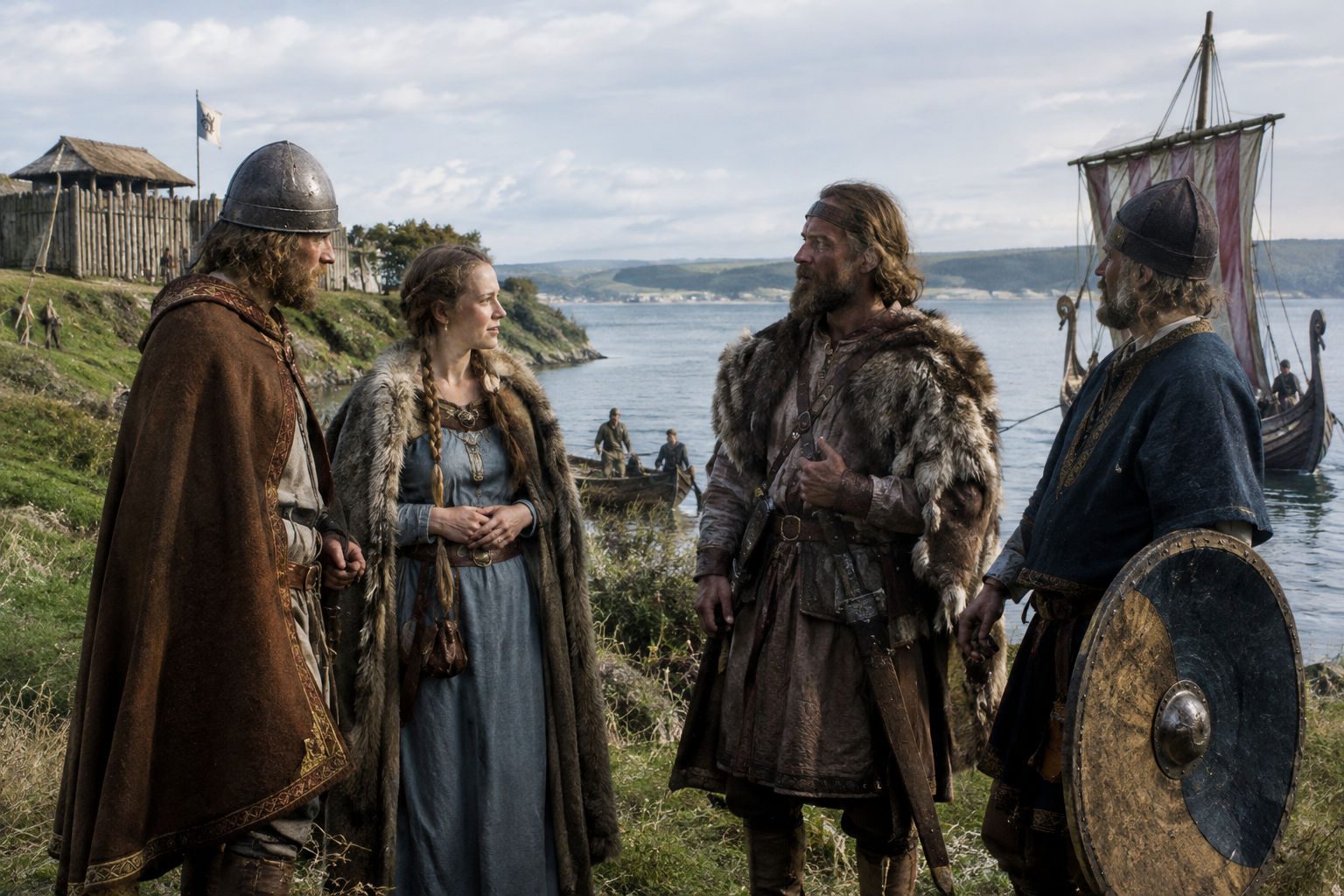
Some Y-DNA haplogroups are so broad that they sweep across half of Eurasia. Others, like R1a1a1b1a3a1a1a1, belong to a much narrower twig on the paternal tree, the sort of branch that becomes interesting precisely because it lets us ask a more focused historical question: not simply where a vast population once moved, but how one particular male line appears in very different medieval settings.
That matters because Y-DNA follows the direct paternal line only: father to son, and so on back through time. It is a powerful tool for tracing one strand of ancestry, but only one strand. It does not describe a person's whole genetic background, still less their culture, language, or identity. Yet when a rare or specific branch turns up in ancient DNA from Hungary, Sweden, and Iceland, it gives us something wonderfully concrete: evidence that one paternal lineage, or a closely related set of lineages, was present in the connected worlds of the Baltic, the North Atlantic, and the European mainland in the early medieval period.
At a broader level, this branch sits within haplogroup R1a, one of the major Y-chromosome lineages found across large parts of Eurasia. But caution is needed. The long history often told for R1a as a whole cannot simply be pasted onto this very specific downstream subclade. What we can say more safely is that by the Viking Age and the Carolingian period, lineages on this branch were already part of the male genetic landscape of northern and eastern Europe and the wider networks that joined them.
How ancient DNA decodes the past
The wider R1a family is often discussed in connection with prehistoric movements across the Eurasian steppe and later expansions into central, eastern, and northern Europe. In the grand historical version, this is the world of Bronze Age mobility, shifting frontiers, and the long afterlife of steppe-related ancestry. But our subclade, R1a1a1b1a3a1a1a1, should be handled more modestly. Without inventing a homeland, age, or route, the safest reading is that it belongs to a paternal tradition already established within the populations that later fed into medieval Europe.
What makes that significant is the geography of the ancient samples linked with it. They do not come from a single valley or one tightly bounded kingdom. Instead they appear in places that were tied together by travel, warfare, trade, and settlement: Carolingian-era Hungary, Viking Age Gotland, and Viking Age Iceland. This is not proof of direct kinship between those men, of course. Sharing a haplogroup can mean a shared paternal ancestor far back in time, not a documented family relationship. But it does place them in the same broad paternal story.
That story is, in part, a northern European one. The Baltic was not a fringe. It was a highway. Gotland sat in the middle of exchange networks linking Scandinavia to the eastern Baltic, river routes into eastern Europe, and markets farther south. Iceland, meanwhile, was settled from that same Viking world. Medieval Hungary, especially in regions shaped by post-Roman and Carolingian power, stood at another crossroads entirely, where western, central, and steppe-connected influences met.
In other words, this haplogroup's known ancient appearances suggest not an isolated lineage but one embedded in mobile societies.
The sample AHS18, from Medieval Hungary Carolingian Empire Zalavar Varsziget, dated to 850 AD, anchors this lineage in a frontier zone of the early medieval continent. Zalavar, in the orbit of the Carolingian world, lay in a region where political authority, conversion, and migration were all in motion. A paternal lineage found here belongs to a society shaped by contact: not just local continuity, but the traffic of peoples and institutions through the Carpathian Basin. It reminds us that medieval Hungary was not a sealed ethnic box but an active borderland.
Then there is VK48, from Viking Age Gotland Kopparsvik Sweden, dated to 975 AD. Gotland is one of those places archaeologists love because it keeps producing evidence that the Viking Age was not merely about raiding monks on the coast of Britain. It was also about merchants, sailors, burial customs, and family strategies in a maritime economy. A Y-line appearing there places this branch in one of the best connected islands in northern Europe.
And then we move even farther out, to VK129, from Viking Age Ingiridarstadir Iceland, dated to 1050 AD. Now the setting is the North Atlantic edge of the Viking world, but only geographically. Historically Iceland was tied by kin, ships, law, and memory to Scandinavia and the British Isles. A paternal lineage present there shows just how far these connected male lines could travel within a few centuries.
Taken together, AHS18, VK48, and VK129 do not prove a neat migration arrow. History is rarely so tidy. But they do show that lineages within this branch were present across a striking range of medieval European settings, from inland political frontiers to Baltic trading spheres to Atlantic colonies.
If one had to choose the most suggestive pairing here, it would be Gotland and Iceland. Not because they prove a father-to-son chain, which they do not, but because they belong to the same wider Viking Age world of movement. Men, goods, stories, and lineages were carried along sea routes that linked the Baltic to the North Atlantic. A haplogroup found in both settings fits that larger historical picture very comfortably.
For readers interested in the Scandinavian side of that world, Gotland is especially tantalizing. The island turns up repeatedly in archaeological discussions because it preserves evidence for long-term occupation, trade, and distinctive burial practice.
Discover ancient DNA from Gotland
Hungary adds a different dimension. The appearance of this lineage at Zalavar suggests that the branch was not restricted to Scandinavian settings. That is hardly surprising in a medieval Europe full of movement, alliance, service, and resettlement. But it is historically valuable. It helps guard against the lazy habit of assigning a Y-line to one people, one language, or one flag. Ancient DNA keeps warning us that the past was more mixed, more mobile, and more interesting than tidy nationalist stories allow.
How does all this connect with later noble families? Carefully, and without pretending that a shared haplogroup is a signed medieval pedigree.
The supplied historical association here is Clan MacDuff, linked with Macduff's Castle near East Wemyss in Fife. The castle is a dramatic ruin on the Scottish coast, but its interest lies partly in the gap between name and certainty. Despite the famous association, it was probably not the seat of the early medieval MacDuff earls of Fife. The oldest surviving remains are mainly from the 14th century, and the site later evolved with 16th- and 17th-century alterations into more of a laird's house than a simple fortress.
That is very Scottish, really: a place where noble memory, later rebuilding, and local legend all become entangled. The castle overlooks the Firth of Forth, a region long connected to the sea routes of the North Sea world. It passed through several noble owners, fell into ruin, and acquired stories linking it to Shakespeare's Macduff and to the Green Lady. Archaeology and folklore, in other words, now inhabit the same cliff edge.
Genetically, one must be careful. The historical association of Clan MacDuff with this haplogroup does not prove that every MacDuff, still less every later owner of the castle, carried R1a1a1b1a3a1a1a1. Noble families often contain adoptions, maternal inheritances, undocumented events, cadet branches, and plain old historical confusion. But as a regional and cultural connection, it is intriguing. A medieval Scottish clan associated with a coastal stronghold in Fife belongs to the same broad northern seascape that linked Scandinavia, the British Isles, and the North Atlantic.
The real value of R1a1a1b1a3a1a1a1 is not that it hands us a romantic fairy tale about one heroic founder striding across Europe. It is better than that. It shows how a paternal lineage can appear in very different historical settings and force us to think about networks rather than boxes.
With AHS18 in Carolingian-era Hungary, VK48 on Viking Age Gotland, and VK129 in Viking Age Iceland, we are looking at a lineage present in worlds of mobility and contact. With Clan MacDuff and Macduff's Castle, we see how later historical memory anchors identity in landscape, architecture, and story. Genetics and castles do different jobs. DNA traces biological lines of descent; castles preserve social memory, power, and place. Put them together carefully, and they illuminate each other.
Readers interested in how these northern movements fed into Britain may also enjoy a wider look at long-run North Sea connections.
Explore North Sea migrations to Britain
That, perhaps, is the chief lesson of this haplogroup. A Y-line is not a nationality. It is not a coat of arms. It is not a guarantee of descent from a particular earl, raider, or laird. But it is a thread, and when ancient DNA preserves enough threads, the historical fabric becomes sharper.
If your own paternal ancestry connects to lineages like this one, MyTrueAncestry can help place that result in a deeper archaeological setting. Uploading your DNA may reveal similarities to ancient individuals and historical populations like those discussed here, offering fresh clues about your past even when it cannot prove direct descent from a specific noble house or medieval clan.






Comments