Haplogroup R1a1a1b1a3a1a1

– 6 min read


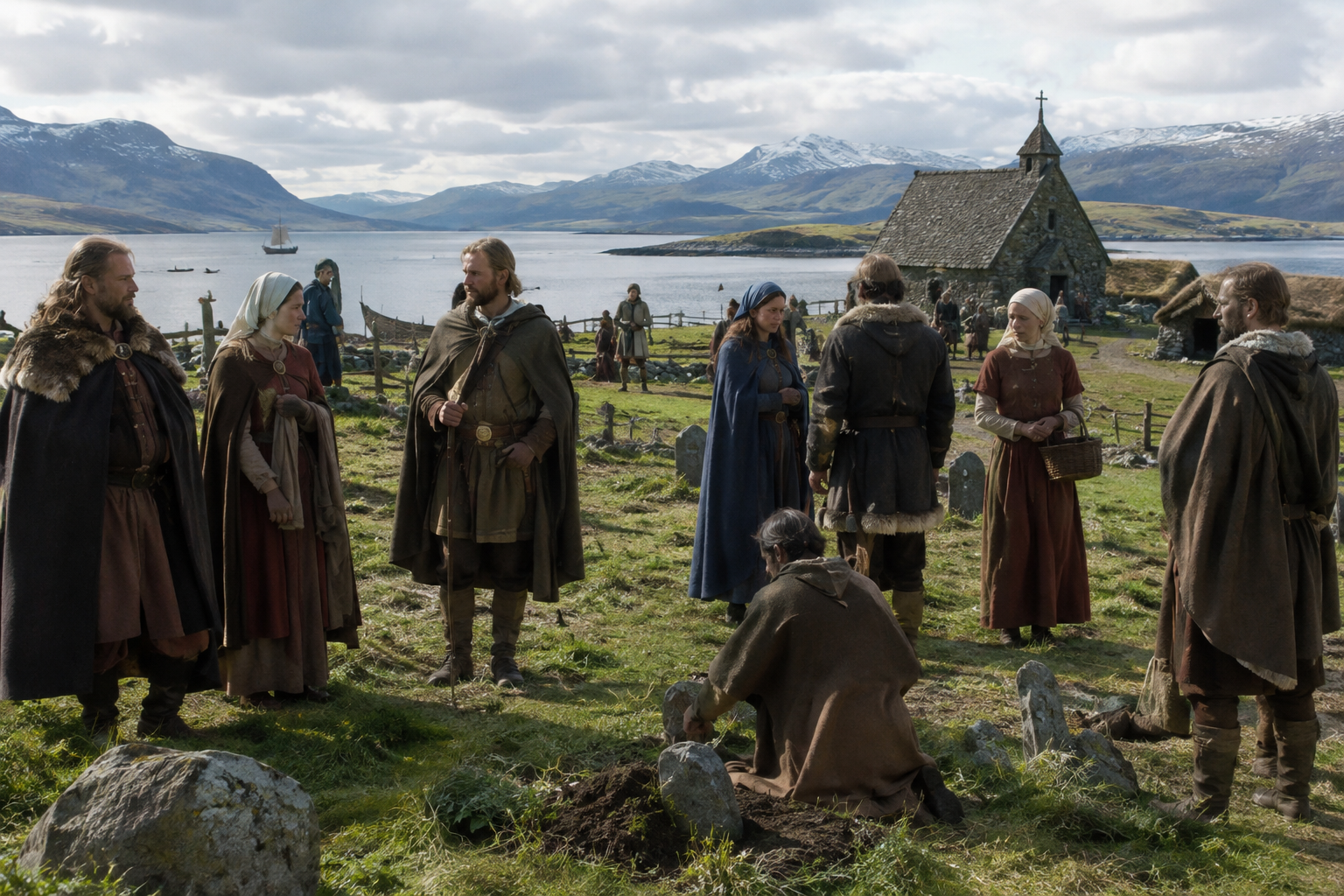
Some Y-DNA branches announce themselves with fanfare: they sit inside famous expansions, appear in royal burials, or turn up again and again in the big narratives of European prehistory. Haplogroup R1a1a1b1a3a1a1 is more delicate than that. It belongs within the wider R1a world, a major paternal lineage with deep importance across Eurasia, but this very specific downstream branch has to be handled carefully. We should not simply pour the whole history of broad R1a into this narrower twig and call the job done.
That, in fact, is what makes it interesting. Y-DNA traces one direct paternal line only: father to father to father, one thread among thousands in a person's ancestry. Yet when a branch like R1a1a1b1a3a1a1 appears in ancient and medieval contexts around the North Sea, the Baltic, Britain, Ireland, Iceland, Hungary, and even colonial North America, it hints at something historically vivid: not a single tribe or dynasty, but a chain of male lines moving through ports, farms, churches, war bands, and frontier lordships over many centuries.
R1a is a well-known Y-chromosome haplogroup with a broad Eurasian distribution and a long association in genetic research with steppe-linked Bronze Age expansions and later movements across central, eastern, and northern Europe. That much is firmly established at the level of the parent lineage. What is more difficult, and more responsible, is narrowing the focus to R1a1a1b1a3a1a1 without inventing certainty we do not have.
For that reason, the safest historical reading is not that this branch "belongs" to one people, language, or kingdom, but that it seems to sit comfortably within the northern and northeastern European worlds where later R1a lineages are well documented. The ancient samples supplied here suggest a particular relevance to the early medieval and Viking-age North Atlantic and Baltic spheres, with appearances also in Anglo-Saxon England and the Carolingian frontier zone of Hungary.
In other words, this is less the story of a single founding event than of recurring movement: seaways, settlement, raiding, intermarriage, and the patient spread of paternal lines through historical communities.
Learn How Ancient DNA Decodes History
The supplied ancient DNA makes one point immediately clear: this paternal line, or a very near part of its family tree, was not confined to one corner of Europe. One of the most striking early anchors is VK551, from Vendel Age Saaremaa Salme II-U, dated 725 AD. Saaremaa, in present-day Estonia, sits at a strategic Baltic crossroads. The Salme finds are famous because they illuminate a martial and mobile world in which Scandinavia and the eastern Baltic were tied together by sea routes, conflict, and exchange.
From there the trail runs north and west. CGG107030 from Viking Age Halogaland Holm, dated 798 AD, places the lineage in northern Norway at the opening of the Viking Age. VK48 from Viking Age Gotland Kopparsvik Sweden, dated 975 AD, and VK35 from Viking Age Skara Varnhem Sweden, dated 1050 AD, show it again in key Scandinavian settings. Gotland was no backwater; it was one of the great Baltic trading hubs, while Varnhem evokes the Christianizing and state-forming world of later Viking-age Sweden.
Then there is the island arc of Norse expansion. VK129 from Viking Age Ingiridarstadir Iceland, dated 1050 AD, together with GTE-A1 from Viking Gaelic Mix Iceland, dated 935 AD, and TSK-A26 from Viking Saxon Iceland, dated 1104 AD, is a reminder that Iceland was never genetically or culturally simple. These labels matter. "Viking Gaelic Mix" and "Viking Saxon" point to precisely the sort of blended settlement history archaeogenetics has revealed again and again: Norse migrants did not move alone or remain isolated. They formed communities from several shores of the North Atlantic world.
Even farther out, VK244 from Medieval Age Faroe Islands Sandoy Church, dated 1600 AD, suggests the longer survival of related paternal lines in a North Atlantic island population shaped by medieval Norse settlement and later continuity.
The same branch also turns up in early medieval England. SED006 from Anglo-Saxon Sedgeford England Norfolk, dated 600 AD, and POH006 from Early Medieval Polhill Kent England, also dated 600 AD, place this paternal line in two important Anglo-Saxon landscapes. Norfolk and Kent were not identical regions, but both were deeply connected to the North Sea. These are exactly the kinds of places where paternal lineages circulated through migration, elite ties, military retinues, and ordinary settlement.
That western spread is echoed in VK546 from Iron Age Islandbridge Dublin Ireland, dated 725 AD. Dublin would later become one of the great Viking towns, but even before that, the Irish Sea was already a lively corridor rather than a barrier. We should not read one sample as proof of a single ethnic identity. What it does show is that related paternal lines were present in the Irish Sea zone before or during the same centuries in which Scandinavian, Insular, and continental worlds were becoming tightly entangled.
And then the line keeps going. I15285, from Historic St. Mary City Chapel Field Cemetery Maryland, dated 1634 AD, brings this story into the colonial Atlantic. By then, of course, the haplogroup is no longer a matter of Vendel-age crews or Anglo-Saxon burials, but of European settlement in North America. It is a useful corrective. Haplogroups do not stay put in neat museum cases. They travel with real men into new political worlds.
Discover Colonial St. Mary's City DNA
One sample in the list stands slightly apart from the North Atlantic cluster: AHS18 from Medieval Hungary Carolingian Empire Zalavar Varsziget, dated 850 AD. Zalavar sat in a politically contested and culturally mixed frontier zone. Carolingian influence, local traditions, Slavic populations, and steppe-linked legacies all met in this region.
That matters because it warns us against over-tidy stories. A lineage found in Viking-age Scandinavia can also appear in early medieval Hungary without needing a dramatic one-step migration tale. Broad R1a-related branches were already spread over a large part of Europe. What the data suggest is a network of overlapping male-line continuities and movements, not a single arrow on a map.
By the medieval and early modern periods, the story turns from burials to surnames, lordships, and fortified seats. Here the supplied family material takes us to the Scottish Borders, a region where ancestry, landholding, and violence all had long memories.
Clan Home is associated with Hume Castle, a stronghold that began in the late 12th or early 13th century and watched the road between Edinburgh and England. That one detail tells you almost everything about its historical life: this was marcher country, where castles were not simply elegant residences but instruments of survival. Hume Castle was damaged, rebuilt, and adapted repeatedly. In 1547, after the Battle of Pinkie, it was blown up by English artillery; later it was restored. During the Civil Wars it changed hands more than once, and in 1650 its tiny garrison supposedly replied to a surrender demand that they had not enough men to defend and not enough to surrender. It is exactly the sort of Borders story one suspects the locals enjoyed retelling.
Clan Swinton takes us to Swinton House, also in the Scottish Borders, though in a rather different register. Its roots lie in the old seat of the Swinton family, but the present mansion is largely late 17th- and 18th-century in character, later enlarged in the 19th century with baronial flourishes. It was not just a home. It advertised continuity, landed power, taste, and improvement in the landscape itself.
Neither house proves a Y-DNA lineage on its own, and we should be explicit about that. A historical association between a haplogroup and a clan or noble family does not mean every documented bearer of the surname shared the same paternal line, still less that an ancient individual from Scandinavia or England can be treated as a direct ancestor of those families. But these Border seats do provide the historical stage on which old paternal lines could persist, branch, fail, or be replaced within named kin groups.
R1a1a1b1a3a1a1 is a good example of how ancient DNA changes the questions we ask. Traditional genealogy starts with documents and works backward until the paper trail thins out. Archaeogenetics starts with bones, graves, and chromosomes and shows us where related paternal lines appear across time, often in places no written pedigree could ever reach.
Here, the pattern is suggestive rather than simplistic: early medieval England, Vendel-age and Viking-age Scandinavia, Baltic mobility, Icelandic mixed communities, a Carolingian-era Hungarian context, the Faroe Islands, Ireland, and eventually colonial Maryland. That does not prove one continuous family saga. It does show that this paternal branch belongs to a historical zone shaped by seafaring, migration, frontier politics, and long male-line continuity.
Readers interested in the Borders setting may also want to compare the story of another local family in Clan Swinton, which follows a similar regional landscape of lordship and continuity.
If your own Y-DNA falls on a branch like R1a1a1b1a3a1a1, MyTrueAncestry can help place that direct paternal line in a wider historical setting, comparing your DNA to ancient individuals and populations from the archaeological record. Those matches do not automatically prove direct descent from a particular warrior, settler, or noble house, but they can open a remarkably concrete window onto the worlds your distant paternal ancestors once inhabited.






Comments