Haplogroup R1a1a1b1a3a1a

– 7 min read


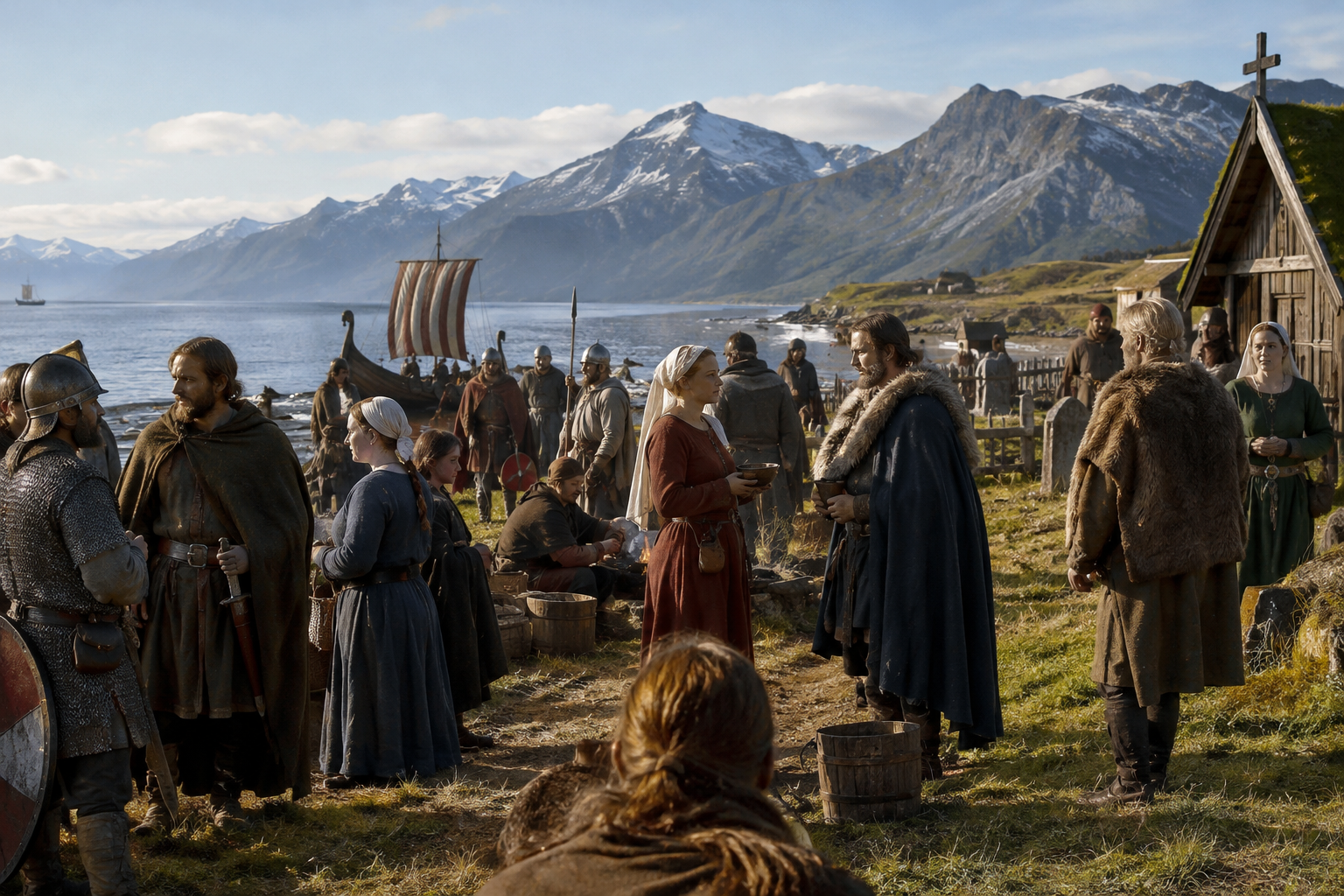
Some Y-chromosome lineages are easy to tell a simple story about. R1a1a1b1a3a1a is not one of them, and that is exactly why it is interesting. This is a very narrow paternal branch within the wider R1a family, a lineage famous in Eurasian population history, yet any specific subclade has its own much tighter and more local history. What ancient DNA gives us here is not a grand slogan about one people or one kingdom, but a trail of men buried from Poland to Norway, from Viking Age Iceland to colonial Maryland, whose direct paternal lines seem to converge somewhere inside this branch.
That matters because Y-DNA traces one thing only: the direct male line, father to son to son across the centuries. It does not describe a person's whole ancestry, culture, language, or identity. Still, when the same paternal branch turns up in several archaeological settings, it can illuminate movements that written sources only partly explain. In the case of R1a1a1b1a3a1a, the picture suggested by the supplied evidence is a notably northern and north-central European one, with especially striking appearances in Scandinavian, Viking Age, and related medieval contexts.
R1a is one of the best-known Y-DNA haplogroups in Eurasian history, with many branches spread across eastern, central, and northern Europe, as well as farther east. But it is important not to pour the whole history of broad R1a into one narrow downstream twig. A lineage like R1a1a1b1a3a1a is better approached modestly: as a later branch within that wider family, visible in historical-period and late first-millennium samples from northern Europe and neighbouring regions.
The supplied ancient evidence points less toward a single dramatic founding event than toward a network of linked worlds: the Baltic, southern Scandinavia, western Norway, northern Norway, the British Isles, Iceland, and parts of central Europe. That is already revealing. It suggests that by the Iron Age and early medieval period, this paternal line - or a very close cluster around it - had become part of the male-line landscape of the North Sea and Baltic worlds.
Readers interested in the deeper background to how such paternal branches are reconstructed may enjoy MyTrueAncestry's broader introduction to the field:
One of the most arresting early appearances in the dataset is PL067, from the Gothic Tribe Poland Maslomecz Wielbark, dated to 250 AD. Maslomecz has become famous precisely because it complicates old-fashioned ideas about the Goths as some tidy biological unit. A paternal lineage found there tells us that this branch was present in a late Iron Age community in eastern Poland associated with the Wielbark cultural horizon. It does not prove that all Goths shared it, nor that this branch was uniquely "Gothic." But it does place the lineage in one of the key contact zones between the Baltic and the wider migration-period world.
Then we have CGG105327, labelled Danii Tribe Sjaelland Roskilde Iron Age Denmark, dated to 313 AD. Here the geography matters enormously. Zealand and Roskilde sit in one of the central corridors of Danish history, where control of sea lanes shaped power long before the Viking Age proper. If PL067 hints at Baltic-facing connections, CGG105327 plants this paternal line in the Danish islands, where the passage between Baltic and North Sea was everything.
Norway adds further weight. CGG107022 from Adogit Pre-Viking Northern Norway Nesna Tomeide at 256 AD, CGG107006 from Pre-Viking Western Norway Langenes Skongeneshelleren at 550 AD, CGG107039 from Viking Age Norway Southwest Klepp at 775 AD, and CGG107030 from Viking Age Halogaland Holm at 798 AD form a remarkable chain. Northern Norway, western Norway, and the southwest all appear. That spread suggests this paternal branch, or a very closely related cluster, was not confined to one fjord or one district. It was present across a long Scandinavian coastline whose men were sailors, traders, raiders, farmers, and settlers.
For readers who want more on the broader genetic setting of such maritime expansion, this is a natural companion:
Once you look at Britain and the North Atlantic, the pattern becomes even more vivid. There are early medieval English finds: SED006 from Anglo-Saxon Sedgeford England Norfolk, dated 600 AD, and POH006 from Early Medieval Polhill Kent England, also 600 AD. These matter because they show the lineage in England before the great age of Norse settlement there had fully unfolded. That does not make it "Anglo-Saxon" in some exclusive sense; it simply shows that northern European male lines of this sort were already circulating in early medieval England.
The Irish Sea world appears too. VK546 from Iron Age Islandbridge Dublin Ireland, dated 725 AD, places this paternal branch in a zone that would soon become central to Viking-Age contact, conflict, and settlement. Again, the temptation is to force a label. Better to resist it. What the sample gives us is evidence that this lineage existed in Ireland in the early medieval period, in a landscape that would later become deeply entangled with Scandinavia.
Then come the classic Viking and Norse diaspora contexts. VK129 from Viking Age Ingiridarstadir Iceland at 1050 AD, NNM-A1 from Viking Norse Iceland at 935 AD, GTE-A1 from Viking Gaelic Mix Iceland at 935 AD, and TSK-A26 from Viking Saxon Iceland at 1104 AD are especially evocative. Iceland is where medieval texts tell us Norse, Gaelic, and other North Atlantic ancestries met. Here the labels themselves remind us that cultural worlds mixed even when paternal lines can be traced.
The Faroe Islands continue that Atlantic story through VK244 and VK237, both from Medieval Age Faroe Islands Sandoy Church, dated 1600 AD. By that point, this was no longer the age of first settlement, but a settled North Atlantic society carrying forward paternal lines that had already crossed sea routes centuries before.
For another MyTrueAncestry article that fits this island story beautifully, see:
Some of the most dramatic samples sit in overtly martial settings. VK493 and VK551 from Vendel Age Saaremaa Salme II, both dated 725 AD, belong to one of the most famous boat-burial discoveries in the eastern Baltic. These are not quiet village graves. They belong to a world of armed retinues, sea travel, and elite display. Add VK256 and VK264 from the Viking Invader Ridgeway Hill England cemetery, dated 998 AD, and the branch appears among men caught up in the violent movement of forces across the North Sea.
Sweden also features strongly: VK344 from Viking Age Oland Sweden at 950 AD, VK48 from Viking Age Gotland Kopparsvik Sweden at 975 AD, and VK35 and VK397 from Viking Age Skara Varnhem Sweden at 1050 AD. This is not random scatter. Oland, Gotland, and Varnhem sit in regions with strong trading, ecclesiastical, and aristocratic importance across the Viking and early Christian centuries.
Central Europe is not absent. AHS18 from Medieval Hungary Carolingian Empire Zalavar Varsziget, dated 850 AD, and I4803 from Early Medieval Slovakia Bratislava, dated 1250 AD, show that the lineage also belonged to inland medieval populations. Their presence hints that the branch was not confined to the Scandinavian peninsula alone, but part of a wider north-central European male-line distribution.
If you want to follow one of these borderland worlds further, the mixed and mobile Gothic setting of Maslomecz is particularly worth pursuing:
Read About the Maslomecz Goths
What, then, do we do with a later historical association such as Clan Baird and Auchmeddan Castle on the north Aberdeenshire coast near Pennan? First, with caution. A clan's association with this haplogroup does not prove that every historical Baird male carried R1a1a1b1a3a1a, nor that ancient men from Denmark, Poland, or Iceland were direct ancestors of the family. But the regional context is compelling.
Auchmeddan was likely first built in the 16th century as a tower house of the Mowat family before passing in the 17th century to the Gardens of Troup after a marriage alliance. Enlarged and altered over time, it had become partly ruinous by the 19th century, yet it remained a vivid marker of local power on the coast. That detail matters because northeast Scotland was never some isolated pocket. It belonged to the North Sea world: tied by shipping, marriage, lordship, and migration to Norway, the Northern Isles, England, and beyond.
A paternal lineage with repeated ancient appearances around Scandinavia and the North Atlantic sits very comfortably in that wider coastal setting. Not as proof of one clan's descent from one Viking warrior - that would be fantasy - but as historical context. Castles like Auchmeddan preserve the visible shell of later kinship systems. Ancient DNA reveals that the male-line histories behind such regions often run much deeper and much wider than surnames alone suggest.
Readers interested in the clan itself can continue with:
R1a1a1b1a3a1a, as reflected in the supplied samples, looks like a paternal branch at home in the connected worlds of the Baltic, Scandinavia, the North Sea, and the North Atlantic, with extensions into medieval central Europe and even the colonial Atlantic through I15285 from Historic St. Mary City Chapel Field Cemetery Maryland, dated 1634 AD. By the time that man was buried in Maryland, the same broad paternal trail had already appeared in Iron Age Poland, Roman-period Denmark, pre-Viking Norway, Viking Age Sweden, Iceland, and England.
That is the fascination of Y-DNA. Not that it tells you who your whole family was, or hands you a noble pedigree, but that it allows one narrow thread of ancestry to be followed across astonishing distances. Written genealogy usually begins late and favours the literate and the wealthy. Ancient DNA widens the cast. It lets sailors, settlers, raiders, villagers, churchyard burials, and shipwreck victims stand beside lairds and castle-builders in the same historical frame.
If your own results include a branch like R1a1a1b1a3a1a, MyTrueAncestry can help you explore where that paternal line appears in the ancient world, and how it intersects with archaeological cultures, medieval regions, and later family histories. Those matches may offer striking historical perspective, even when they do not prove direct descent from any one ancient individual or noble house.






Comments