Haplogroup R1a1a1b1a2c

– 8 min read


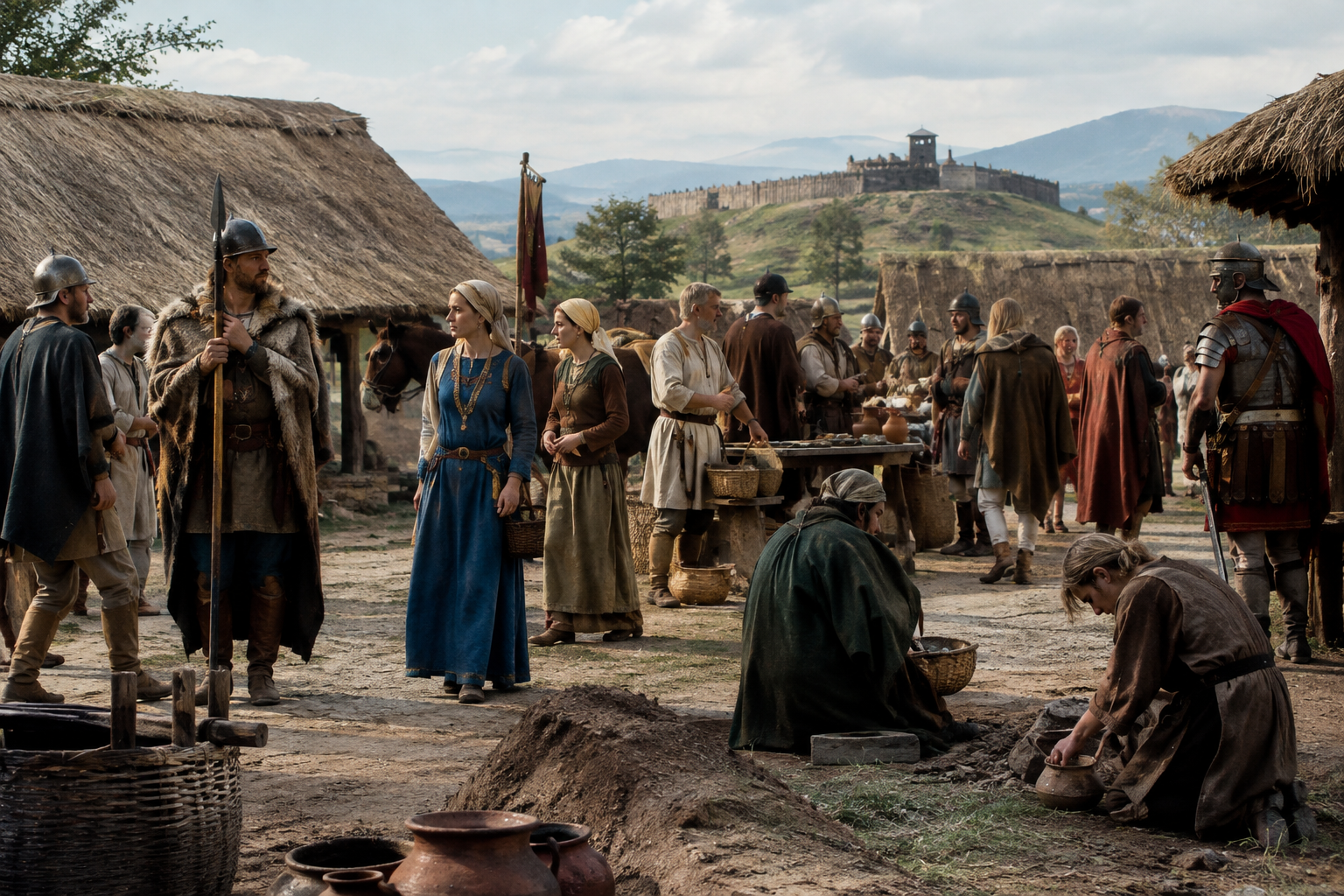
Some Y-chromosome lineages are easy to pin to one famous historical chapter. Others are more interesting precisely because they refuse to stay in one place. Haplogroup R1a1a1b1a2c belongs to that second category. In the ancient DNA record supplied here, it appears across a striking spread of places and periods: Bronze Age Germany and Poland, Iron Age France and Denmark, Gothic-era Poland, Late Antique and post-Roman Hungary, early medieval Germany and Italy, medieval Poland, Belgium, and even a post-medieval plague burial in Germany.
That matters because Y-DNA traces one narrow line of inheritance: the direct paternal line, passed from father to son. It does not describe a person's whole ancestry, culture, language, or identity. But when a paternal branch appears again and again in different archaeological settings, it gives us a rare way to follow long-term male-line continuity, mobility, and reshuffling across centuries that written history can barely see.
R1a1a1b1a2c is a very specific subclade within the broader R1a family, one of the major Y-chromosome lineages discussed in Eurasian archaeogenetics. Broadly speaking, R1a lineages are often associated in prehistoric studies with eastern and central parts of Europe and with populations affected by steppe-related movements in the Copper and Bronze Ages. But that broad background should not be lazily pasted onto every tiny downstream branch. A subclade like R1a1a1b1a2c has its own history, narrower and more local in some periods, unexpectedly wide in others.
The ancient samples here suggest that this branch, or closely related paternal lines within its neighborhood of the Y tree, had a long presence in central and eastern Europe and later circulated through the shifting worlds of Iron Age, Roman frontier, and early medieval societies. What stands out is not a single conquest story, but persistence across changing archaeological cultures.
Explore How Ancient DNA Rewrote History
The earliest anchors in this dataset come from the Bronze Age, and they are revealing. Sample LEU017, from Bronze Age Unetice Thuringia Leubingen Sommerda Germany dated to 1950 BC, places this paternal line in one of central Europe's important early Bronze Age settings. The Unetice world was not some dim prelude to history. It was a landscape of metalworking, elite burials, long-distance exchange, and regional power. A paternal lineage found there was part of a society already structured, connected, and socially differentiated.
Further east, the branch appears in Bronze Age Poland: N17 from Early Bronze Age Gustorzyn Poland dated to 1900 BC, poz230 from Bronze Age Eastern Poland Stryjow dated to 1830 BC, and poz788 from Bronze Age Eastern Poland Hrebenne dated to 1744 BC. These finds suggest that paternal lines in this part of the R1a tree were not confined to one valley or one famous cemetery. They were spread across a broad belt of central and eastern Europe during the Bronze Age.
There is also an intriguing eastern edge in kzb005 and kzb008, both from the Trans-Volga Forest Steppes CWC dated to 1725 BC. The Corded Ware horizon has long been central to debates about mobility, language dispersals, and steppe-derived ancestry. One should be careful here: a single subclade cannot stand in for the whole Corded Ware phenomenon. Still, these samples show that related paternal lines were present in the broad zone linking eastern European forest-steppe and the central European Bronze Age world.
By the later Bronze Age, the pattern has not vanished. We find I0099 at Late Bronze Age Germany Halberstadt-Sonntagsfeld dated to 1021 BC, I13795 at Late Bronze Age Knoviz Konobrze Bohemia dated to 800 BC, and X13 in Late Bronze Age Estonia dated to 610 BC. This is the sort of evidence that stops us telling tidy stories. Whatever else was changing in material culture and political geography, some paternal lines endured and spread over a very wide northern and central European zone.
Read About Late Bronze Age Central Europe
Once we reach the Iron Age, the map becomes even more varied. CGG022433 from Belgic Suessiones Iron Age France Bucy-le-Long dated to 503 BC shows this paternal presence in a Belgic context in northern Gaul. Meanwhile CGG107504, from Iron Age Denmark South Sjaelland Holmegaard Toksvard By dated to 175 AD, places it in southern Scandinavia.
This is a useful reminder that Y-DNA branches do not belong to neat ethnic boxes. The same paternal lineage can turn up in communities archaeologists describe as Belgic, Scandinavian, Gothic, Thuringian, or post-Roman frontier populations. Those labels describe historical and archaeological contexts, not fixed biological tribes.
The Roman world, with its garrisons, trade routes, resettlements, and federate groups, created ideal conditions for lineages to move or reappear in new settings. Sample R9673, described as a Baltic Outlier Roman Era Viminacium Serbia dated to 146 AD, hints at exactly that sort of mobility across imperial space. Even more striking is PL046 from Gothic Tribe Poland Strzyzow Wielbark dated to 250 AD. Whatever one makes of the complicated old arguments about "the Goths," this sample places the lineage in a population associated with the Wielbark zone of northern and eastern Europe.
That wider Gothic and frontier world is worth exploring further in the MyTrueAncestry community, especially because ancient DNA increasingly shows that such groups were more mixed and mobile than older textbooks allowed.
If there is a geographic cluster in this dataset that really deserves attention, it is the Carpathian and Pannonian region around the end of Roman rule. We have GYS045 from Late Antique Pannonia Arrabona Szechenyi Square Hungary dated to 425 AD, HMU048 from Late Roman Period Pannonia Scarbantia Hegyko Barbaricum Hungary dated to 525 AD, and SZL101 from Post Roman Period Pannonia Savaria Szeleste Barbaricum Hungary dated to 525 AD. These are precisely the kinds of centuries when frontier identities blurred, Roman administration gave way, and new political formations emerged.
To that we can add DRH007 from the Thuringii Tribe Germany Deersheim Saxony-Anhalt dated to 500 AD, and two samples from the Alps, 2426X and 2426_5, both from Dark Ages Italy South Tyrol Malles Burgusio Santo Stefano dated to 450 AD. Taken together, they suggest that this paternal line was present across the unstable corridor stretching from central Europe into the Alpine world during the centuries after Rome.
It is tempting to read direct migrations off such a map, but caution is essential. Ancient DNA can show presence, overlap, and long-range patterning. It does not, by itself, tell us whether every appearance represents local survival, incoming settlers, military service, marriage networks, or small elite groups. Still, this cluster strongly supports the idea that R1a1a1b1a2c belonged to a male-line landscape that remained very much alive in post-Roman central Europe.
For readers interested in this exact frontier zone, one especially relevant companion piece is the community article on post-Roman society in the Little Hungarian Plain.
The medieval samples show that the story did not stop with Late Antiquity. ST2653 from Medieval Belgium Sint-Truiden Groenmarkt dated to 1090 AD, PCA0211 from Medieval Poland Piast Dynasty Lad dated to 1100 AD, and PCA0350 from Medieval Poland Ostrow Dziekanowice dated to 1155 AD place this paternal branch in the mature medieval landscape of Latin Christendom.
The Piast-associated sample is especially interesting because it brings us into the same Polish historical sphere later associated with the House of Czartoryski. That does not prove any direct paternal link between a Piast-era burial and the Czartoryski family; it simply shows that the same broad region preserved lineages from this branch over a very long span.
By this point, the story has moved out of prehistory and into a world where lineages also begin to appear inside named families, houses, and regional traditions. That does not let us collapse archaeology into genealogy. But it does mean that the long history of a paternal branch can be glimpsed not only in ancient graves, but in the later historical communities that preserved their own memories in chronicles, heraldry, and stone.
Among the later families linked in historical discussion to this haplogroup, the House of Czartoryski stands out as one of the most prominent aristocratic names in Poland. The family belonged to the world of the Polish-Lithuanian nobility and later became deeply bound up with Polish political and cultural memory. In the context of this haplogroup article, their importance is less that they somehow "explain" the ancient samples, and more that they show how paternal lines found in medieval and earlier central-eastern Europe also remain relevant in the documented history of elite families from the same broad region. Any reported genetic association must be treated carefully: it may link a paternal line to a family tradition or documented line, but it does not mean every historical Czartoryski male necessarily carried the same exact branch.
The supplied material also points to Clan Joyce, a name associated with western Ireland and with the layered history of Gaelic and Anglo-Norman society. That is useful as a reminder that the later history of a haplogroup can surface in places far removed from its earliest archaeological appearances. A clan name does not function as a genetic shortcut, and one should not assume that all Joyces, still less all people connected to Joyce history, share one paternal signature. But the clan's presence in the record shows how a Y-DNA branch can enter very different historical worlds: not only the dynastic politics of Poland, but also the maritime and lordly landscape of Ireland.
Taken together, these associations underline a point made throughout the ancient DNA evidence. This haplogroup is not neatly confined to one people or kingdom. It appears instead in a long historical corridor stretching from Bronze Age and medieval central-eastern Europe into the later family histories of both aristocratic houses and regional clans, each embedded in its own social and political setting.
The later history of such families becomes easier to picture when it can be tied to real places. For Clan Joyce, the supplied stronghold is Rockfleet Castle, a 16th century tower house on the shore of Clew Bay in County Mayo. Best known as the stronghold of Grace O Malley, the celebrated Gaelic Irish chieftain and seafarer, it belongs to the hard-edged world of Ireland's western coast in the Tudor period. Built by the Burkes, it later became entangled with stories of O Malley and with the wider conflicts of Tudor expansion in the west of Ireland. The building still survives in restored form, and its survival matters. It gives a concrete setting for the clan traditions and local power structures that shaped the lives of later families associated with this broad paternal history.
For the House of Czartoryski, the corresponding landmark is Czartoryski Palace in Pulawy. Rebuilt in the late 17th and 18th centuries, it became the home of Princess Izabela Czartoryska, who turned it into a major center of Polish culture and remembrance. That role is especially striking in the aftermath of wars, partitions, and uprisings, when aristocratic residences could become political symbols as much as domestic seats. Though damaged and rebuilt over time, the palace survived as part of the Pulawy estate and remains one of Poland's notable aristocratic and patriotic landmarks.
Neither castle nor palace proves a genetic connection by itself, of course. What these sites do offer is something more grounded and, in a way, more interesting: they show the later historical settings in which families associated with this haplogroup lived, ruled, remembered, and represented themselves. Ancient DNA gives the deep time background. Places like Rockfleet and Pulawy show how, centuries later, paternal lines were woven into recognizable local histories.
R1a1a1b1a2c, as represented by these samples, seems less like the badge of one people than the trace of a long-lived central and eastern European paternal network that kept resurfacing in new historical settings. Bronze Age burials in Germany and Poland, Iron Age France and Denmark, Gothic Poland, Pannonian frontier communities, early medieval Italy and Germany, and medieval Poland and Belgium all show how one branch can persist while cultures, kingdoms, and identities change around it.
That is why ancient DNA is so valuable. Written genealogies begin late and usually concern elites. Archaeology gives us objects and graves. Y-DNA adds another layer: one that can connect distant centuries without claiming that everyone who shares a haplogroup was kin in any meaningful social sense. It offers context, not fairy tales.
If your own paternal line falls near this branch, MyTrueAncestry can help place it against the background of ancient individuals like LEU017, PL046, GYS045, or PCA0211. That does not make any of them your documented ancestor, and it certainly does not make you a member of a medieval dynasty or noble house. But it may show that your direct paternal line belongs to one of the old male-line histories that helped shape Europe from the Bronze Age onward.
Upload your DNA to MyTrueAncestry to explore whether your results connect you with ancient samples, archaeological cultures, and historical regions like the ones in this article.






Comments