Haplogroup R1a1a1b1a1a1c1e

– 6 min read


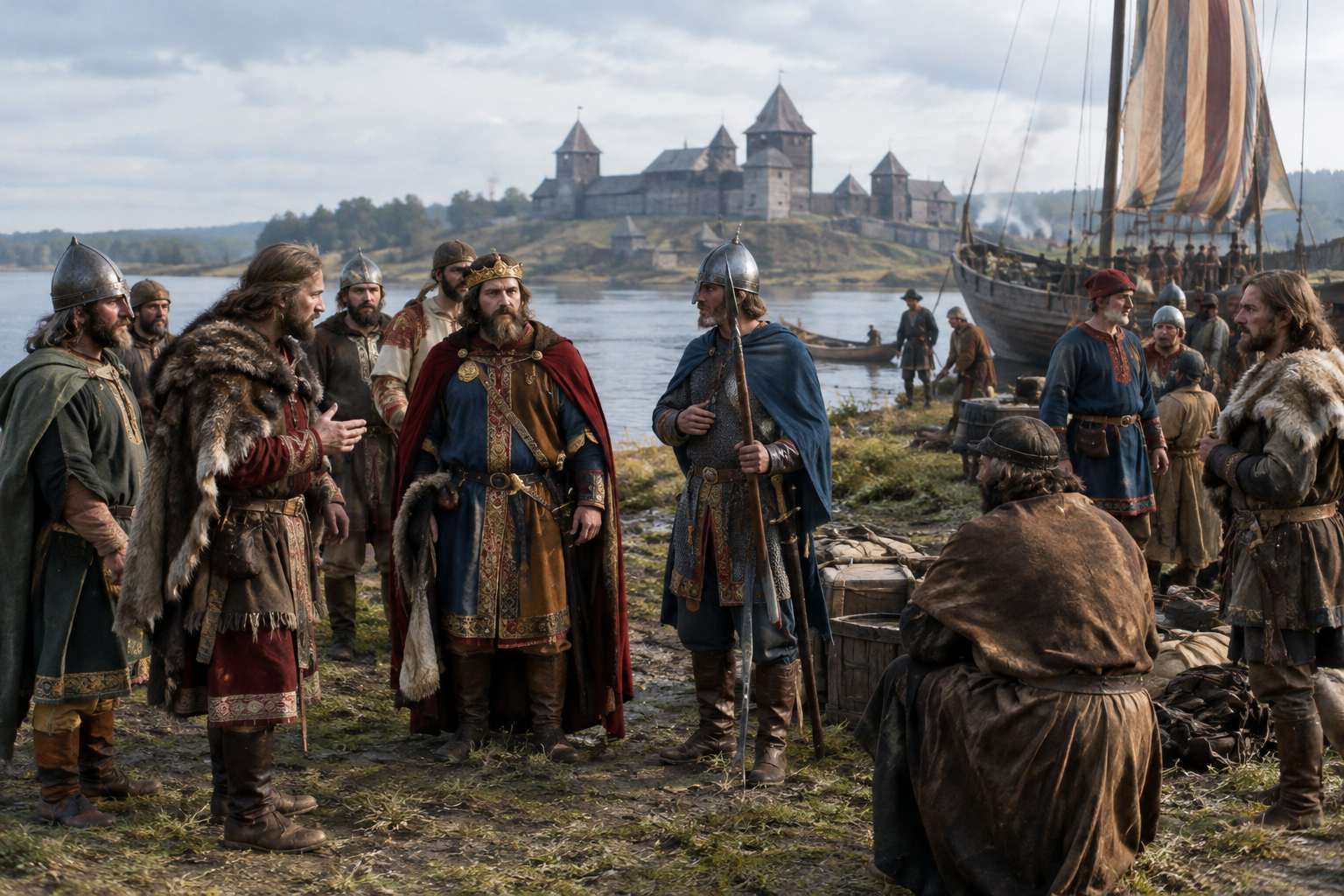
There is something wonderfully awkward, and therefore wonderfully human, about a Y-chromosome lineage with a name like R1a1a1b1a1a1c1e. It does not sound romantic. It sounds like a filing system. Yet behind that string of letters and numbers sits a long paternal history that touches the Baltic world, medieval kingdoms, Gothic-era cemeteries, Scandinavian burials, and even the ruined shell of a Scottish tower house.
As ever with Y-DNA, a note of caution comes first. A Y-haplogroup traces only one line: the direct paternal line from father to son to son across the generations. It is not a person's whole ancestry, not a shortcut to ethnicity, and certainly not a certificate of descent from kings or clans. But it can be a remarkably useful thread. In the case of R1a1a1b1a1a1c1e, the supplied ancient DNA points us toward a story centered above all on northern and east-central Europe, where paternal continuity and movement can sometimes be glimpsed across more than a millennium.
This haplogroup is a very narrow branch within the broader family of R1a, one of the major Y-chromosome lineages found across large parts of Eurasia. The broad parent clade has a deep and complicated history involving multiple regions and many downstream branches. That matters because we must be careful not to pour the entire history of all R1a men into one highly specific subclade. Still, the ancient samples supplied here suggest that this particular branch, or very near relatives of it, had a strong presence in the lands around Pomerania, Poland, parts of Germany, Hungary, Denmark, and Sweden in the first and second millennia AD.
That distribution does not prove a single people, language, or kingdom. What it does suggest is that one paternal line moved within the busy corridor linking the Baltic coast, the Oder and Vistula basins, the central European plain, and the Scandinavian world. These were not empty spaces on a map. They were meeting grounds of Gothic groups, post-Roman tribal confederations, emerging Slavic polities, medieval dynasties, and maritime networks that connected the North Sea and Baltic.
The earliest supplied anchors come from Pomerania in the Roman Iron Age. Several individuals from the Wielbark cultural horizon are especially striking: PCA0457 from Early Goth Pommerania at Pruszcz Gdansk Pruszcz Wielbark, dated to 200 AD, and PCA0550, PCA0551, and PCA0554 from Early Goth Pommerania Czarnwko Lebork County Wielbark, also dated to 200 AD. These are valuable not because they let us declare "this was the haplogroup of the Goths" - that would be far too crude - but because they place this paternal line in a region deeply associated with long-distance contacts across the southern Baltic.
The Gothic label in these sample descriptions is historically evocative. It recalls the old question of movement around the Baltic: how much was migration, how much local development, and how much a cultural fashion that spread through trade and alliance? Ancient DNA has complicated the older, simpler stories. Rather than neat ethnic blocks marching across Europe, we find mixed communities and overlapping lineages. That is precisely why these Pomeranian samples matter. They suggest that the paternal background represented by R1a1a1b1a1a1c1e was already established in this coastal zone during the Roman period.
Another useful waypoint is DRH009, from the Thuringii Tribe Germany Deersheim Saxony-Anhalt, dated to 500 AD. Here we are in the unsettled centuries after Rome's western empire had broken apart, when central Europe was being rearranged by shifting military and political coalitions. A related paternal line appearing in this setting hints that the distribution of this branch was not confined to one coastline or one tribe, but extended into the inland German world as well.
If the Roman-era Pomeranian burials show early presence, the medieval Polish material shows something even more intriguing: persistence in the heart of an emerging kingdom. The supplied list includes several men linked to the Piast Dynasty and to key Polish sites. Among them are PCA0213 from Piast Dynasty Greater Poland Lad dated to 1100 AD, PCA0336 from Medieval Piast Dynasty Poland Ostrow Lednicki dated to 1100 AD, PCA0181 from Medieval Poland Piast Dynasty Lad dated to 950 AD, and PCA0643 and PCA0624, identified as Piast Non-Masovian Dynasty males, dated to 1115 AD and 1499 AD respectively.
Then there is Santok, one of those places historians love because it sits exactly where worlds rub against one another. The samples PCA0383, PCA0394, and PCA0399, all dated to 1100 AD, come from Santok on the Lubusz-Greater Poland border. Frontier towns are rarely tidy places. They are military posts, river crossings, markets, and bargaining tables. To find related paternal lines here and in Piast-associated burials suggests that this branch belonged not merely to drifting populations but to men living inside the political framework of medieval state formation in Poland.
That is not proof that every Piast ruler belonged to this exact narrow subclade, nor that a modern tester with it descends from the dynasty. But it does show that the paternal background represented by this branch was present in circles close enough to those political centers to appear in dynastic and frontier contexts alike.
The geographical spread becomes broader still in the later medieval and early modern samples. In Hungary, we have AHPS185W from Medieval Hungary Carolingian Szekesfehervar Sarkereszturi dated to 1000 AD, alongside AHPS190W and AHPS199W from Medieval Hungary Carolingian Border Bodajk Proletarfoldek dated to 950 AD. These are reminders that the Carpathian Basin was not an isolated bowl but a crossroads, absorbing influences from the Latin West, the post-Carolingian world, steppe-linked newcomers, and older central European populations.
Farther north, CGG101689 from Medieval Denmark Tjrby Randers Municipality dated to 1325 AD places this paternal line in Jutland. Then kro002, from the Stora Kronan Shipwreck Battle of Oland Sweden dated to 1676 AD, carries it into the naval world of early modern Scandinavia. One can hardly ask for a neater demonstration that a Y-line can persist through very different societies: Gothic-era cemeteries, medieval courts, border settlements, Danish communities, and a Swedish warship.
Even the later outliers are telling. KRA001X from Medieval Germany Krakauer Berg Peissen dated to 1140 AD, PDH006 from the Duchy of Sandomierz Lublin Region Pidhirtsi dated to 1150 AD, PCA0165 from Medieval Pommerania Legowo dated to 1100 AD, and YYY088B from a Soldier of Napoleon Grande Armee Mass Grave Vilnius Latvia dated to 1812 AD all help show that the lineage remained part of the moving populations of northern and east-central Europe across many centuries.
What, then, are we to make of the supplied noble connection: Clan Ainslie and Dolphinstone Castle in East Lothian? The answer is that castles and clan traditions give us historical setting, not automatic genetic proof.
Dolphinstone Castle began as a fortified tower house, probably built in the late 16th century for the Seton family or their tenants. That alone tells us much about lowland Scotland. This was a world in which status and security went together: thick walls, a vaulted basement, and the unmistakable air of a residence that expected trouble while also advertising rank. Over time the building became a more comfortable lairdly home, before falling into ruin as tastes changed. In that slow transformation, it mirrors a larger shift from late medieval defensibility to early modern domestic display.
For a clan such as the Ainslies, and for neighboring powers such as the Setons, such places preserved memory as much as property. Yet we must not claim more than the evidence allows. The association of a haplogroup article with Clan Ainslie or Dolphinstone Castle does not prove that all Ainslies shared this Y-line, nor that the castle itself is evidence of a particular paternal branch. What it does provide is a later historical landscape in which readers can imagine how paternal lineages, whatever their exact subclades, were carried by families whose names survived in charters, ruins, and local tradition.
In that sense, the leap from Pomeranian cemeteries and Piast burials to East Lothian is not a genealogical claim but a historical juxtaposition. Ancient DNA shows how long paternal lines can endure and how widely they can spread; clan and castle history shows how later societies remembered lineage, status, and place.
R1a1a1b1a1a1c1e is interesting not because it can be turned into a slogan, but because it resists one. The evidence supplied here places related paternal lines in Roman-era Pomerania, post-Roman Germany, medieval Poland, Hungary, Denmark, Sweden, and beyond. That pattern suggests durability, mobility, and repeated participation in important northern European historical worlds.
It also shows the real value of ancient DNA. Written genealogy usually begins late and favors the powerful. Y-DNA and archaeology widen the frame. They let us see lineages before surnames, before heraldry, before the surviving records of lairds and princes. At the same time, they force humility. Shared haplogroups do not equal close kinship, and ancient similarity is not proof of direct descent.
If your own paternal line falls somewhere near this branch, MyTrueAncestry offers a way to explore whether your DNA shows affinities to ancient individuals like PCA0457, DRH009, or the Piast-era samples from Santok and Ostrow Lednicki. That kind of match may not place a crown on your head or a castle in your family tree. But it may place your ancestry in the company of real men who lived through the making of medieval Europe.
Upload your DNA to MyTrueAncestry to explore ancient connections, compare yourself with archaeological samples, and see how your family history may fit into the larger human past.






Comments