Haplogroup R1a1a1b1a1a1c1c1b
– 5 min read


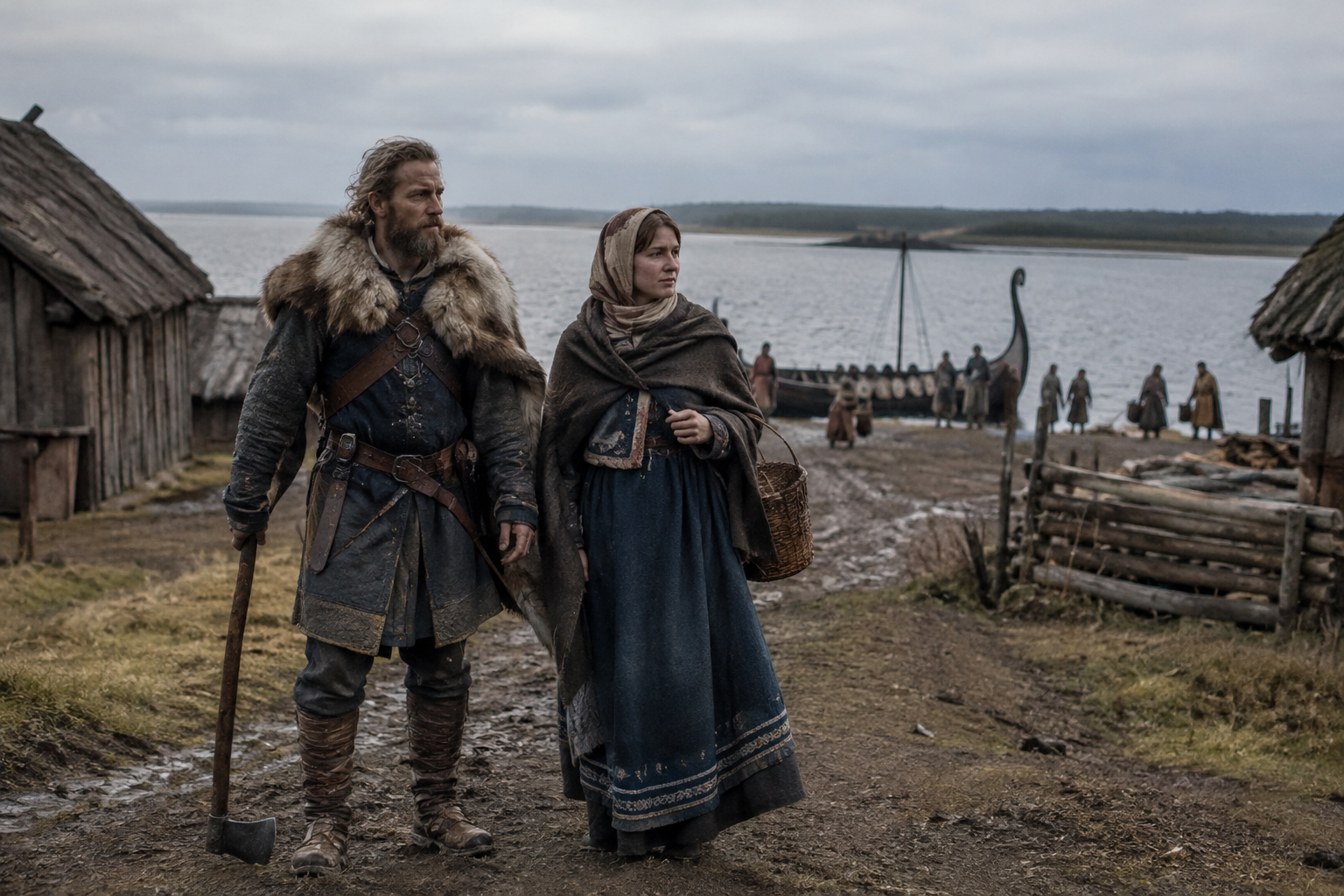
At Kurevanikka in Russia, an individual dated to about AD 1100 and identified as VK160 offers a neat little reminder that Viking-Age history in the east was never simply a Scandinavian story transplanted abroad. By that date, the great river routes linking the Baltic to the Volga and beyond had already produced centuries of movement, trade, raiding, settlement, and cultural mixing. The Y-DNA lineage associated here with that man, R1a1a1b1a1a1c1c1b, sits squarely inside one of the broad paternal families often found across northern and eastern Europe.
That is exactly why VK160 is interesting. A Y-chromosome tells us about one direct paternal line only, not a person's whole ancestry, language, or identity. But when a lineage turns up in a Viking-era context in northwestern Russia, it helps illuminate the male-line threads running through the eastern Baltic and Rus' world, where Norse, Finnic, and Slavic histories overlapped in ways that archaeology has been slowly making clearer.
Kurevanikka belongs to the vast zone where Scandinavian expansion met local societies around the Gulf of Finland, Lake Ladoga, and the river systems feeding the Rus' networks. By around AD 1100, this was not a frontier in the simple sense of a border between two fixed peoples. It was a lived-in corridor of exchange, where identities could be local, regional, mercantile, military, and dynastic all at once.
That makes a sample like VK160 more valuable than its single line in a table might suggest. It places the article's haplogroup in a historical setting shaped by mobility and contact rather than isolation. In eastern Viking and post-Viking settings, paternal lineages such as branches under R1a are entirely plausible, but plausibility is not the same thing as proof of ethnicity. What the sample gives us securely is a male line present in this world of Baltic-Russian interaction at the close of the Viking Age.
An ancient DNA study examining populations connected to the Viking world has helped frame these eastern settings in broader context, showing just how mixed and regionally varied Viking-Age communities could be across Europe and the North Atlantic: https://www.biorxiv.org/content/10.1101/703405v1.
The full label R1a1a1b1a1a1c1c1b is a very narrow twig on a much larger Y-DNA tree. The larger R1a family has a long and complicated history across Eurasia, with many branches distributed across different regions and periods. It would be a mistake to take the broad fame of R1a and pour all of that history directly into this one fine-grained subclade.
For that reason, the careful way to read VK160 is not as "the origin" of the haplogroup, nor as evidence that everyone carrying this lineage descends from Viking warriors. Rather, it shows that a man associated with this branch, or reported in connection with it, was present in Viking-era Russia around AD 1100. That is a historically meaningful anchor point, especially for people whose own paternal results fall in a similarly eastern or northeastern European part of the Y-chromosome tree.
The eastern Viking sphere often tempts modern readers into tidy labels: Scandinavian, Slavic, Finnic, Rus'. The archaeology resists that neatness. Trading towns, river ports, cemeteries, and military routes tied together populations that were not genetically identical and certainly not culturally uniform. A paternal line can survive through all sorts of historical transformations while the language, religion, and political allegiance of its carriers change more than once.
If one stands back from this single burial and looks at the larger map, Kurevanikka sits in a region where R1a lineages are historically unsurprising, though the exact subclades matter enormously. Northwestern Russia and the eastern Baltic were zones of repeated contact between populations speaking early Slavic and Finnic languages, with Scandinavian groups moving in and out through trade and warfare. Male-line continuity and male-line replacement could both happen there, sometimes within the same few centuries.
That is one reason ancient DNA has become so useful. It allows historians to move away from the old habit of assuming that an object style, a burial custom, or a place-name automatically reveals biological descent. In this case, the value of VK160 lies in fixing one paternal branch to one actual human being in one actual medieval landscape.
Baltic links in early medieval Finland
That broader Baltic-Finnic setting matters because the eastern Viking world was not confined to famous centres such as Novgorod or Staraya Ladoga. Smaller sites and lesser-known cemeteries also preserve the evidence for how lineages circulated. Some men arrived from far away; others were deeply local; many probably belonged to communities that had been mixing for generations.
It is easy to dismiss a single ancient Y-DNA result as too slight to say much. But ancient history often works by accumulation. A lone burial, accurately placed, can become important when later finds begin to cluster around the same region or period. Even where the wider ancestry profile is unavailable or the full archaeological report is not in front of us, the combination of place, date, and paternal lineage already gives us something solid to work with.
For descendants testing today, this is especially relevant in cases where family tradition points vaguely toward "Viking," "Russian," "Baltic," or "northeastern European" roots. VK160 does not confirm any one of those identities for a modern tester. What it does do is show that the paternal branch under discussion belongs within a medieval world where those categories met and overlapped.
There is also a useful corrective here to more romantic ideas about Viking ancestry. The eastern Viking sphere was not populated solely by migrants from Scandinavia. It included local men, mixed communities, dynastic retainers, traders, and converts to new political and religious orders. A lineage found in that world may have reached the site through many generations of regional history rather than one dramatic voyage.
Migrations in the northern Black Sea region
By about AD 1100, the Viking Age in the strict sense was drawing to a close, but the social landscape it had helped shape was still very much alive. Christianization had advanced in many northern regions. Trade routes remained active. Political centres in the Rus' lands were increasingly formalized, yet they still depended on networks built over earlier centuries of movement.
A male line such as R1a1a1b1a1a1c1c1b appearing in that setting is therefore historically apt. It belongs to a period when old Scandinavian-linked connections persisted, even as local societies in Russia and the eastern Baltic were consolidating into something less recognizably "Viking" and more distinctly medieval. That is often how lineages survive in the record: not at moments of theatrical conquest, but in the quieter continuity that follows.
So the real significance of this haplogroup is not that it unlocks a single grand saga. It is that R1a1a1b1a1a1c1c1b, through VK160 at Kurevanikka, is tied to a documented human presence in the eastern Viking and early medieval Russian world around AD 1100. For anyone researching this paternal line, that is a grounded historical clue: a sign that this branch belongs in the tangled northern-eastern European zone where Baltic, Rus', Finnic, and Scandinavian histories met in the same landscapes.






Comments