Haplogroup R1a1a1b1a1a1c

– 5 min read


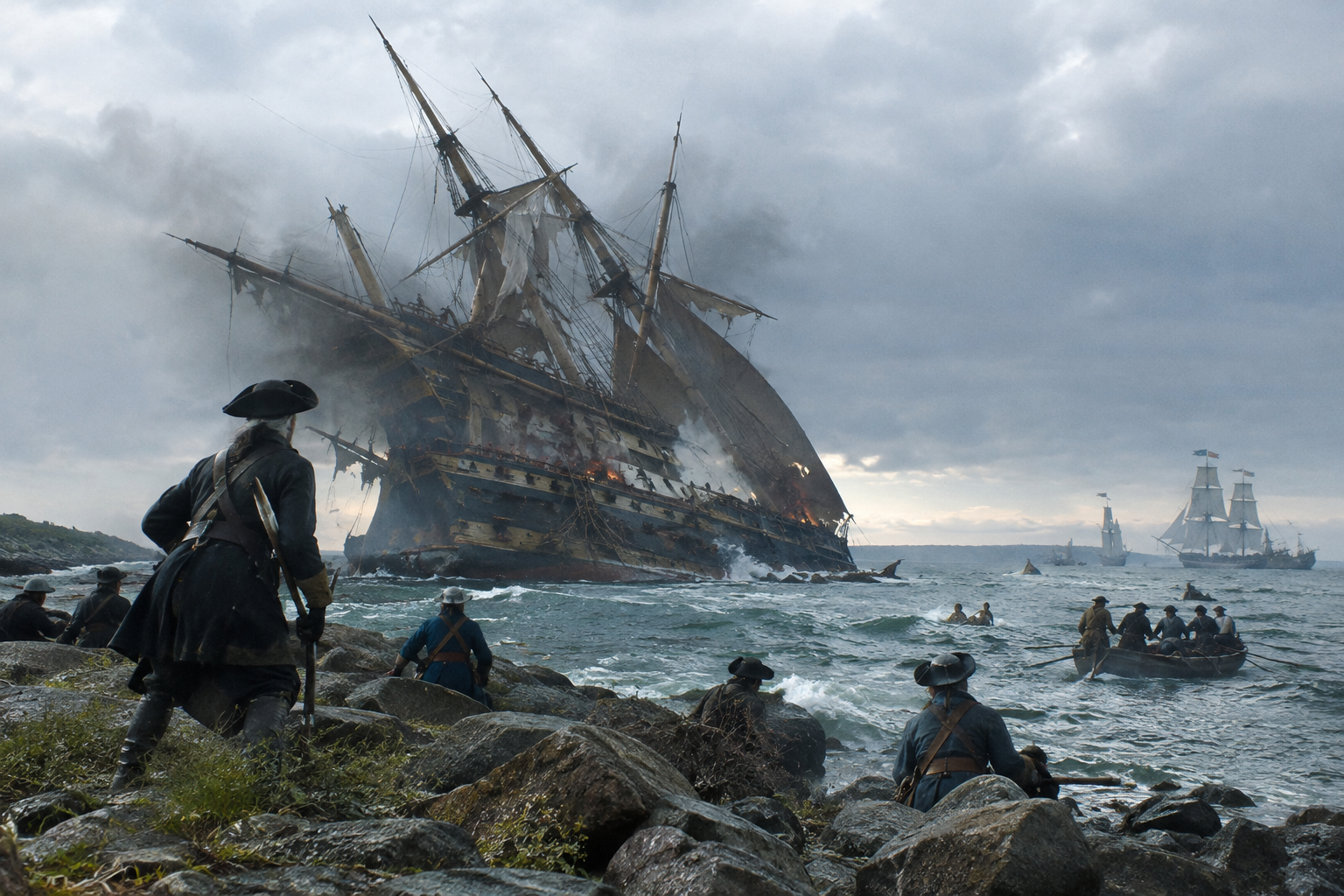
One of the more arresting recent finds in Scandinavian archaeogenetics does not come from a princely tomb or a Viking hall. It comes from the wreck of the Stora Kronan, the great Swedish warship lost in the Battle of Oland in AD 1676. Among the men recovered from that disaster is sample kro002, associated here with the Y-DNA haplogroup R1a1a1b1a1a1c.
That is a very precise paternal label, and it matters because Y-DNA follows one direct male line only: father to son, back through time. It does not describe the whole ancestry of the man from the Kronan, still less the whole ancestry of seventeenth-century Sweden. But even a single paternal line can open a remarkably vivid historical window when it is anchored to a real person, a real ship, and a real moment of catastrophe.
The Stora Kronan was one of the largest warships in the Swedish navy, built during the age when the Baltic was a fiercely contested political sea. In June 1676, during the Scanian War, she was lost off Oland in battle against a combined Danish-Dutch fleet. Contemporary disaster and underwater archaeology meet here in an unusually direct way: the dead are not vague figures from saga or legend, but named through context as members of a seventeenth-century naval crew caught in one of Sweden's greatest maritime losses.
Sample kro002 belongs to that setting. Even with only a sparse individual record, the context is unusually powerful. This was not a prehistoric cemetery later assigned to a broad culture; it was a tightly dated military event in early modern Scandinavia. That gives the haplogroup a fixed point in place and time: a paternal line carried by a man serving aboard a Swedish flagship in AD 1676.
The wider study that brought renewed attention to Scandinavian ancient DNA, including later-period individuals and the long arc of population history in the region, was published in Cell. For readers of ancient DNA, the importance of such work is not simply that it names haplogroups, but that it places them inside real archaeological and historical contexts.
The branch name R1a1a1b1a1a1c sits deep within the larger haplogroup R1a, one of the major Y-chromosome lineages found across wide parts of Eurasia. That broad parent lineage has a long and complicated history involving many different populations, languages, and historical worlds. The narrower branch in this article should not be casually made to carry all of that larger story on its shoulders.
What can be said more carefully is that lineages within R1a are well documented in northern, eastern, and central Europe, and they appear in a variety of historical settings, including Scandinavia. In that sense, kro002 is not interesting because he belongs to some exotic outlier lineage, but because he shows how one particular paternal branch was present among the men who crewed an early modern Swedish warship.
That point may sound modest, but modesty is part of good historical method. A wreck victim from AD 1676 is not evidence for the first arrival of a lineage in Sweden, nor proof of a single ethnic identity, nor a shortcut to grand claims about "Viking blood." He is, instead, secure evidence that this paternal branch formed part of the human reality of the Baltic world in the age of gunpowder navies and imperial rivalry.
If one wants to understand why a haplogroup like R1a1a1b1a1a1c might appear in seventeenth-century Sweden, the first thing to remember is that the Baltic connected as much as it separated. Sweden's military, trading, and political networks reached across present-day Sweden, Finland, the eastern Baltic, and into lands further south and east. Seamen, soldiers, craftsmen, and administrators moved through those circuits constantly.
So the most sensible historical frame for kro002 is not an isolated national essence, but a maritime commonwealth. The crew of a major royal warship would have been drawn from the broader social and regional world of the Swedish realm. A Y-chromosome lineage in that setting could reflect deep local roots in Scandinavia, older eastern Baltic connections, or the long accumulation of movement around the North and Baltic Seas over many centuries.
This is where archaeology and genetics work best together. The wreck gives us the event. The Y-line gives us one thread of paternal descent. The wider history of the Baltic explains why that thread need not point to a single tidy origin story.
Although kro002 is an early modern individual, his lineage sits within a much older Scandinavian population history. Ancient DNA from the region has shown again and again that Scandinavia was shaped by repeated episodes of migration, mixture, and local continuity. Mesolithic foragers, Neolithic farmers, Steppe-derived groups, Iron Age communities, and medieval populations all contributed to the ancestry of later Scandinavians in varying degrees.
That longer background is important because it stops us from flattening the past. A seventeenth-century sailor was not simply a frozen survival of some distant Bronze Age population. He belonged to a society already built from many earlier layers. The paternal line marked as R1a1a1b1a1a1c may have been transmitted through generations of men living in Scandinavia for a long time, but the man himself inhabited a thoroughly historical world of states, fleets, taxation, war, and religion.
Readers interested in how genetics has been used to trace language spread in northern Europe may find it useful to compare this maritime Swedish case with broader work on ancient populations and Germanic-speaking regions.
There is a temptation, with any narrow haplogroup, to ask immediately for dynasties, famous surnames, or heroic origin myths. But one of the pleasures of archaeology is that it brings us back to ordinary historical people, even when they died in extraordinary events. kro002 was not recovered from a royal vault. He was one of the men who made a state war machine function, until that machine failed spectacularly at sea.
That gives this haplogroup article a different sort of value. Instead of tracing only elite pedigrees, it places R1a1a1b1a1a1c in the lived world of Baltic naval history. It ties a paternal lineage to a documented disaster, to Sweden's seventeenth-century expansion, and to the human cost of naval warfare. In other words, the lineage is not floating abstractly on a phylogenetic tree; it is anchored to a deck, a battle, and a body recovered from cold water.
Shipwreck archaeology is especially good at this sort of historical correction. It reminds us that states are built not only by kings and admirals but also by crewmen whose names are often lost, though their bones and DNA survive. A haplogroup result from such a context is small in one sense, but in another it is wonderfully exact.
For someone researching R1a1a1b1a1a1c today, the most defensible insight from this evidence is not a claim to a single ancient tribe or noble house. It is something both smaller and more historically satisfying: this paternal line was present in the Scandinavian-Baltic world of the late seventeenth century, carried by at least one man aboard the Stora Kronan when Sweden fought for mastery of the sea. That is the sort of finding ancient DNA does particularly well when handled carefully - it restores one precise human connection between lineage and history.






Comments