Haplogroup R1a1a1a1d2b3

– 6 min read


Some Y-DNA haplogroups turn up like a neat local family story. Others appear more like a set of scattered clues across a very large map. Haplogroup R1a1a1a1d2b3 belongs to the second category. It is a very specific paternal branch, tucked deep within the wider R1a tree, and that matters because the narrower the branch, the more careful we have to be. A broad parent haplogroup can have a vast prehistoric history; a downstream subclade represents only one smaller twig on that much older tree.
That is also what makes it interesting. Y-DNA traces one direct male line only: father to father to father. It does not describe a person's whole ancestry, culture, language, or identity. But when a branch like this appears in ancient burials from Iron Age Denmark, post-Roman Germany, and even Coptic Period Egypt, it gives us something valuable: not a simple ethnic label, but evidence that one paternal line, or closely related lines within the same part of the tree, could move through very different historical worlds.
In broad terms, the larger R1a family is often discussed in connection with parts of Eurasia and with major prehistoric and later population movements. But for a lineage as specific as R1a1a1a1d2b3, caution is essential. We should not casually pour the full story of all R1a into this one branch. What ancient DNA can do is narrower and better: it can show us where related paternal signatures appear, when they appear, and in what archaeological settings.
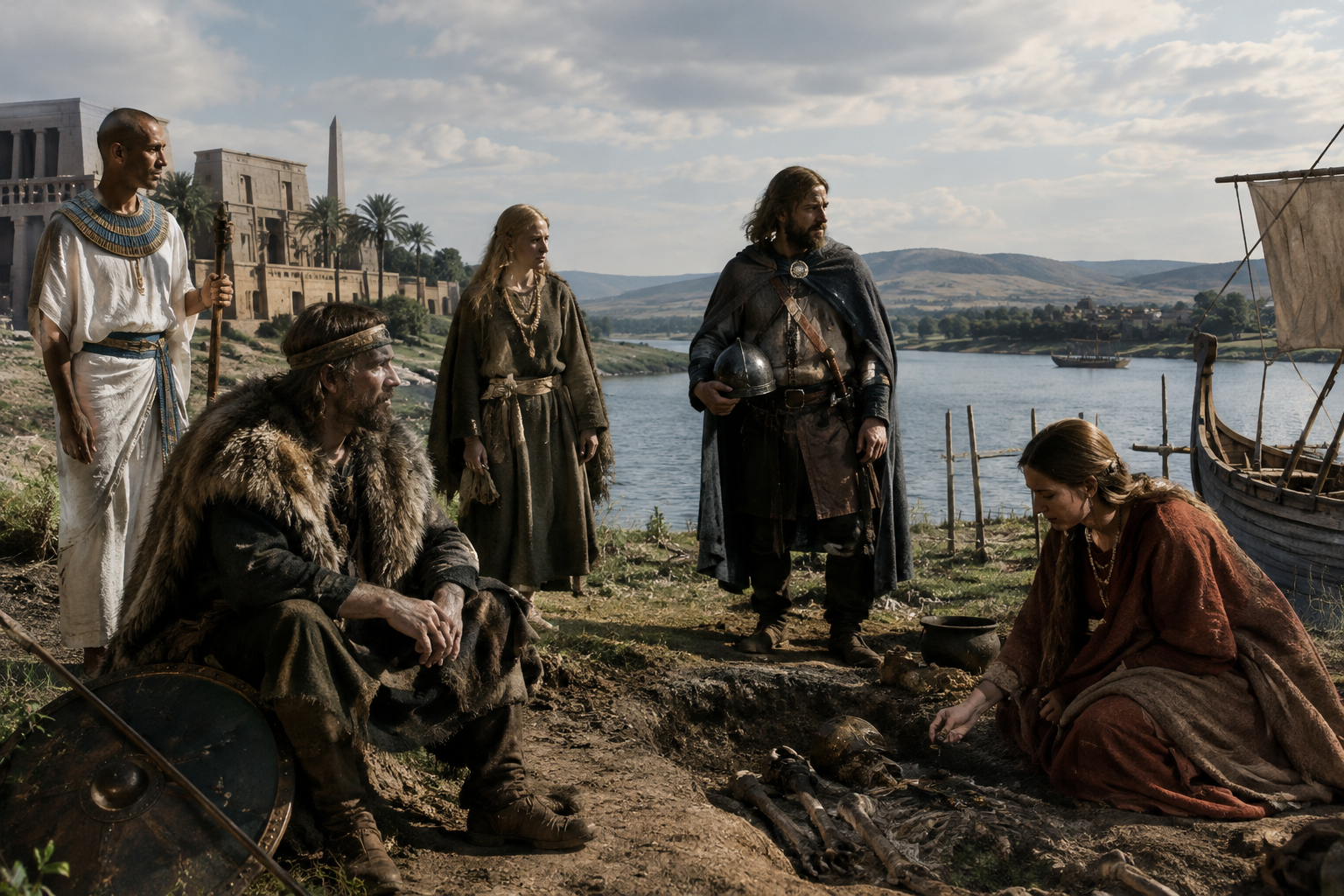
The most striking thing about the evidence supplied here is its spread. One sample comes from Jutland in Denmark before the Roman Empire had reached its height. Two more appear in what is now Germany during the unsettled centuries after Rome's western provinces broke apart. Another turns up in Thebes in Egypt in the Coptic Period. That is not a tidy migration arrow from A to B. It is something far more historically realistic: a reminder that late Iron Age and early medieval worlds were full of mobility, recruitment, trade, marriage, service, and resettlement.
The oldest of the listed individuals is CGG106813, described as Ancient Individual:Jute Iron Age Denmark Jutland Nr Hedegord Year:322 BC ID:CGG106813. Even in that short label there is a great deal to think about. Jutland was no remote fringe. It sat in a zone tied to North Sea and Baltic networks, a place where later Jutes, Angles, Saxons, and other peoples would be woven into the history of northern Europe. One Iron Age male from Jutland does not prove that this exact subclade was a "Jute haplogroup," but it does place this paternal branch, or one very near it, in the Scandinavian sphere well before the early medieval migrations that loom so large in written history.
That northern setting matters because R1a lineages are regularly part of discussions about prehistoric and early historic Europe, especially in regions touched by steppe-derived ancestry and later northern and eastern population histories. But archaeology is always local. A man buried in Iron Age Jutland lived not in a textbook but in a real landscape of farms, exchange routes, and warrior politics.
Readers interested in how ancient DNA illuminates Scandinavian prehistory may also enjoy the broader background in Denmark's earlier population story.
Read Denmark's Deep Genetic History
Move forward several centuries and the picture becomes even more intriguing. DRH031 is listed as Ancient Individual:Thuringii Tribe Germany Deersheim Saxony-Anhalt Year:500 AD ID:DRH031. That date places him in the age when Roman political structures had fractured in the west, while new kingdoms, tribal confederations, and frontier societies were taking shape across central Europe. The Thuringii are a perfect example of why ancient DNA matters. Written sources name peoples, but genetics shows us that those named groups were lived communities, often mixed, local, and changing.
Then there is IND010, from Ancient Individual:Merovingian Grave North Rhine-Westphalia Germany Alt-Inden Year:600 AD ID:IND010. Merovingian Europe was not a sealed ethnic box. It was a political world of military service, elite display, Christianization, and movement across former Roman frontiers. A paternal lineage found in a Merovingian grave may reflect local continuity, incoming ancestry, or some combination of both. The point is not to force certainty where we do not have it, but to notice how this branch appears in exactly the sort of borderland where Roman and non-Roman identities had been blending for generations.
That makes the Lower Rhine and adjacent German regions particularly useful settings for thinking about this haplogroup. They are places where archaeology and genetics repeatedly show that late antique and early medieval communities were more mixed than older nationalist histories once liked to imagine.
If you want a wider view of that frontier world, one especially relevant MyTrueAncestry article looks directly at the blending of populations in these centuries.
Explore the German Frontier 400-700 CE
The most arresting sample in the set may be 2287, listed as Ancient Individual:Coptic Period Egypt Thebes Year:518 AD ID:2287. On the face of it, a paternal line turning up in Thebes and also in northern Europe invites dramatic storytelling. Better, though, to resist drama and ask sensible historical questions. Late antique Egypt was part of a connected world. Soldiers, officials, merchants, pilgrims, monks, and migrants moved through the eastern Mediterranean and beyond. A northern-associated Y-line appearing in Coptic Egypt need not signal mass migration; a single male line can travel a long way through individual movement over generations.
This is exactly where ancient DNA is so valuable. It reminds us that the ancient world was not made up of neatly bounded peoples sitting still in their assigned provinces. Thebes in the sixth century was Christian, urban, monastic, and tied into imperial networks. A Y-chromosome result there is not proof of a dramatic invasion or a family legend fulfilled. It is something more interesting: a glimpse of the human variety present in a real historical city.
For a broader perspective on genetic history in this region, readers may want to look at MyTrueAncestry's work on North Africa and adjacent populations.
Discover North African Population History
Here we need to be plainspoken. The supplied field for associated noble families and castles is empty. That means there is no responsible way to attach this haplogroup to a named dynasty, clan, manor, or ancestral stronghold in this article. It would be very easy to fill the gap with half-familiar medieval romance - some castle on a hill, some marching house, some grand paternal continuity from Iron Age warrior to baron. But it would also be bad history and worse genetics.
That absence is itself a useful lesson. Y-DNA can sometimes help test historical lineages, especially where named burials or well-documented paternal genealogies survive. More often, though, it works differently. It gives context rather than pedigree. In the case of R1a1a1a1d2b3, the current evidence here links us more securely to archaeological regions - Jutland, Saxony-Anhalt, North Rhine-Westphalia, and Thebes - than to any proven noble house.
Castles and family traditions belong to a later layer of history. Ancient DNA belongs to a deeper one. Sometimes the two can be joined. Sometimes they cannot. Honest scholarship means knowing the difference.
So what can we say, responsibly, about R1a1a1a1d2b3? First, it sits within a major paternal family whose wider history stretches across large parts of Eurasia. Second, the ancient individuals supplied here show that related paternal signatures were present in very different settings: Iron Age Denmark, post-Roman and Merovingian Germany, and Coptic Egypt. Third, that distribution fits a historical picture of movement, contact, and continuity rather than a simple one-people, one-place story.
Most of all, this haplogroup shows why Y-DNA is so compelling. A single paternal branch can cut across the categories that textbooks often keep separate: "Germanic," "Roman frontier," "Coptic Egypt," "Iron Age Scandinavia." Genetics does not replace archaeology or written history. It complicates them, and usually for the better.
If this is your haplogroup, or one near it, the real value is not in claiming a throne room or a tribal banner. It is in seeing how one thin paternal thread may connect your family story to the long, untidy, fascinating history of real people who lived in these landscapes centuries apart.
Upload your DNA to MyTrueAncestry to explore whether your results show similarities to ancient individuals like CGG106813, DRH031, IND010, or 2287. Those matches do not prove direct descent from a specific ancient person, still less membership in a noble house, but they can offer an extraordinary window into the deeper human past behind your family line.






Comments