Haplogroup R1a1a1a1d2

– 5 min read


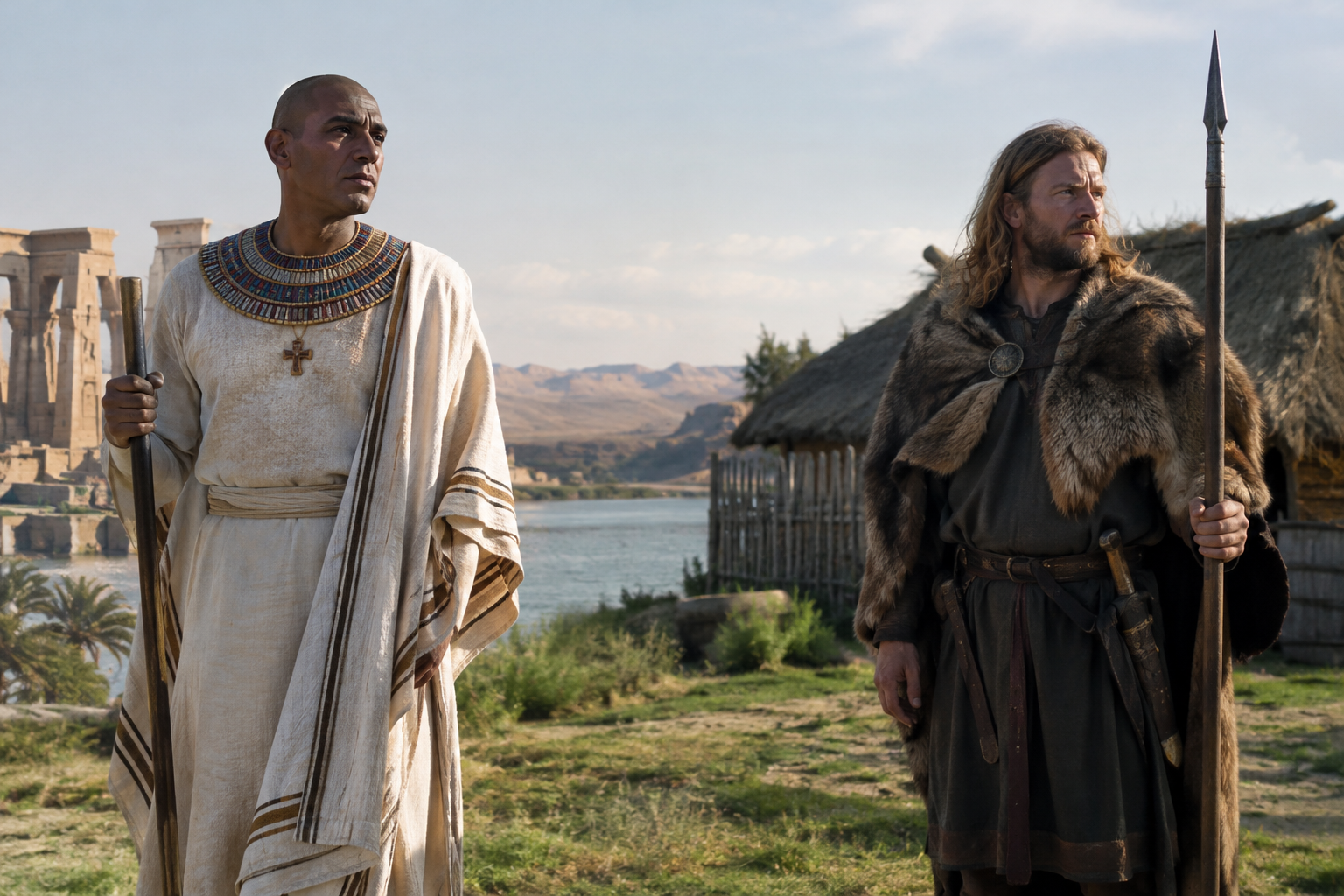
One of the more intriguing appearances of R1a1a1a1d2 in the ancient record comes from Thebes in Egypt, where a man from the Coptic period, sample ID:2287, is dated to around AD 518. That date places him in a world after the pharaohs, after Alexander, and after Augustus too: a Christian city living among temples, monasteries, Roman administration, and long-distance trade. The surprise is not that Egypt was connected to the wider world. It always was. The surprise is that a paternal line usually discussed within broader Eurasian and often northern or eastern European contexts turns up here in late antique Thebes.
This is where Y-DNA becomes useful, provided we keep it in proportion. A Y-chromosome haplogroup traces one direct paternal line only - father to son across many generations - and not a person's whole ancestry, language, or identity. Even so, the appearance of R1a1a1a1d2 in both Coptic Egypt and Iron Age Jutland gives us something valuable: not a neat migration tale, but a glimpse of how widely some paternal branches could move through very different historical worlds.
Thebes is one of those places where history sits in layers so dense that almost any burial belongs to several stories at once. By the early 6th century AD, the city was part of the Eastern Roman Empire and deeply shaped by Christian institutions, yet it still occupied a landscape famous for much older sacred and funerary traditions. Sample ID:2287, identified simply as a Coptic-period individual from Thebes, belongs to that late antique environment rather than to pharaonic Egypt.
That distinction matters. Too often, Egypt is flattened into a single timeless backdrop. But the Egypt of around AD 518 was a province tied into Mediterranean exchange, theological controversy, military movement, and local continuity all at once. A paternal lineage such as R1a1a1a1d2 in this setting does not automatically point to one recent migrant, one ethnic label, or one dramatic episode. It may reflect generations of movement through Roman and post-Roman networks linking the Nile Valley to the Levant, Anatolia, the Balkans, and beyond.
A study connected with ancient human remains and disease risk in historical populations is available at this research link. Even when a paper's wider focus is medical rather than purely archaeological, such work reminds us how often ancient DNA now comes from burials that also speak to ordinary health, mortality, and lived experience rather than only kings and conquerors.
The second anchor point is far to the north: a Jute Iron Age individual from Jutland, at Nr Hedegord in Denmark, sample CGG106813, dated to around 322 BC. Here the setting is not a late antique Christian town but pre-Roman northern Europe. The chronology matters again. This is centuries before the Viking Age and before the Roman Empire reached its full northern frontier system.
In historical writing, Jutland can easily be pulled forward into later identities - Jutes, Angles, Saxons, and all the familiar migration-period peoples of early medieval fame. But a burial around 322 BC belongs to an earlier Iron Age landscape. It should be read first in that local archaeological context, not as a shortcut to later tribal narratives. What the sample does show is that a lineage associated here with R1a1a1a1d2 had reached, or was already present within, Iron Age Scandinavia well before the better-documented upheavals of the first millennium AD.
That makes Nr Hedegord especially useful for this haplogroup article. The Danish sample is not interesting because it proves a grand ethnic story. It is interesting because it gives this paternal line a firm foothold in an early northern European context, which can then be set beside the much later Egyptian case without forcing either into a simplistic route map.
Denmark and deep population history
The long name is a clue in itself. R1a1a1a1d2 is a downstream branch within the wider R1a family, one of the best-known Y-DNA lineages across large parts of Eurasia. But that broader fame can be misleading. It is one thing to discuss R1a in general terms across steppe expansions, Iron Age societies, or later medieval populations; it is quite another to make specific claims about a narrower branch like R1a1a1a1d2.
For that reason, it is better to stay close to the evidence. In the material at hand, the branch is associated with two ancient individuals separated by nearly nine centuries and a very considerable distance: one in Iron Age Denmark, one in Coptic Egypt. That does not mean the branch was common in both places, nor that these men shared a recent historical connection. It means the direct paternal line had a geographic spread wide enough to appear in sharply different archaeological settings.
This is also a helpful case study in why ancient DNA works best when paired with context. Haplogroups travel through households, military service, marriage patterns, trade routes, slavery, resettlement, and ordinary demographic drift. By themselves, they do not tell us which of those processes mattered most in any individual life.
Put the two samples together and a familiar but important historical truth comes into view: the ancient world was mobile in ways that do not always match later national stories. Northern Europe was not isolated, and late antique Egypt was not sealed off from the wider Mediterranean or from more distant regions. People, and therefore paternal lines, moved.
For the Egyptian sample, the likeliest broad frame is the connected world of the late Roman and early Byzantine eastern Mediterranean. Soldiers, officials, merchants, monks, laborers, and families all circulated within that orbit. For the Danish sample, the broader frame is earlier and different: the complex prehistoric and Iron Age population history of Scandinavia and the North Sea zone, where ancestry components and male lines had already been shifting for millennia before any written account called someone a Jute.
Research on ancient Scandinavian populations continues to refine that older picture, and readers interested in the region's long genetic background may want to compare this with wider Danish evidence.
Scandinavia before the Iron Age
There is also a larger methodological point here. When a specific subclade appears in both a northern Iron Age burial and a late antique Egyptian one, the temptation is to imagine a single arrow on a map. Real history is rarely so tidy. A lineage can spread, contract, split into local branches, and reappear in places connected only indirectly through centuries of intervening demographic history.
Ancient DNA articles sometimes drown in speculation simply because the evidence is thin. Here, the thinness is exactly why the two samples are worth taking seriously. CGG106813 from Jutland gives us an early northern European occurrence in a pre-Roman Iron Age setting. ID:2287 from Thebes gives us a much later occurrence in Christian Egypt under eastern Roman rule. Each sample adds something the other cannot.
An ancient DNA study examining broad patterns of human movement and mixture in old burials can be found at this biorxiv link. Without overstating any one paper's conclusions, that sort of research context is essential: ancient populations were often more mixed, more local, and more mobile at the same time than older textbook models allowed.
The result is a more interesting history, not a less interesting one. R1a1a1a1d2 is not important because it belongs to some sweeping myth of origin. It is important because it appears in real people, in real places, under very different historical conditions.
Roman-era mobility and mixed communities
If your paternal line falls within R1a1a1a1d2, these ancient matches suggest a branch with a documented presence in both Iron Age northern Europe and late antique Egypt, though not in a way that supports a single simple origin story. The real lesson is subtler and better: your direct male line belongs to a history of movement across very different cultural worlds, from pre-Roman Jutland to Coptic Thebes. That is exactly the kind of pattern ancient DNA is best at revealing - not legends, but the stubbornly complicated human past.






Comments