Haplogroup Q1b1a3b

– 5 min read


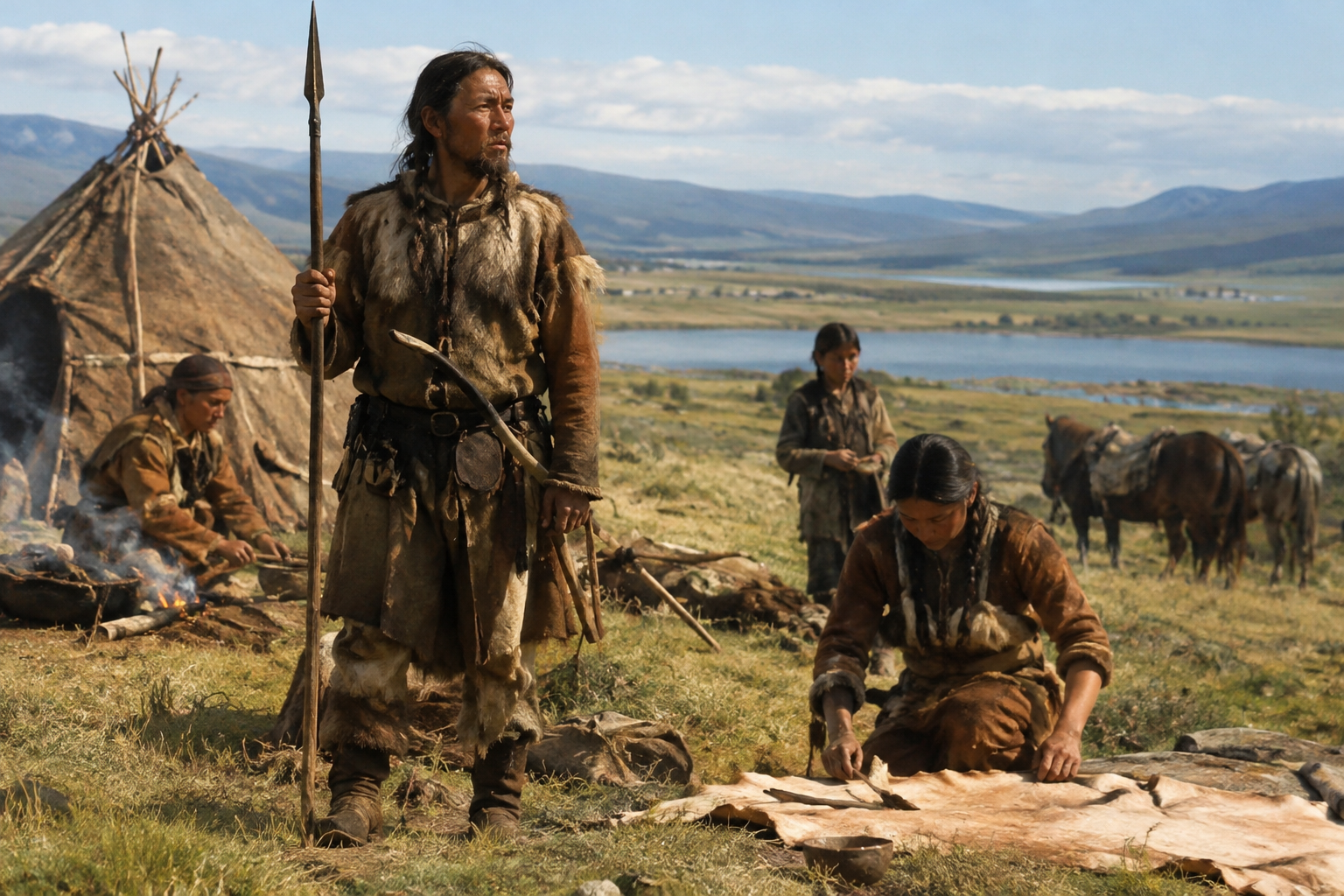
The most concrete ancient clue here is a man labeled irk057, dated to around 1000 BC in the Trans-Baikal region east of Lake Baikal. He is important not because one burial can explain an entire paternal line, but because he places the Y-DNA branch Q1b1a3b in a real Bronze Age landscape on the eastern side of the Eurasian steppe world, where Siberian forest, open grassland, and mobile pastoral routes met.
That matters because haplogroup Q is one of the great northern Eurasian paternal lineages, yet its branches do very different things in different places and periods. Q1b1a3b is a narrow paternal branch, not a synonym for all of haplogroup Q, and not a shorthand for an ethnicity. Still, when a branch like this appears in an ancient individual from Trans-Baikal, it gives us a historical setting: a Bronze Age frontier where populations were mixing, moving, and leaving descendants in more than one direction across Inner Asia.
Trans-Baikal is exactly the sort of region where a paternal lineage can tell an unexpectedly large story. It sits beyond Lake Baikal, between the Mongolian steppe, the Siberian taiga, and routes that later linked eastern Central Asia to northern East Asia. By around 1000 BC, this was not an isolated backwater. It was a contact zone.
The ancient individual irk057 shows that a lineage assigned here to Q1b1a3b had reached, or persisted in, this eastern steppe-border environment during the late Bronze Age. That is already historically useful. It places the branch in a region known from archaeology and archaeogenetics to have hosted complicated mixtures of local hunter-gatherer ancestry, incoming steppe-related ancestry, and links to populations farther east.
A broader ancient DNA study of this northern Asian region, published in Science Advances, helped clarify just how dynamic the Baikal and surrounding zones were over long stretches of prehistory. Even without forcing irk057 into a grand migration tale, the wider lesson is clear enough: lineages in this region belonged to communities shaped by repeated population contact, not by timeless isolation.
For many people researching their paternal ancestry, haplogroup Q immediately calls to mind very deep northern Eurasian history and, in some branches, the peopling of the Americas. But that is precisely where caution is needed. Q1b1a3b is a much narrower branch than haplogroup Q as a whole, and its history should not be flattened into the history of every Q lineage everywhere.
What the ancient evidence here supports is something more specific and, in its own way, more interesting: Q1b1a3b belongs within the northern Asian world that connected Baikal, the eastern steppe, and adjacent regions over thousands of years. A Bronze Age occurrence in Trans-Baikal does not prove where the branch first formed, nor does it map every later movement. It does, however, anchor this line in a part of Eurasia that repeatedly mattered for exchanges of people, animals, technologies, and languages.
That also helps explain why Y-DNA can be so revealing and so limited at the same time. It tracks one direct paternal line only. A man carrying Q1b1a3b in Bronze Age Trans-Baikal would still have had ancestors from many other lines, maternal and paternal, just as people do today.
It is easy, from a Mediterranean or western European perspective, to imagine places like Trans-Baikal as remote edges of history. Archaeology has steadily overturned that habit of thought. Regions around Baikal were crucial meeting grounds where foragers, herders, and later more mobile steppe populations overlapped. That makes a sample like irk057 more than a pin on a map.
By the late Bronze Age, the wider eastern steppe and forest-steppe belt was part of a huge zone of human interaction. Metalworking traditions, herd management, riding cultures in their earlier phases, and long-distance movement all reshaped the human landscape. A paternal branch appearing there may reflect local continuity, incoming males joining established groups, or the survival of older northern Asian lines through new social worlds. With one sample, we cannot choose confidently between those possibilities, but all three are historically plausible in this setting.
This is where archaeogenetics is often at its best: not in handing us a neat tribal label, but in showing that seemingly distant places were connected. If your direct paternal line falls under Q1b1a3b, the strongest ancient signal available here points toward that connected Inner Asian sphere rather than toward a narrowly local story.
There is a temptation in Y-DNA writing to turn every ancient carrier into a founder, a chieftain, or the representative man of a whole people. That is not how the evidence works. irk057 is one excavated individual from one region and approximate period. He shows presence, not monopoly; survival of a line, not ownership of an entire culture.
Even so, single finds matter when the branch is narrow and the geography is informative. In this case, the sample helps place Q1b1a3b in a Bronze Age environment that later fed into several major historical zones: the Mongolian steppe, southern Siberia, and corridors leading toward northern China and Central Asia. That does not mean every later bearer of the branch followed the same route. It means the branch was already participating in a world where such routes existed.
The Trans-Baikal setting also reminds us that paternal lineages often outlast cultural change. A Y-chromosome line can pass from one archaeological horizon to another even when language, burial custom, subsistence, or political identity changes around it. So a Bronze Age signal for Q1b1a3b is best read as a durable thread running through changing societies, not as a frozen ethnic badge.
Ancient DNA from Inner Asia has repeatedly shown that the region was neither a simple east-to-west conveyor belt nor a single homogeneous steppe population. Instead, it was a mosaic. Some communities carried strong local northern Asian ancestry, others show substantial steppe-related ancestry, and many were mixed in varying ways over time. A branch like Q1b1a3b fits comfortably into that picture of diversity.
That broader context is especially useful because it stops us making lazy assumptions. A Q-lineage in northern Asia is not automatically a marker of one language family, one imperial expansion, or one archaeological culture. The same paternal branch may have passed through communities with very different identities over the centuries. The Bronze Age date of irk057 places this lineage well before many later historically named peoples of the region, which is why prehistory matters so much here.
For readers interested in how paternal lines across East Asia and neighboring regions can shift over time while populations remain interconnected, that wider archaeological background is invaluable. It turns a technical haplogroup label into something more human: evidence that your direct male line may once have belonged to communities living at one of Eurasia's great prehistoric crossroads.
The clearest ancient insight for Q1b1a3b is not a royal pedigree or a tidy migration legend, but a Bronze Age foothold in Trans-Baikal. Through irk057, this branch is tied to a real northern Asian contact zone around 1000 BC, where populations, lifeways, and ancestries were already being reshaped by long-distance interaction. For someone researching this paternal line today, that is a meaningful starting point: your direct male ancestry may connect to the deep and mobile human history of the Baikal-steppe frontier.






Comments