Haplogroup Q1b1a1a2

– 4 min read


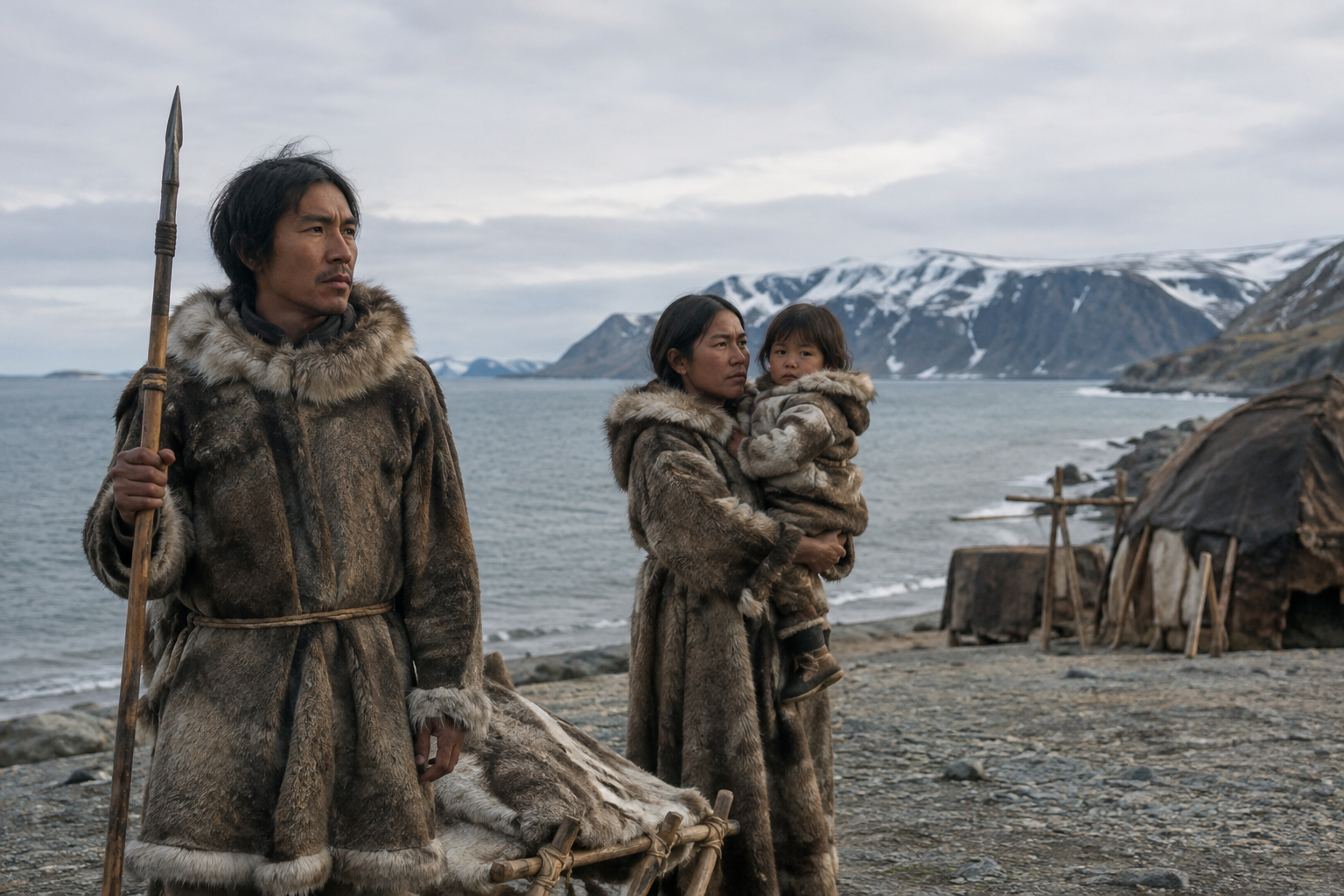
At Uelen, on the Chukotka Peninsula at the far northeastern edge of Russia, archaeologists and geneticists recovered the remains of a man dated to around AD 1035 and identified as sample I1524. It is a striking location for any Y-chromosome story: this is Bering Strait country, the narrow meeting place of Asia and the Americas, where history is written not in imperial capitals but in sea ice, coastal camps, and long-distance northern connections. For the haplogroup Q1b1a1a2, that setting matters enormously, because Q lineages belong to one of the major paternal branches associated with ancient populations of northern Eurasia and, at broader levels, with the peopling of the Americas.
That does not mean one ancient man from Uelen can stand in for all of that history. Y-DNA follows one direct paternal line only. But I1524 offers something better than a grand slogan: a real medieval person, from a real Arctic site, showing that a branch reported as Q1b1a1a2 was present in the old societies of the Bering Strait world well into the last millennium.
Uelen sits in one of the most historically important bottlenecks on earth. This is not merely "remote Siberia" in the vague sense so often used in popular writing. It is a coastal zone facing Alaska across the strait, part of a northern maritime world where people moved, traded, hunted, and maintained contacts across difficult but connected landscapes. A medieval individual from here belongs to a human geography shaped by walrus coasts, sea routes, and seasonal mobility rather than by the better-known farming states farther south.
Sample I1524 is therefore valuable not because he can be turned into a legend, but because he anchors a paternal lineage in a specific Arctic context. Research on ancient northern populations, including work published in a major ancient DNA study of northeastern Siberia and the Americas, has helped clarify how populations around this region relate to deeper population movements across North Asia and into the New World. The importance of Uelen lies in that frontier position: not an isolated cul-de-sac, but a hinge between continents.
Ancient Americas settlement waves
The first useful thing to say about Q1b1a1a2 is that it is a narrow branch within the wider haplogroup Q family. That wider family has a long and complicated history across northern Eurasia, and some of its branches became especially important in the ancestral histories of Indigenous peoples of the Americas. But one should be careful here: it would be wrong to pour the entire history of haplogroup Q into this one subclade as if every branch travelled together forever.
What the Uelen evidence supports is more modest and more interesting. It shows that a paternal line assigned within this part of Q was present in the medieval population of Chukotka. In historical terms, that places Q1b1a1a2 in a region where peoples of northeast Asia maintained enduring local continuity while also participating in wider Arctic networks. For someone researching this haplogroup today, that makes the Bering Strait region a meaningful point of reference, even if it is not the whole story.
There is a temptation in DNA storytelling to privilege only the oldest possible sample. Yet medieval evidence can be just as revealing, because it shows whether a paternal line persisted in a region long after the great prehistoric movements had passed. I1524 is useful precisely in that sense. By about AD 1035, this was not the age of first settlement, but a world of established Arctic communities with their own traditions, interactions, and demographic histories.
That matters for interpreting Q1b1a1a2. A lineage in medieval Uelen is evidence for survival and continuity in the far northeast, not simply for a one-off migration event in deep prehistory. The point is subtle but important. Many Y-chromosome articles rush too quickly from branch name to heroic migration map; archaeology is usually less tidy than that. Here, the stronger claim is regional persistence in a place that remained central to northern human history for thousands of years.
Chukotka has often been treated as a margin, but from the perspective of Arctic archaeology it is better understood as a corridor. The narrow sea crossing to Alaska is famous because it recalls the much older population history of Beringia, yet the region's significance did not end when the first Americans dispersed southward. Communities on both sides of the strait continued to inhabit an interconnected world of technology, exchange, and maritime adaptation.
That larger setting helps explain why haplogroup Q draws so much attention. In broader form, it is one of the classic northern lineages for discussions of trans-Beringian history. But the presence of Q1b1a1a2 in I1524 reminds us that these lineages were not museum pieces left behind by prehistory. They remained part of living medieval populations in the Arctic, carried by men who belonged to their own local societies, not merely to our retrospective migration diagrams.
In this respect, the Uelen sample sits comfortably beside the wider body of research on North Asian and Arctic population history. MyTrueAncestry readers interested in how ancient DNA tracks movements across eastern Eurasia may also want to compare work on broader paternal patterns in East Asia, where ancient Y-chromosome studies show how regional branches can persist, spread, and recombine across very different historical settings.
One sample is never the whole argument. But one sample can still be historically important when it comes from the right place. Uelen is exactly such a place. A medieval male from Chukotka carrying a Q-derived paternal line contributes to a map of northern continuity that links archaeology, geography, and genetics better than any romantic tale about "lost tribes" ever could.
It is also a good reminder that lineages survive through ordinary people. Not kings, not named dynasties, not neat textbook populations, but communities whose histories were shaped by coastlines, climate, kinship, and endurance. The farther north one goes, the more obvious this becomes. In regions like Chukotka, the archaeological record may be thinner than in the Mediterranean or China, but each identified individual can carry unusual historical weight.
If your paternal line belongs to Q1b1a1a2, the most defensible historical insight from the evidence here is a connection to the long northern history of haplogroup Q, with a securely relevant ancient foothold in medieval Chukotka at Uelen. That does not assign you a single ethnicity, tribe, or recent homeland. What it does offer is something firmer than fantasy: your direct paternal line belongs to a branch represented in the Bering Strait world, one of the crucial contact zones in human history between northeast Asia and the Americas.






Comments