Haplogroup O2a2b1a1a1c

– 6 min read


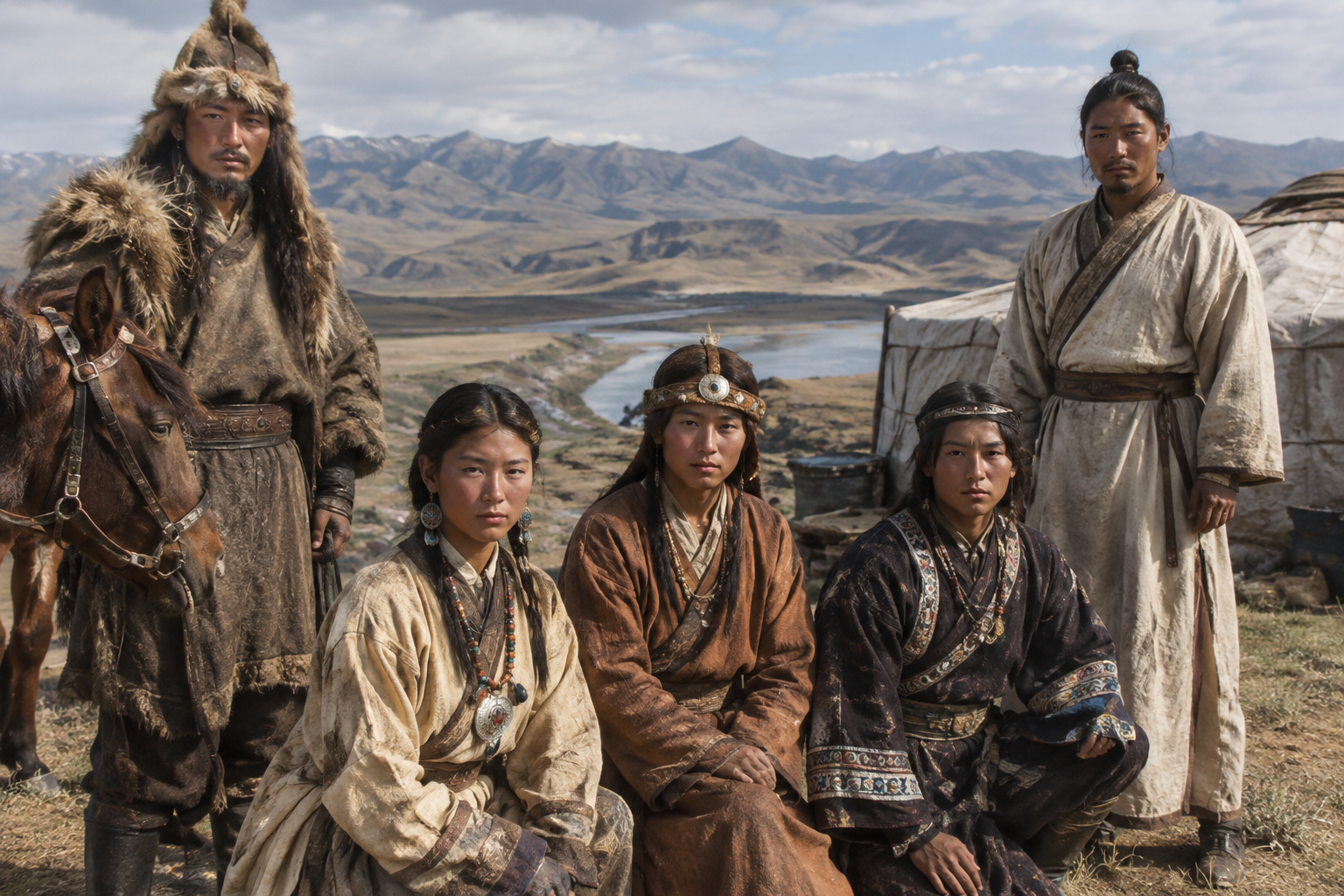
Some Y-chromosome lineages announce themselves in the grand capitals of history. Others first appear in places that are easier to miss on the map: a Bronze Age village in Qinghai, a burial from Han-era China, a grave on the Mongolian steppe. Haplogroup O2a2b1a1a1c belongs to that second category. It is interesting not because it can be made to fit a simple story, but because it sits in the middle of several of the biggest themes in East Asian history: early farming, frontier movement, river valleys, uplands, and the long traffic between northern China and the steppe.
As ever with Y-DNA, a small warning is also the most useful one. A Y-haplogroup traces one direct paternal line only: father, father's father, and so on. It does not represent a person's whole ancestry, culture, or identity. But precisely because it follows that narrow line, it can sometimes illuminate continuity and movement across astonishing spans of time. In the case of O2a2b1a1a1c, the ancient samples supplied here place that paternal thread in northwestern and northern China, and later in a steppe setting linked to the Xiongnu world.
Haplogroup O is one of the major Y-chromosome lineages of East and Southeast Asia. Within that larger tree, O2 is especially important for understanding many paternal histories in East Asia. The very specific branch O2a2b1a1a1c is a much narrower twig on that tree, and that distinction matters. We should not lazily assign to this subclade the entire history of all O or even all O2 men. What we can do, more carefully, is use the available ancient evidence to sketch the settings in which this lineage or closely related paternal lines appear.
The supplied ancient DNA points repeatedly toward the upper Yellow River and neighboring frontier zones. That is historically significant territory. Qinghai and Gansu were not peripheral in any simple sense; they were corridors, meeting grounds, and often contested spaces where farming communities, mobile herders, and later imperial states interacted. A lineage found there in the Bronze Age and again further east and north in later periods invites a sensible hypothesis: that some branches of this paternal family were part of the long demographic history linking the northwestern Chinese frontier to the wider world of northern China and Inner Asia.
If you want a broader introduction to how such paternal histories are reconstructed from ancient remains, MyTrueAncestry's overview of archaeogenetics is an excellent companion.
The earliest supplied evidence comes from Qinghai around the start of the second millennium BC. At Lajia village, Minhe County, Qinghai, China, two individuals dated to 1900 BC, LJM5 and LJM3, place this paternal signature in a Bronze Age community already famous in archaeology for dramatic preservation and for the wider cultural world of northwestern China.
There is also JCKM1-1 from Qijia Jinchankou, Qinghai, China, dated to 1910 BC. The Qijia cultural sphere has long attracted attention because it sat at an intersection: millet-farming traditions from the north China world met influences moving along the Gansu-Qinghai corridor, including technologies, animals, and ideas connected to broader Eurasian exchange. One must be cautious; a haplogroup does not equal a culture. Still, finding this paternal lineage in that setting suggests that men from this branch, or closely related ones, were part of the social fabric of those early communities.
What is striking is not merely antiquity, but geography. These are not isolated dots. They cluster in the upper Yellow River region, a landscape of river terraces, loess margins, and mountain corridors. That makes O2a2b1a1a1c historically interesting because it ties a paternal line to one of the great connective zones of ancient China.
Readers interested in that exact frontier world should also see MyTrueAncestry's piece on Bronze Age Gansu, which explores the population history of the same wider region.
By the time we reach the historical era, the lineage has not vanished into prehistory. The sample LGM41 from Han Dynasty LuoHeGuXiang, China, dated to 100 BC, shows this paternal line, or a very close relationship to it, within the world of the Han Empire. That matters because the Han period was an age of state expansion, military colonies, transport networks, and repeated movement of people across northern China and into frontier regions.
A Han-period occurrence does not prove a straight, unbroken chain from any one Bronze Age man at Lajia to this later individual. Ancient DNA rarely gives us such neat little family trees over two millennia. But it does suggest continuity of paternal branches across major political change. The men of these lineages lived through a world that shifted from local Bronze Age communities to imperial administration, taxation, armies, and long-distance exchange.
There is a useful historical lesson here. Written history can make empires look like they arrive suddenly, all banners and proclamations. Genetics often tells a more prosaic story: many imperial subjects were descended from older regional populations already rooted in the landscape long before the bureaucrats turned up.
The most arresting sample in this group is UGO002, from Ugoomor Xiongnu Period Mongolia, dated to 650 AD. The label is itself a reminder that the archaeological and historical worlds of Mongolia were shaped by long traditions of steppe confederations and post-Xiongnu successor societies. The supplied description links the burial context to the Xiongnu period, while the date is much later; responsibly, we should preserve both exactly as given rather than force the evidence into a tidier chronology than the input allows.
What can we say? At the very least, UGO002 places this paternal lineage, or a very near branch, in Mongolia in a steppe setting. That is important because it shows how a line also seen in Bronze Age and Han-era China can appear far to the north in Inner Asia. This does not mean that O2a2b1a1a1c was uniquely "Xiongnu," nor that every man in such steppe polities shared the same paternal origin. Ancient steppe populations were often mixed and mobile. But the sample does fit the larger picture of demographic connections between northern China and the Mongolian steppe.
If that world interests you, two MyTrueAncestry articles are especially relevant: one on the genetic history of the Mongolian steppe and another on Xiongnu-linked questions in the origins of the European Huns. Both help place UGO002 in a wider Eurasian context.
In this case, the supplied field for associated noble families and castles is effectively empty. That is disappointing only if one expects every haplogroup story to end in a genealogical flourish involving battlements and heraldry. In fact, it is rather refreshing. It reminds us that many of the most important paternal histories are older than surviving lineages of nobility and older than the castles through which later families advertised permanence.
For O2a2b1a1a1c, the stronger story lies not in a documented medieval dynasty but in the landscapes themselves: Qinghai's Bronze Age villages, Han China's settled and administered territories, and Mongolia's steppe burials. Those are the ancestral strongholds here, if you like: not masonry keeps, but ecological zones and cultural frontiers that endured for centuries.
That absence also offers a useful methodological point. Genetics and genealogy are related but not identical pursuits. A later noble house may preserve a surname, a pedigree, and a seat; ancient DNA preserves biological evidence from people who often left no written names at all. The two kinds of history sometimes meet, but one should never pretend they always do.
For a wider look at how ancient paternal lines shaped East Asian history across broad regions, see this related MyTrueAncestry article on ancient Y chromosomes and migration patterns.
Discover East Asian Y-DNA Paths
So what does O2a2b1a1a1c reveal? First, that a direct paternal line can be tracked in meaningful ways across very different historical settings: Bronze Age Qinghai, Han-period China, and a later burial in Mongolia. Second, that the upper Yellow River and adjacent frontiers were central to the making of northern East Asian populations. And third, that ancient DNA often complicates tidy categories. The same paternal branch can appear in settled farming communities, imperial contexts, and steppe-connected worlds.
That is the real pleasure of this evidence. It does not give us a fairy tale of a single tribe marching neatly across the map. It gives us something better: a record of human continuity through changing political and cultural worlds. Men carrying this paternal lineage may have spoken different languages, served different rulers, and lived very different lives. Their shared Y-line does not erase those differences; it simply reveals that beneath them ran a much older family thread.
If your own Y-DNA belongs somewhere near this branch, MyTrueAncestry can help you explore whether your paternal line shows affinities with ancient individuals like LJM5, LJM3, JCKM1-1, LGM41, or UGO002. Such matches do not prove direct descent from any named ancient person, nor do they make anyone a member of a historical elite. But they can place your ancestry within the real archaeological history of East Asia and Inner Asia, which is far more interesting than most family legends.






Comments