Haplogroup O2a1b1a1a1a1e1a1a
– 5 min read


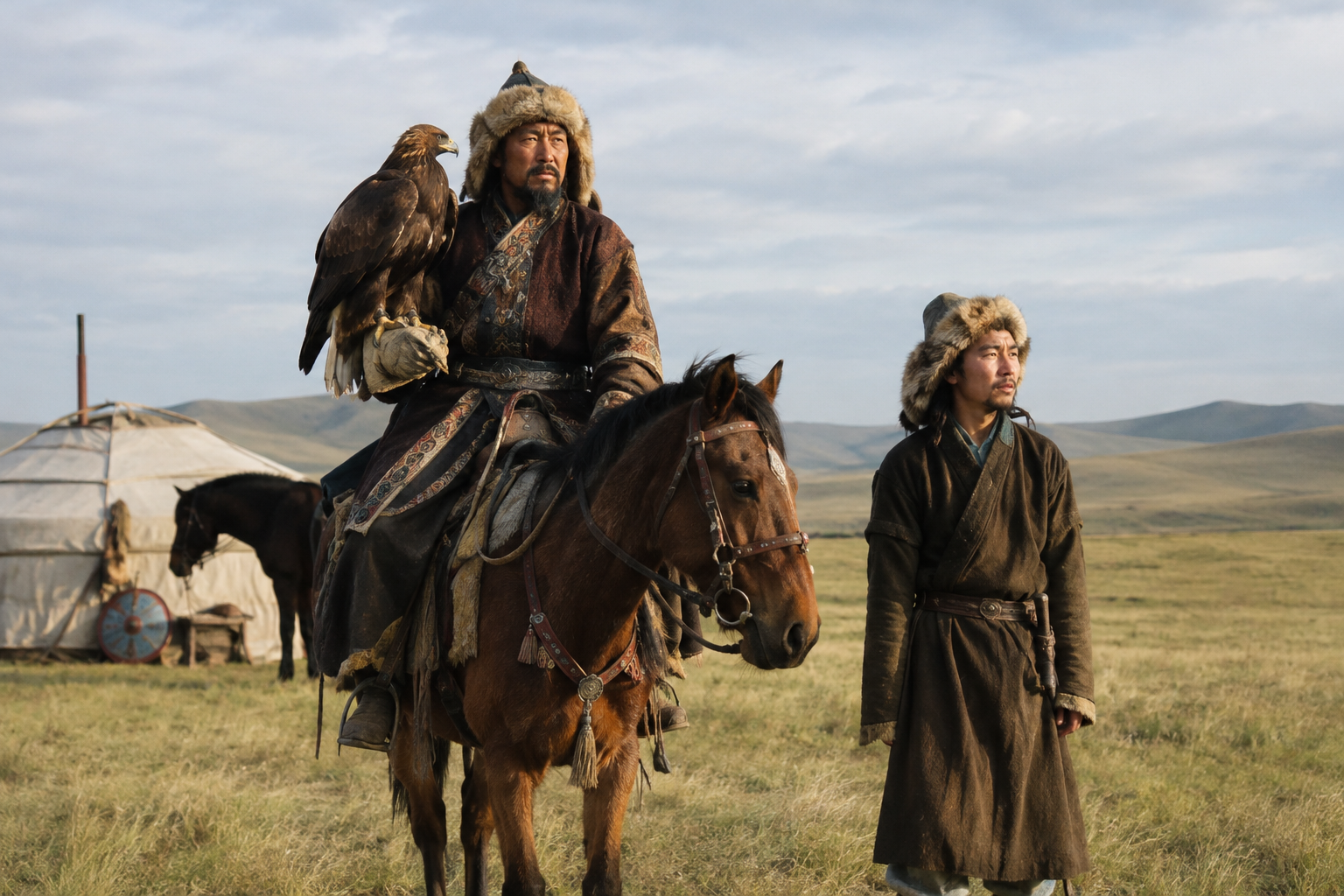
At Khalgan Khoshuu in Mongolia, one late medieval individual stands out for anyone tracing the paternal line O2a1b1a1a1a1e1a1a: sample KNN001, dated to around AD 1400. That is a strikingly specific moment in history. The Mongol Empire had long since fractured, yet the steppe was still tied together by old routes of mobility, exchange, and political memory. A Y-chromosome result from this setting does not give us a whole biography, but it does place this paternal branch in a real human landscape rather than an abstract tree of letters and numbers.
That matters because O2a1b1a1a1a1e1a1a is a very narrow branch name, while ancient DNA evidence is often much thinner on the ground than modern haplogroup charts suggest. In this case, the article's evidence is centered on a single documented ancient individual from late medieval Mongolia. Y-DNA tracks one direct paternal line only, but even one securely placed person can tell us something important about where a lineage appears in the archaeological record, and in what historical world it was living.
KNN001 comes from Late Medieval Khalgan Khoshuu, in Mongolia, with a date given as about AD 1400. Even that bare description is enough to place the sample in a vivid historical setting: post-imperial Mongolia, after the great age of Chinggisid expansion but before the political map of Inner Asia settled into the early modern order. Communities across the steppe were still shaped by herding, seasonal movement, regional alliances, and the long afterlife of imperial institutions.
For a paternal lineage like O2a1b1a1a1a1e1a1a, this context is especially useful. Mongolia in the centuries after the Mongol Empire was not an isolated world. It sat within a broad zone linking North China, Siberia, Central Asia, and eastern steppe populations. So when a branch of Y-DNA appears here, the most responsible reading is not a tidy one-line migration tale, but a reminder that steppe societies were often genetically mixed, historically connected, and far more entangled with neighboring regions than older stereotypes allowed.
A major ancient DNA project on the wider region helped establish just how deep and varied Mongolia's population history really is, from prehistoric periods into historic times. For readers wanting the broader genetic background to steppe populations, the regional synthesis behind these discussions can be found in research on ancient populations of Mongolia and the eastern steppe.
The difficulty with a lineage as specific as O2a1b1a1a1a1e1a1a is that the label can look more certain than the ancient evidence behind it. Haplogroups are nested branches: a narrow subclade sits inside broader ancestral branches, and not every ancient sample is published at the same level of detail. So it is worth keeping the distinction clear between the very precise branch name used for this article and the broader paternal background from which it descends.
In East and Inner Asia, broader branches within haplogroup O are important parts of the paternal story of many later populations. But it would be careless to project the whole history of those wider branches directly onto O2a1b1a1a1a1e1a1a itself. What KNN001 securely gives us is one late medieval occurrence in Mongolia. That is valuable evidence, but it is not proof that every earlier movement of related O-lineages belongs to this exact terminal branch.
In other words, the ancient sample anchors the lineage in time and place. It does not magically supply a fully continuous story from prehistory to the present. Archaeogenetics is most useful when it resists that temptation.
Mongolia around AD 1400 is not just "another place on the map." It is a zone where political power, trade, and population movement had been unusually intense for centuries. The Mongol imperial period had drawn together people from very different backgrounds, and its aftermath did not undo those connections overnight. Paternal lineages on the steppe could persist locally, spread through elite or ordinary family lines, or arrive through older streams of contact from neighboring regions.
That broader picture is one reason a single result like KNN001 deserves attention. Late medieval Mongolia was a meeting ground, not a genetic island. A lineage found there may reflect continuity within eastern steppe populations, the legacy of earlier integration with populations to the south and east, or both. Without a larger cluster of directly comparable ancient men from the same branch, one should not choose among those possibilities too confidently. But the setting itself tells us that O2a1b1a1a1a1e1a1a was living within one of Eurasia's classic crossroads.
This also helps correct a common misunderstanding. Steppe history is sometimes narrated only through imperial founders and conquerors, as though every male lineage in Mongolia must be reduced to a dynastic legend. Ancient DNA usually tells a more interesting story: many paternal lines coexisted, endured, and moved through these societies, whether or not they ever entered chronicles.
Although KNN001 is late medieval, the deeper significance of O-lineages in Mongolia lies in the long relationship between the eastern steppe and northern China. For millennia, these were not sealed worlds. Farming communities, frontier zones, pastoral societies, and mixed economies interacted repeatedly through trade, conflict, intermarriage, and migration. Ancient DNA increasingly shows that the boundary between "China" and "steppe" was historically porous, even when political rhetoric tried to make it sound absolute.
That does not mean every paternal branch followed the same route, or that any one sample can be assigned a neat ethnic label. It means that a lineage such as O2a1b1a1a1a1e1a1a appearing in Mongolia fits a large and well-supported historical pattern: eastern Eurasian populations were connected over long spans of time, and male lineages could move, survive, and diversify across those connections.
Readers interested in the longer background to eastern East Asian paternal history may want to compare this with broader work on ancient Y-chromosomes and East Asian population structure. The same general question - how coastal and inland movements shaped later paternal diversity - is explored in MyTrueAncestry's discussion of ancient Y-chromosomes in East Asia.
There is an awkward honesty required in writing about some haplogroups. Here, we do not have a grand cemetery full of men from the same narrow branch, nor a documented royal house attached to the lineage, nor a chain of father-son burials across centuries. What we do have is one ancient anchor point, and sometimes that is exactly where good history starts.
KNN001 shows that this paternal line, or at least the branch assigned to it in this context, was present in late medieval Mongolia. That makes O2a1b1a1a1a1e1a1a part of the human story of the eastern steppe: a world of mounted mobility, frontier exchange, and post-imperial continuity. Sparse evidence does not make the story smaller; it makes precision more important.
That precision is especially valuable for family historians. If your Y-DNA falls within O2a1b1a1a1a1e1a1a, the ancient record does not yet give you a neat named tribe or dynasty. What it does give you is something sturdier: a documented appearance of this paternal line in the Mongolian world around AD 1400, within a region whose history was shaped by long-range contact across Inner and East Asia.
The distinctive insight for O2a1b1a1a1a1e1a1a is not a claim of famous descent, but a firm archaeological foothold. Sample KNN001 places this paternal branch in late medieval Mongolia, in a landscape shaped by the enduring networks of the eastern steppe. For someone researching this lineage today, that is a meaningful clue: your direct paternal line belongs to a history connected to Inner Asia's mobile societies and the deep ties between Mongolia and neighboring East Asian worlds.






Comments