Haplogroup O1b2a1a1a

– 5 min read


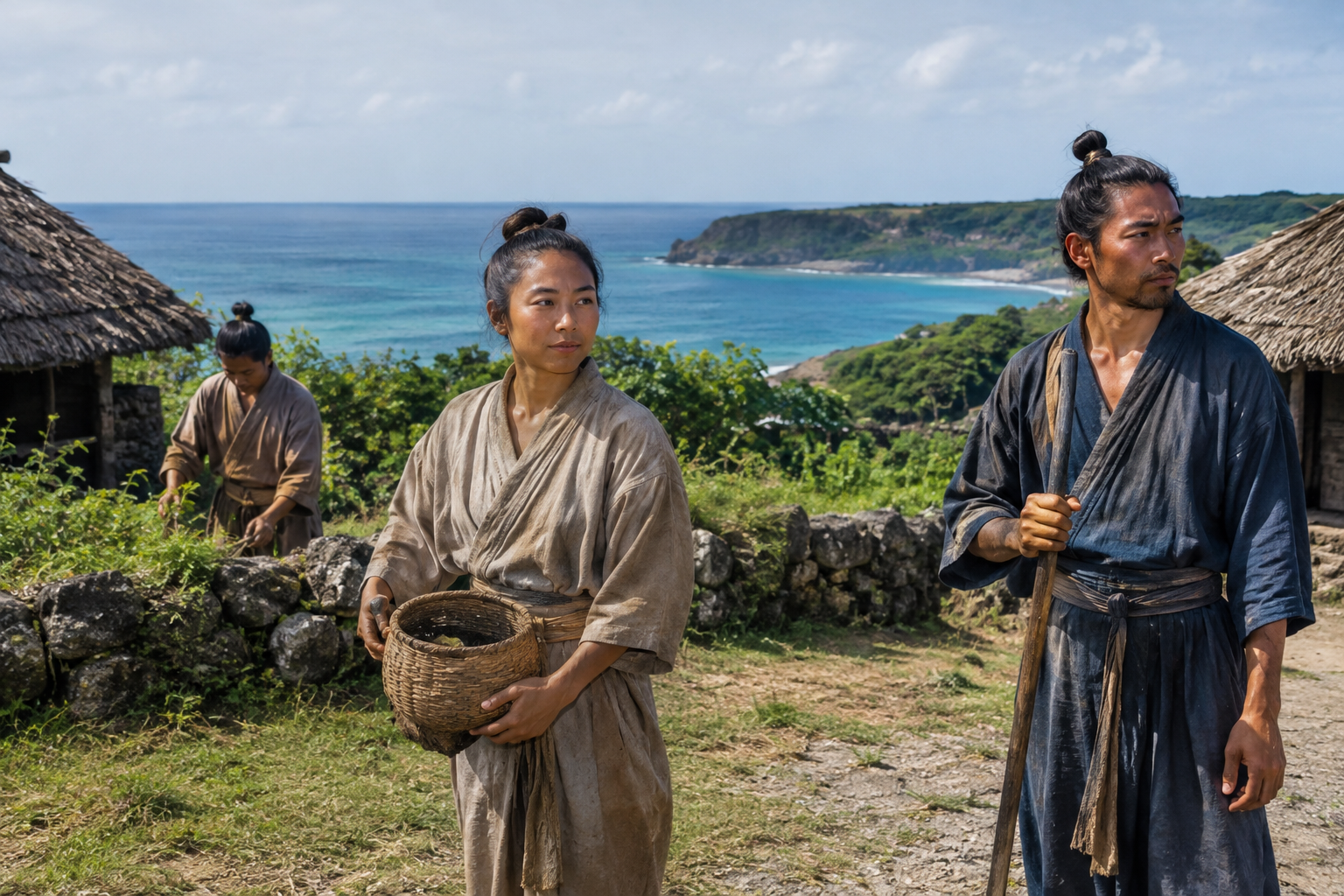
One of the clearest ancient signposts for Y-DNA haplogroup O1b2a1a1a comes from Okinawa, where sample NAG007, dated to around AD 400, was recovered from the historic Ryukyu Islands. That is a useful moment to pause over. By the 5th century, Okinawa was not some isolated footnote on the edge of East Asia, but part of a maritime world shaped by island movement, local continuity, and contact with the Japanese main islands and beyond.
NAG007 matters because haplogroups are often discussed as if they were floating abstractions. Here, by contrast, we have a man from a real place and a real period whose paternal line is associated with O1b2a1a1a. Y-DNA traces one direct male line only, not a person's whole ancestry, but even that narrow line can be historically revealing when it turns up in a securely dated ancient individual.
AD 400 sits well before the later, better-documented Ryukyu Kingdom. The Okinawan world of this period belongs to a deeper island history: communities living in the southern arc of the Japanese archipelago, tied to older local traditions but also increasingly connected to wider currents of exchange. A paternal lineage like O1b2a1a1a appearing in this setting is not a dramatic surprise, but it is valuable because it anchors discussion of the lineage in a specific archaeological landscape rather than in modern frequency maps.
That matters especially in the Ryukyus, where prehistory and history do not line up neatly with the better-known narratives of the Japanese mainland. The islands have long shown signs of both continuity and interaction. Ancient DNA has been especially important here because it helps test whether lineages seen in living populations reflect deep local roots, later migration, or some mixture of both.
O1b2a1a1a is a narrow branch within the broader O family of Y-chromosomes, one of the major paternal groupings in East and Southeast Asia. It should not be treated as shorthand for a single people, language, or political identity. A subclade can persist through many cultural changes, surviving shifts in speech, social structure, and allegiance that archaeology and written history register far more directly than a Y-chromosome ever could.
Still, the branch is historically interesting because broader O-related paternal lineages are strongly associated with East Asian population history, including movements along coasts and through island chains. That does not mean every carrier followed the same route, or that a single migration event explains all later appearances. What NAG007 gives us is something much more solid: evidence that this paternal line, or a lineage closely associated with it, was present in historic Okinawa by late antiquity.
That kind of evidence fits neatly with the larger trend seen in East Asian archaeogenetics, where ancient Y-chromosome studies are beginning to separate older coastal patterns from inland ones. For readers interested in that bigger frame, MyTrueAncestry has also explored these questions in Ancient Y Chromosomes Reveal Coastal and Inland Migrations that Shaped East Asian Paternal History.
There is a temptation, especially in popular history, to treat Okinawa merely as an offshoot of whatever was happening in Kyushu or central Japan. Archaeology has been steadily correcting that habit. The Ryukyus had their own long sequence of settlement, their own local material traditions, and their own rhythms of contact. Ancient individuals from Okinawa therefore deserve to be read first in island context, not simply as lesser versions of mainland cases.
For O1b2a1a1a, that makes NAG007 especially useful. The sample does not prove that the lineage originated in Okinawa, nor does it prove uninterrupted descent from one ancient island population to every modern carrier. What it does show is that this paternal signature had entered, or persisted within, the human story of the Ryukyus by a historically meaningful date.
This is also why Ryukyu genetics has attracted growing attention in recent years. Studies of ancient island populations have begun to show how local ancestry components survived into later times, even while outside connections changed the population mix. Readers who want more on that island-specific perspective may find this related post helpful.
Ancient DNA at Katsuren Castle
With only one named ancient individual in view here, the honest approach is a careful one. NAG007 is not a dynasty, not a whole tribe, and not a census of Okinawa around AD 400. He is one man from one archaeological setting. But one well-placed individual can still matter a great deal when ancient DNA from a region is relatively scarce.
In practical terms, NAG007 helps place O1b2a1a1a in the archipelago's historical record. If you carry this haplogroup today, the sample suggests that closely related paternal lines were present in the Ryukyus in late antiquity. That is more informative than vague claims about East Asia in general, because it ties the lineage to a dated human life in a particular island world.
This is a familiar lesson across archaeogenetics. Ancient DNA rarely hands us a complete family tree for a haplogroup, but it does provide checkpoints. In regions like Okinawa, where written documentation for early centuries is limited, such checkpoints are especially valuable.
It is worth being cautious with labels like "Japanese," "Ryukyuan," or even "Jomon-derived" when discussing a Y-lineage. Those are not interchangeable categories. A paternal branch can survive across different cultural horizons, and populations can absorb newcomers without losing all continuity with earlier inhabitants.
That is precisely why the Ryukyu case is so interesting. The islands sit between larger narratives: the peopling of the Japanese archipelago, maritime links through the East China Sea, and later state formation in Okinawa. A lineage such as O1b2a1a1a belongs inside that complicated history. It is best understood not as a badge of ethnicity, but as one thread in a population shaped by both endurance and contact.
For a wider Japanese historical setting, the community article on The Imperial House of Japan offers a very different kind of evidence base: dynastic history rather than an island archaeological sample, but still part of the broader story of how Japan's past is reconstructed.
The most distinctive thing about haplogroup O1b2a1a1a in this case is not a grand migration claim or an invented royal pedigree. It is the simple, sturdy fact that an ancient man from historic Okinawa, NAG007, connects this paternal branch to the Ryukyu Islands around AD 400. For anyone exploring this haplogroup today, that offers a historically grounded clue: your direct paternal line belongs to a branch that was already part of the human landscape of the southern Japanese archipelago in late antiquity.
That is how ancient DNA is most useful when handled properly. It does not flatten history into slogans. It puts a lineage back into place: in this case, on an island chain with its own deep past, its own connections, and one quietly important man whose Y-chromosome still helps tell the story.






Comments