Haplogroup O1b1a2

– 5 min read


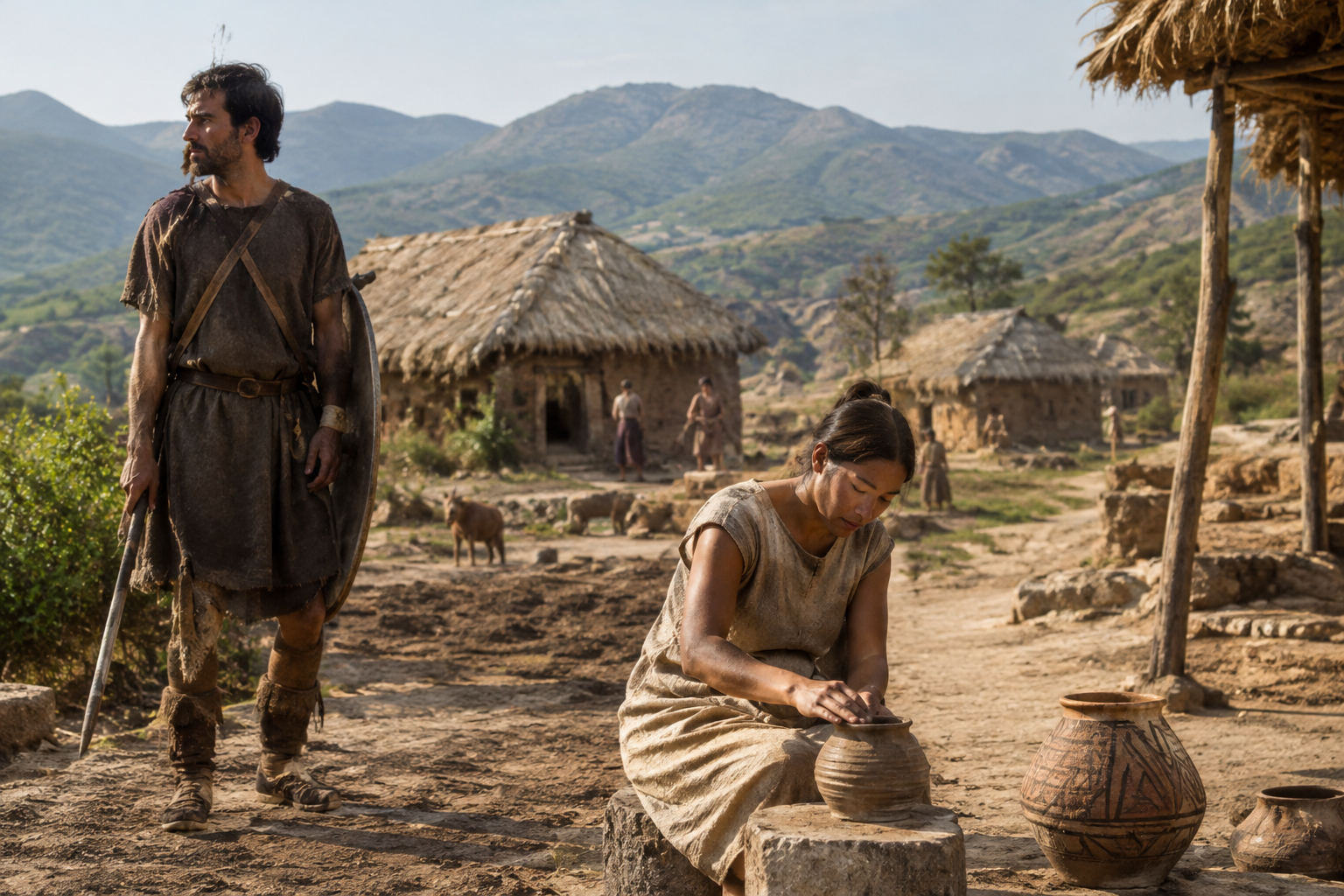
At Wanggou Village in Henan, one ancient male known as WGM94 takes us into a very early chapter of paternal history. He belonged to the Yangshao horizon, around 3230 BC, in the Middle Yellow River region where some of northern China's best-known Neolithic farming communities were taking shape. For anyone interested in Y-DNA haplogroup O1b1a2, that matters because it places this paternal branch, or at least a lineage reported within it, in one of the great agricultural landscapes of prehistoric East Asia.
That is already enough to make O1b1a2 interesting. It is not simply a modern label on a testing report. In the ancient record we have here, it appears in very different settings: once in Neolithic Henan, and again in an Early Iron Age burial from Didnauri in Georgia, represented by sample geo006 around 1049 BC. Those two points do not tell us a complete story, and they certainly do not map a neat single migration route. But they do show something archaeologists often find more revealing than a tidy legend: a paternal line turning up in very different worlds.
Wanggou Village sits in Henan, deep in the historical core of the Middle Yellow River zone. By the late Yangshao period, communities in this region were living in settled agricultural landscapes shaped by millet farming, local exchange, and increasingly varied village life. When a male individual such as WGM94 is associated with O1b1a2, the result is not just a technical haplogroup assignment. It anchors that paternal line in a real archaeological setting: one of the earliest large and well-studied farming regions in northern China.
That context matters because Y-DNA tracks only one line of descent, father to son, while the individual himself would have belonged to a much broader web of ancestry and kinship. Still, direct paternal lines can illuminate social continuity. In a village world where households, land use, and burial grounds mattered, a lineage like O1b1a2 may have been part of the long demographic processes that helped shape later populations in and beyond northern China.
A broader ancient DNA discussion of this region's long population history can be found in MyTrueAncestry's post on the Middle Yellow River.
One reason to be cautious, though, is that ancient Y-DNA labels can sit at different levels of resolution. A study may securely place an individual in a wider branch, while later databases or derived reports place him within a narrower one such as O1b1a2. That does not make the result useless; it simply means the precision of the label must be handled carefully. For the reader, the sensible takeaway is that WGM94 connects this paternal tradition to Neolithic north China, even if every downstream twig of the lineage tree is not equally certain from every publication.
Haplogroup O is one of the major Y-chromosome families of East and Southeast Asia, but that broad fact should not be mistaken for the full history of O1b1a2 itself. A narrower branch can have its own regional concentrations, expansions, and local histories. The evidence in hand does not justify writing a grand single-origin epic for this exact subclade. What it does justify is something more archaeologically grounded: O1b1a2 belongs to a paternal landscape that was already present in ancient East Asia and later appears in unexpectedly wide contexts.
That kind of pattern is familiar to archaeogenetics. Y-chromosome branches can persist for long periods, move through trade or migration, appear in frontier zones, and survive inside populations whose language, culture, and political identity changed dramatically over time. In other words, a paternal lineage may travel through history without carrying a fixed ethnic badge.
An ancient DNA study examining East Asian paternal history in archaeological context is linked here: https://www.nature.com/articles/s41467-020-16557-2. It is especially relevant for thinking about how lineages in the Yellow River world fit into longer-term regional population change.
The second ancient individual in this small but striking record is geo006 from Didnauri in Georgia, dated around 1049 BC. This is a very different world from Neolithic Henan. We are now in the South Caucasus, in the Early Iron Age, among communities living in a region long shaped by movement between steppe, plateau, and Near Eastern spheres.
That a sample associated with O1b1a2 appears here is exactly the sort of finding that prevents simplistic storytelling. It does not mean that the Didnauri man was "Chinese," nor does it license a direct line from one excavated individual in Henan to one in Georgia. What it does show is that paternal branches usually thought of in East Asian contexts could also appear far to the west in complex frontier societies.
The South Caucasus was never an isolated pocket. Over millennia it connected the Black Sea, the Caspian, the Iranian plateau, Anatolia, and the Eurasian steppe. Ancient DNA work on the region has repeatedly shown a history of mixture, continuity, and incoming influences rather than a single frozen population. In that sense, geo006 is not an anomaly so much as a reminder that the Caucasus was a crossroads in the deepest archaeological sense.
For readers following Caucasus archaeogenetics more broadly, MyTrueAncestry has also covered long-term population history in the region.
Two ancient samples do not define the whole history of O1b1a2. But they do something more useful than a sweeping map full of arrows. They place the haplogroup in two concrete archaeological settings separated by more than two thousand years and a great deal of geography: a Yangshao farming community in the Middle Yellow River region, and an Early Iron Age burial in Georgia.
That spread invites historical questions rather than instant conclusions. Was this branch carried westward through multiple episodes of movement across Inner Asia? Did it survive at low frequency in populations connected by exchange networks, marriage, or frontier mobility? Or are we seeing two distant appearances of a broader paternal family whose deeper structure is still under-sampled in ancient DNA? At present, the evidence supports the question better than a final answer.
Research on ancient East Asian paternal structure is especially relevant here because it shows how much detail can emerge once more male lineages are sampled across time. MyTrueAncestry's discussion of ancient Y chromosomes in East Asia is a good companion piece.
There is also a useful wider lesson. Archaeology often tempts us into thinking in blocks: farmers here, steppe people there, mountain peoples somewhere in between. But paternal lineages do not always respect those tidy compartments. A single branch can pass through settlements, chiefdoms, mobile communities, and mixed frontier populations without preserving a simple cultural label.
If your paternal line falls under O1b1a2, these ancient finds suggest a lineage with real depth in East Asia and at least occasional appearance far beyond its more familiar heartlands. WGM94 ties the branch to the Neolithic farming world of Henan, while geo006 shows that by the Early Iron Age, related paternal ancestry could also be present in the South Caucasus. That does not turn your Y-DNA into a personal map of one migration, but it does place your direct paternal line in a history of settlement, movement, and survival across very different ancient societies.
For readers interested in East Asian family structures and later historical DNA from China, this related article offers another useful angle.






Comments