Haplogroup O1a2

– 5 min read


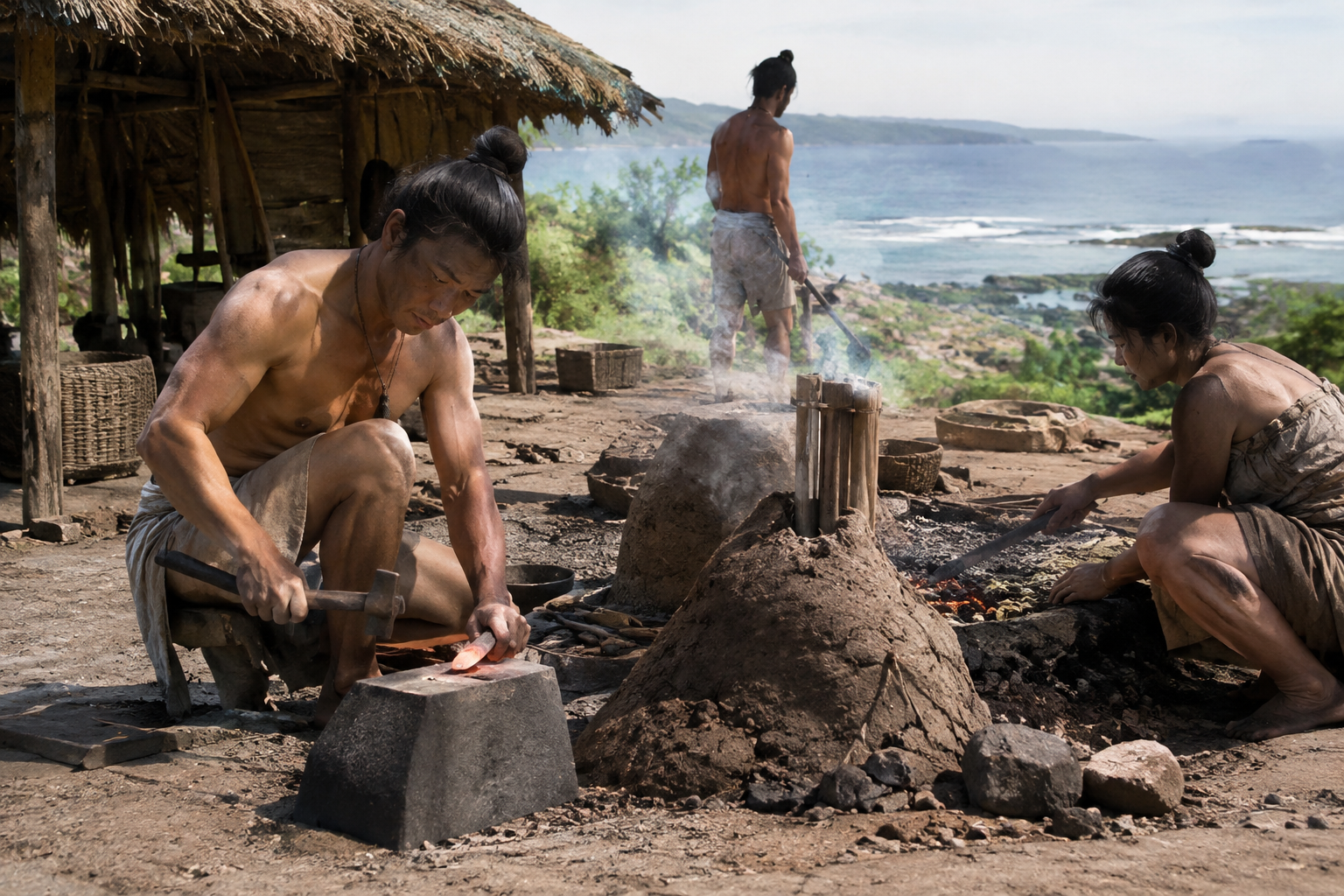
At Hanben on Taiwan's eastern coast, archaeologists uncovered an Iron Age community whose remains speak to a surprisingly connected world. One of the men from the Blihun metalworking phase, sample I15158, dated to around AD 400, has been associated with Y-DNA haplogroup O1a2. That is a small technical label, but it opens a large historical question: what does a paternal line like this tell us about the men living in Iron Age Taiwan at the moment when metallurgy, seafaring exchange, and local community life were all meeting in one place?
The answer needs care. Y-DNA traces one direct paternal line only, not a person's whole ancestry, language, or identity. But when a lineage such as O1a2 appears in an ancient individual from Hanben, it becomes a useful thread in a wider archaeological story about Taiwan, the Austronesian world, and the coastal movements that helped shape East Asian paternal history.
Hanben is important because it is not just a burial spot with a convenient DNA result attached. It belongs to a coastal archaeological landscape in eastern Taiwan where Iron Age communities were participating in changing technologies and regional contacts. The description attached to I15158 places him in the Blihun Metalworking Period, a label that immediately matters more than any romantic tale of origins. It tells us that this man lived in a society where metal use had become part of local life, and where Taiwan was not isolated from the maritime currents of the wider region.
That setting gives O1a2 real interest. This haplogroup sits within the wider O family of East Asian Y-chromosome lineages, and branches related to O1a have often been discussed in connection with coastal populations and island Southeast Asia. Still, one ancient Taiwanese man is not proof of a single grand migration. What I15158 does provide is something much better: hard evidence that a paternal line now associated with parts of coastal East and Southeast Asia was present in Iron Age eastern Taiwan.
An ancient DNA study of Taiwan and Island Southeast Asia, published here in research on the region's population history, helped frame Taiwan not as a remote fringe but as a key node in larger human movements. That broader context makes a Hanben-associated O1a2 lineage especially suggestive, even when we keep the individual sample itself firmly anchored to its own site and period.
East Asian Y-chromosome migrations
Taiwan has long occupied a central place in debates about the peopling of the Pacific and the spread of Austronesian-speaking peoples. Linguists, archaeologists, and geneticists do not always ask exactly the same questions, and that is worth remembering. A Y-DNA haplogroup is not a language family. Yet some paternal branches can still illuminate how communities formed, mixed, and expanded.
O1a2 is most meaningful here as part of a coastal pattern. In broad terms, lineages in this neighborhood of the Y-chromosome tree are frequently discussed in populations distributed around southern China, Taiwan, and maritime Southeast Asia. The Hanben sample does not by itself date the origin of O1a2, nor does it prove that every earlier or later Taiwanese group carried it. What it does show is that by about AD 400 this paternal branch, or a lineage classified within that branch in available reporting, was present in an Iron Age community on Taiwan's east coast.
That matters because eastern Taiwan is not the first place many casual histories look when they imagine the making of the ancient world. Yet coastal margins are often where large historical processes become visible: trade, marriage exchange, craft transmission, and small-scale mobility. O1a2 at Hanben fits that sort of history better than any simple tale of a lone migration wave.
There is a temptation, whenever DNA appears, to turn every individual into a signpost on a map. Archaeology usually gives a better lesson. Hanben's significance lies in showing an established local community living through technological and social change. The phrase "metalworking period" is doing a lot of work here. It places I15158 in a Taiwan that was engaged with new materials and, almost certainly, with the networks by which those materials, skills, and ideas circulated.
For paternal-line research, this is a helpful corrective. If your own Y-DNA falls within O1a2, the most responsible ancient comparison is not a fantasy of direct descent from one excavated man. It is the recognition that your paternal line belonged to a population world that included coastal interaction, island settlement, and long-lived communities in and around Taiwan.
That is also why ancient Taiwan deserves to be discussed alongside the wider prehistory of East Asia. The island was not merely a departure point in someone else's migration model. It was home to real communities with their own histories, and samples like I15158 let us see one of those histories in sharper outline.
Ancient DNA in historical China
With only one directly supplied ancient sample in this article, the sensible question is how far we can go. Not very far if we are trying to reconstruct a dynasty, a tribe, or a single migration route. Much further if we are asking what kinds of paternal histories were already established in the coastal East Asian sphere by late antiquity.
Sample I15158 suggests that O1a2 had already become part of the paternal landscape of Iron Age Taiwan. That does not mean everyone at Hanben belonged to the same lineage, and it does not mean that O1a2 defines the site's people any more than one surname defines a modern town. But it is a genuine anchor point. Ancient DNA often works best not by giving us everything, but by giving us one secure foothold where before we had none.
Seen that way, Hanben helps bridge scales of history. At the local scale, it is an archaeological site on Taiwan's eastern seaboard during a metalworking phase around AD 400. At the regional scale, it belongs to the same broad maritime arena that connected Taiwan with neighboring coasts and islands. At the genetic scale, O1a2 becomes part of the growing picture of how East Asian paternal lineages were distributed across these connected shores.
Ancient Indonesia's genetic divide
For members of the MyTrueAncestry community, the most distinctive point about O1a2 is not royal glamour or an invented clan saga. It is that this haplogroup is glimpsed here in a real man from Iron Age Taiwan, I15158, living in a coastal metalworking society around AD 400. That makes O1a2 a lineage with a documented place in the maritime history of East Asia, and especially in the human story of Taiwan.
If this is your paternal haplogroup, Hanben offers something solid: evidence that one branch of your direct male line was present in an island community shaped by coastal contact, technology, and continuity. It is a small window, but a clear one, and in ancient DNA that is often where the best history begins.






Comments