Haplogroup N1c1a1a

– 5 min read


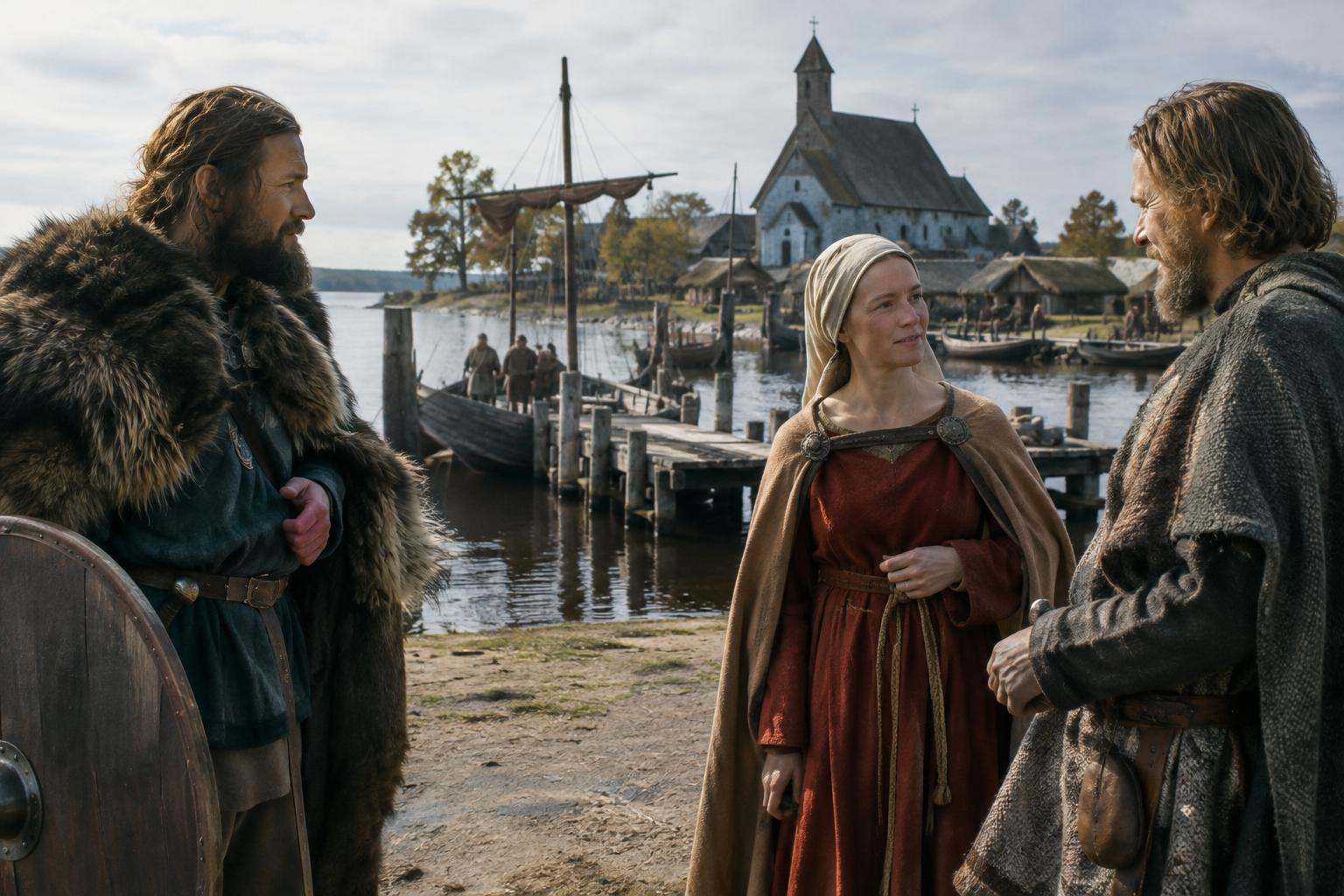
At Sigtuna in Sweden, three medieval male burials stand out for a very specific reason. One Viking Age individual, nuf001, dated around AD 935, and two later medieval individuals, mbs172 and mbs142, dated around AD 1100, have been associated with the Y-DNA haplogroup N1c1a1a. That matters because Sigtuna was not some remote village at the edge of events. It was one of the first true towns of medieval Sweden, a royal and ecclesiastical center where trade, migration, and conversion were all entangled.
So the interest here is not simply that a paternal lineage turns up in Sweden. It is that N1c1a1a, a branch within the wider haplogroup N, appears in a place that was actively assembling a new Scandinavian urban world. Y-DNA traces one direct paternal line only, not a person's whole ancestry, but in this setting even a handful of male lineages can illuminate the human traffic moving through an early northern town.
Sigtuna was founded in the late 10th century and quickly became one of the most important places in early Christian Sweden. Coins were minted there, churches were built there, and people buried there belonged to a community living through large political and religious change. In other words, this is exactly the kind of site where archaeologists would expect to see evidence of both continuity and mobility.
The three relevant samples do not give us a ready-made family saga, and it would be wrong to invent one. But they do show that N1c1a1a was present at Sigtuna across more than one burial horizon: first with nuf001 in the Viking Age, then again with mbs172 and mbs142 in the medieval town around AD 1100. That repeated appearance suggests that this paternal line was not a one-off curiosity.
An ancient DNA study examining medieval Swedish burials has helped frame these questions of kinship and community in towns such as Sigtuna, and a research project focused on biological and social kinship reflected in genomes from medieval Swedish multiple burials shows how genetics can be used to ask who lived together, who was related, and how burial grounds reflected social life rather than just raw biology.
Medieval Swedish graves and kinship
Haplogroup N1c1a1a belongs to a broader Y-chromosome family that today is especially important in parts of northern and northeastern Europe, including among several Finnic-speaking populations, as well as further east across northern Eurasia. That broad pattern is useful background, but it should not be lazily collapsed into a single migration story. A narrow branch such as N1c1a1a is not automatically a label for one people, one language, or one event.
Still, in medieval eastern Scandinavia the appearance of such a lineage is historically plausible and archaeologically interesting. The Baltic was not a barrier. It was a corridor. Sweden's eastern contacts linked the Mälaren region to Finland, the eastern Baltic, and the wider trading world stretching toward the rivers of northern Eurasia. A paternal lineage like N1c1a1a in Sigtuna fits that larger picture of movement around the Baltic Sea rather well.
That does not mean that every man carrying this lineage was newly arrived, nor that the three Sigtuna males were closely related. It means that this branch was part of the male-line diversity present in a formative Scandinavian town, one whose population was being shaped by trade, politics, marriage, and migration.
The earliest of the three samples, nuf001, belongs to Viking Age Sigtuna around AD 935. That date places him close to the period when the site was becoming prominent in central Sweden. His association with N1c1a1a suggests that this paternal line was already present in the region at the threshold of urban growth and state formation.
Then come mbs172 and mbs142, both from medieval Sigtuna around AD 1100. By then Sigtuna was a much more established Christian town. The repeated presence of the same haplogroup across this span hints at persistence: whether through one local lineage, several unrelated men from similar paternal backgrounds, or continued contact drawing in men from neighboring Baltic zones, the branch remained part of the town's demographic mix.
What is striking is the timing. These are not samples from one frozen moment. They belong to a century and a half in which Swedish society was changing fast. Seeing N1c1a1a on both sides of that transition reminds us that early medieval urbanization did not erase older regional links; if anything, it intensified them.
Early Christian DNA in Scandinavia
To understand why this matters, it helps to think geographically. Sigtuna sat in the orbit of the Baltic, and the Baltic in the Viking and early medieval periods was a network of ports, landing places, markets, and seasonal routes. People moved not just as raiders or rulers but as spouses, servants, traders, clergy, craftspeople, and children.
In that world, lineages associated today with Finland or other northeastern Baltic regions could appear in Swedish towns without requiring any melodrama. The historical reality is simpler and more interesting. Early medieval Scandinavia was full of overlapping identities and local histories. A Y-chromosome lineage could travel with an individual migrant, persist in a settled family for generations, or reflect older population layers already present in eastern Scandinavia.
Large-scale genomic work on the Viking world has also emphasized how mobile and mixed these populations were. Research published on ancient populations across the Viking diaspora in Cell helped underline a now familiar lesson: Viking Age society was not genetically uniform, and local Scandinavian communities already contained considerable diversity.
Early medieval Finland and Baltic links
A single ancient carrier of N1c1a1a in Sweden could be dismissed as an isolated case. Three men from Sigtuna, spread across the Viking Age and medieval period, are harder to wave away. They do not prove a dynasty, an ethnic bloc, or a simple east-to-west migration route. But they do show that this paternal branch belonged to the lived population of one important Scandinavian center.
That is exactly the scale at which ancient DNA is often most revealing. Not in grand claims about whole peoples, but in demonstrating who was actually present in a specific town, at a specific time, during a specific historical transformation. Sigtuna was a place where old Scandinavian power, Christian institutions, and Baltic connections met. N1c1a1a was part of that story.
For men researching this haplogroup today, the Sigtuna evidence offers a grounded historical image: not a mythical founder, but real medieval individuals in an early Swedish town whose paternal line linked them into the wider northern world.
Finnic peoples and Y-chromosomal history
The best-supported insight from these burials is modest but important. N1c1a1a was present in Sigtuna from the Viking Age into the medieval town, placing this paternal line inside one of the key urban and political settings of early Sweden. That does not tell every carrier of N1c1a1a exactly where his direct paternal ancestors lived a thousand years ago, but it does show that this lineage belonged to the real human mixture of the Baltic-Scandinavian world at a decisive moment in history.






Comments