Haplogroup N1c1a1

– 5 min read


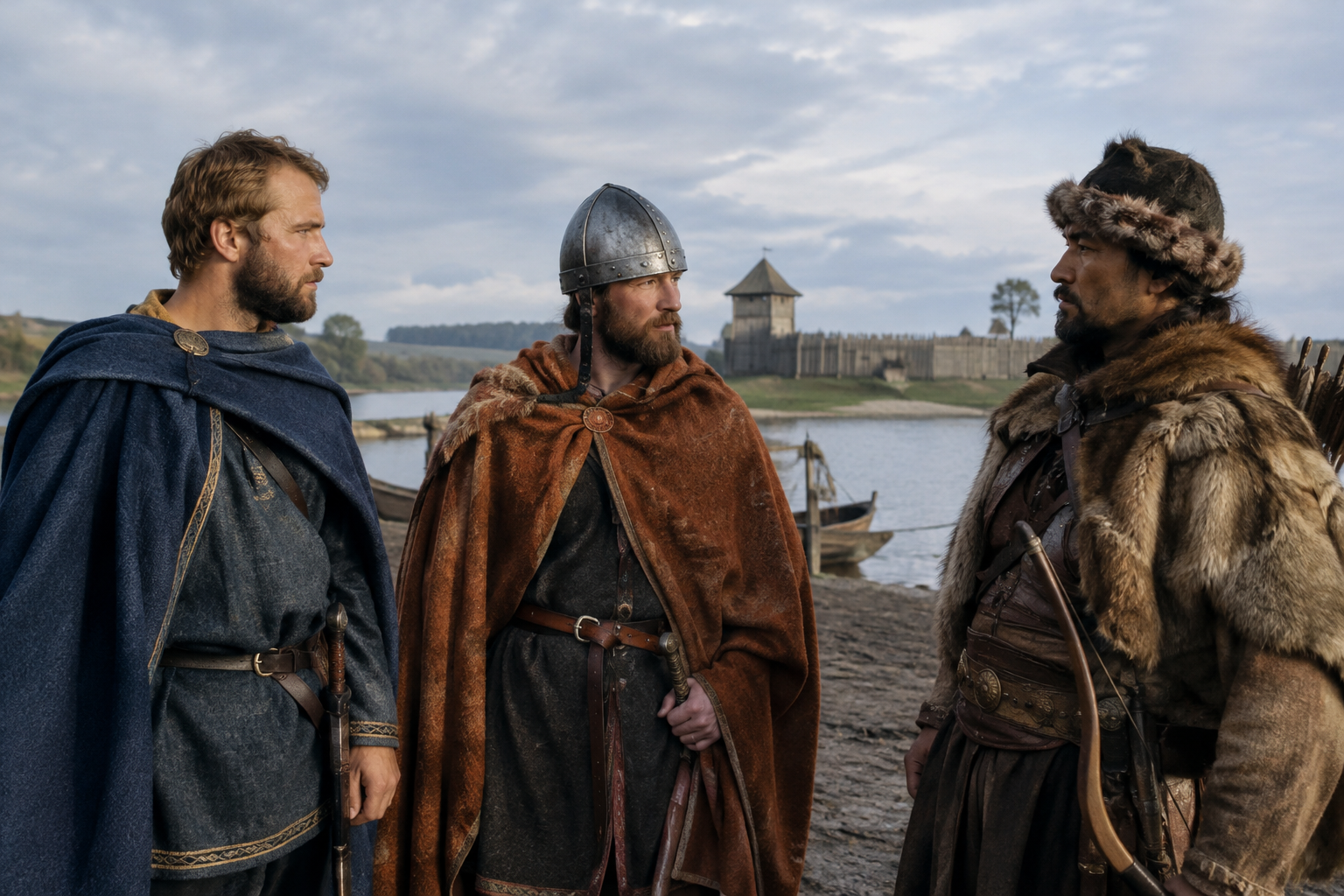
In medieval Sigtuna, one of Sweden's earliest towns, a man identified as mbs121 was buried around AD 1100. On its own, that sounds like a small fact from a cemetery register. But when a paternal lineage such as N1c1a1 appears in a town like Sigtuna, it opens a rather larger historical question: how did a Y-chromosome line most strongly associated with northern and northeastern Eurasia come to sit inside the social world of a Christian Scandinavian town at the turn of the 12th century?
The answer is not a fairy-tale of a single migration or a lost royal house. It is more interesting than that. N1c1a1 is a Y-DNA branch found today especially among several Uralic-speaking and northeastern European populations, and ancient DNA keeps showing that its history in Europe is tied to long processes of movement, mixing, and local settlement. Y-DNA tracks one direct paternal line only, not a person's whole ancestry, but it can still be a remarkably sharp tool when placed inside real archaeological settings.
Sigtuna was not an isolated village. Founded in the late 10th century, it was a royal and ecclesiastical center, a place of coinage, trade, conversion, and burial in a newly Christian landscape. A man like mbs121 belonged to that urban world, where identities were being made not just through kinship but through institutions, markets, and religion.
That matters for interpreting N1c1a1. Its presence in medieval Sigtuna does not mean the town was somehow "Finnic" in a simple ethnic sense, nor does it turn one burial into evidence for a mass migration. What it does suggest is that paternal lines associated with the eastern and northern Baltic world had become part of medieval Swedish society by this period. That fits the broad historical picture of intense movement across the Baltic, where merchants, clerics, craftsmen, captives, and families crossed water far more often than older nationalist histories once allowed.
An ancient DNA project focused on medieval Swedish burials has explored precisely these questions of biological and social kinship in urban and churchyard settings, offering an important framework for how such individuals can be understood in context rather than as isolated genetic curiosities. See the research background here: https://www.rj.se/en/grants/2016/biological-and-social-kinship-reflected-in-genomes-from-medieval-swedish-multiple-burials/.
The second Swedish sample, mbv110 from Medieval Vasterhus, dated around AD 1313, adds a different setting. Vasterhus, on Jamtland's Frösön, is not the same kind of place as Sigtuna. Instead of an early royal town, we are in a rural churchyard in an inland region with its own long history of contacts running west into Norway and east toward the forest and lake districts of the Baltic north.
This is exactly why the pairing of Sigtuna and Vasterhus is so useful. N1c1a1 is not appearing only in one exceptional urban center. It shows up in two quite different medieval Swedish environments: one a politically significant town in central Sweden, the other a burial ground in Jamtland. That does not prove continuity from any single founding family, but it does point to the branch being established in more than one social and geographic niche.
For historians of Scandinavia, this is a helpful corrective. Medieval Sweden was not built solely out of lineages moving westward from a stereotyped "Viking" core. The kingdom and its regions grew within a wider Baltic and northern Eurasian zone, where Saami, Finnic, Scandinavian, and steppe-linked histories sometimes touched, sometimes overlapped, and sometimes merged into local populations in ways only now becoming visible.
Early medieval Finland and Baltic links
With haplogroups, scale is everything. N1c1a1 is a fairly specific label within haplogroup N, but the deeper history of haplogroup N as a whole stretches across enormous distances and many millennia. One must be careful not to collapse all of that into a single story. The fact that medieval Swedish individuals carried N1c1a1 does not by itself tell us when their paternal ancestors first entered Scandinavia, whether they spoke Norse, Finnic, or Saami languages, or how they identified in life.
Still, the branch is historically informative because it has a strong association with northeastern Europe and adjacent northern Eurasian populations. In Scandinavian contexts, that often raises questions about eastern Baltic contacts, movements connected with forest-zone populations, and the gradual formation of medieval communities in regions where cultural frontiers were never as tidy as modern maps suggest.
The most responsible reading is therefore cumulative. One N1c1a1 burial might be a surprise. Two in medieval Sweden, in different settings, begin to look like part of a real regional pattern. They hint that paternal lines with northeastern affinities were not marginal visitors but participants in the making of medieval Scandinavian society.
The third sample in this group is the most dramatic chronologically: TGH012, described as a Hun Invader from the Danube-Tisza region of Hungary, dated around AD 450. Here we are in the turbulent world of the 5th century, when the Hunnic horizon brought new political structures, military followings, and mobile elites into the Carpathian Basin.
This does not mean that every later European N1c1a1 lineage descends from Huns, nor that one Hungarian sample explains medieval Sweden. But TGH012 is important because it reminds us that lineages under haplogroup N could appear in very different historical theaters: not only in the northern Baltic world, but also in the steppe-connected societies pressing into late Roman Europe.
That broadens the interpretive frame. N1c1a1 belongs to a zone of history that includes forests, river corridors, and steppe frontiers rather than neatly bounded civilizations. In one age, carriers of related paternal lines could be caught up in the political storm of the Hunnic world; in another, they might appear as ordinary townsmen or rural Christians in medieval Scandinavia. The lineage is the same branch label, but the social worlds are entirely different.
A recent ancient DNA study on populations connected with the Carpathian Basin and adjacent historical transitions helps show how complex these movements were, even when labels such as "Hun" sound deceptively simple: https://www.pnas.org/doi/10.1073/pnas.2418485122?sfnsn=mo&sfnsn=scwspmo&fbclid=IwY2xjawIq3rpleHRuA2FlbQIxMQABHZBFk9G4ThAr1GQIOnp-hU6S376GrYkadAYg3fntCaEDF96KrH97_fnftw_aem_mEMvG7-GRaMWM_nz2BLnjg#t01.
What makes this set of samples distinctive is not sheer quantity but contrast. One branch, N1c1a1, appears here in a 5th-century context linked to the Hunnic sphere in Hungary and then in two medieval Swedish burials centuries later. That is not a straight genealogical trail, but it is a reminder that the paternal history of Europe was shaped by more than the classic Mediterranean and Atlantic narratives.
Northern and eastern routes mattered too: the Volga, the Baltic, the inland lake systems, the forest belt, and the corridors running into the Carpathian Basin. These were not empty spaces between "real" civilizations. They were historical engines in their own right, moving people, languages, goods, and lineages across extraordinary distances.
If your Y-DNA falls under N1c1a1, these ancient matches suggest a paternal line with real depth in the northern and northeastern histories of Europe. The Swedish samples show that such a line could be fully embedded in medieval Scandinavian communities, while the Hungarian Hun-period example shows that the wider world around haplogroup N could also intersect with the mobile frontier societies of late antiquity.
That is perhaps the most useful historical takeaway: N1c1a1 is not a badge of one people or one episode, but a paternal thread that appears in some of Europe's most interesting contact zones. It points toward a past shaped by Baltic crossings, northern settlement, and, at times, the far-reaching upheavals of the Eurasian steppe.






Comments