Haplogroup N1a1a1a1a2a1c1a

– 5 min read


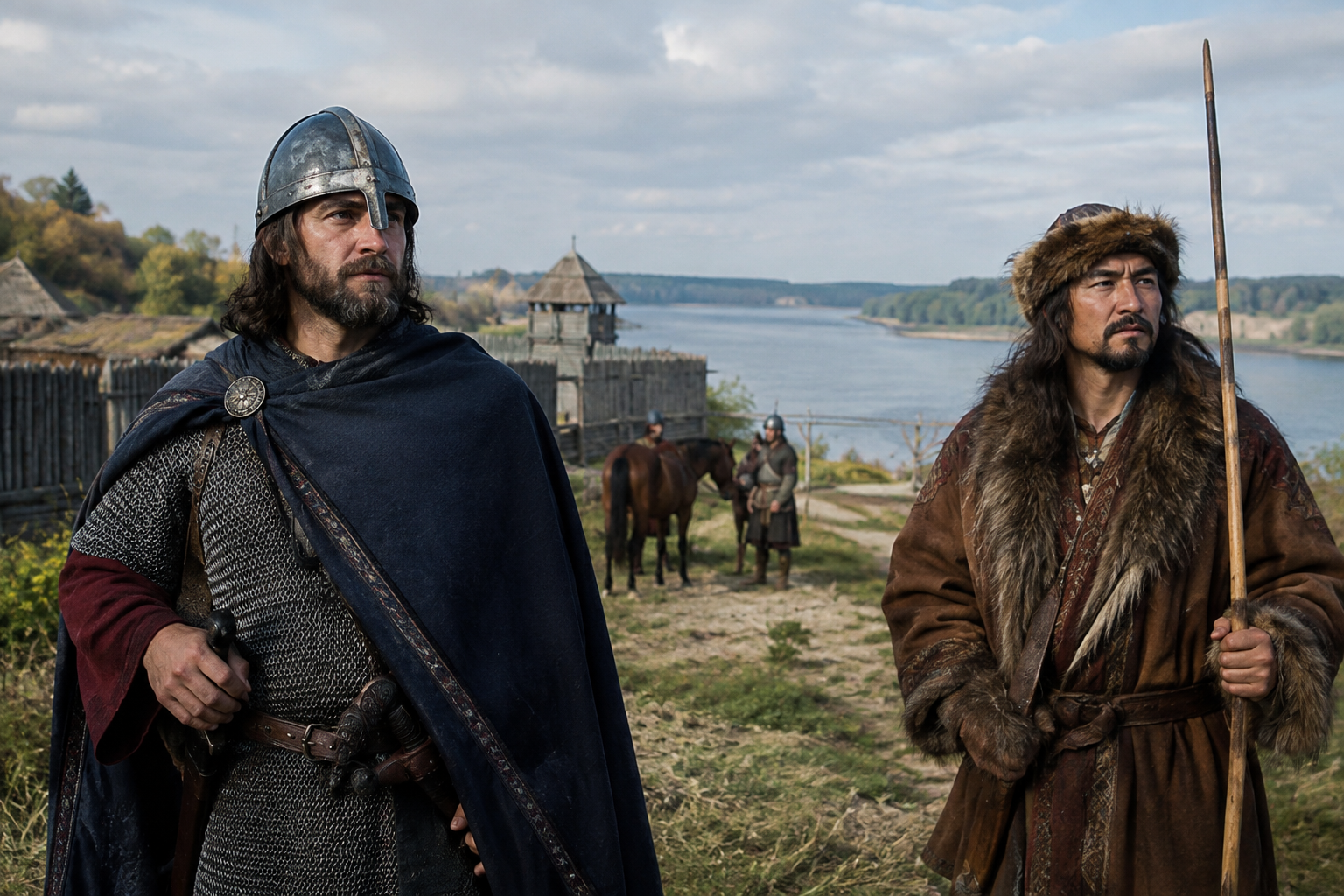
At Zalavar-Varsziget in medieval Hungary, one excavated man stands out not because we know his name, but because his Y chromosome links him to a much wider northern and eastern story. The individual recorded as AHS21, dated to around AD 850, belongs in the Carolingian-period world of the western Carpathian Basin. He is also associated here with the Y-DNA branch N1a1a1a1a2a1c1a, a very narrow paternal line within the broader haplogroup N complex that appears repeatedly in populations tied to the forest-steppe and Uralic-speaking zones of northern Eurasia.
That makes AHS21 interesting straight away. He was buried not in the Trans-Urals, but in a frontier landscape of early medieval Pannonia, at a time when the region sat between Frankish power, local successor communities, and the movements that soon reshaped Hungary. Y-DNA traces only one direct paternal line rather than a person's whole ancestry, but even that single line can reveal surprising long-distance connections when it appears in archaeologically distinct settings.
Zalavar is one of those sites that matters because of where it sits. In the 9th century, this was a strategic zone in western Hungary, within a political world touched by the Carolingian Empire and by older Avar and post-Avar traditions. A paternal lineage such as N1a1a1a1a2a1c1a appearing here does not make AHS21 a "foreigner" in any simplistic sense, but it does show that the male lines present in the region were not all drawn from the usual western or central European expectations.
That broader point fits the growing picture emerging from medieval Hungarian archaeogenetics. The early medieval and conquest-period populations of the Carpathian Basin were not genetically uniform. Instead, they included mixtures of local European ancestry, steppe-derived ancestry, and lineages with deeper ties to the Volga-Ural and Trans-Ural worlds. A recent ancient DNA study on medieval Hungary helps frame that complexity in exactly this period and region: research on medieval Hungarian elites and related populations has underlined how durable those eastern connections could be.
What makes AHS21 especially valuable is that he comes from just before the classic Hungarian conquest horizon usually gets most of the attention. He reminds us that eastern-linked paternal lines were present in the Carpathian Basin before, during, and around those transformations, rather than appearing all at once in a single dramatic migration event.
The second sample, Uyelgi2, comes from Uyelgi in the Trans-Ural region of Russia and is dated here to around AD 900. That geography matters enormously. The Trans-Urals have long been central to debates about the population background of early Hungarians and their neighbors, because archaeology, linguistics, and now genetics all point to this broad zone as a key contact region between steppe, forest, and riverine worlds.
If AHS21 shows the lineage in medieval Hungary, Uyelgi2 shows it in a region often discussed as part of the deeper eastern backdrop to Magyar ethnogenesis. That does not mean one man was the ancestor of the other, nor that a single haplogroup can solve the history of language or peoplehood. But the recurrence of such a narrow paternal branch in both western Hungary and the Trans-Ural sphere is exactly the kind of pattern that makes archaeogenetics historically useful.
An ancient DNA study focused on the Uyelgi cemetery and related material in the Ural region has been important in this discussion: research published on Uyelgi and the early medieval Ural population strengthened the case that some lineages later seen in the Carpathian Basin had meaningful eastern precedents. Uyelgi is therefore not just another dot on the map. It is one of the places where the genetic and archaeological arguments actually meet.
Southern Urals and early Hungarians
The exact branch in this article is N1a1a1a1a2a1c1a. That is far more specific than simply saying "haplogroup N," a very broad paternal family spread across large parts of northern Eurasia. It would be careless to project the entire history of haplogroup N onto this one tiny twig. What we can say, based on the samples here, is narrower and more useful: this branch appears in two early medieval settings that connect the Trans-Ural zone and the Carpathian Basin.
That is a historically suggestive pattern because those same regions feature prominently in debates about mobility, alliance, and population formation in the centuries around the Hungarian conquest. Archaeologists have long worked with material culture, burial customs, and settlement histories to trace such links. Y-DNA now adds another layer: not a complete answer, but a direct line of male descent that sometimes survives where identities, languages, and political loyalties have all changed.
It is also worth stressing that the two samples belong to different archaeological contexts. Uyelgi2 comes from the Trans-Ural world often discussed in relation to Uralic and steppe-border populations; AHS21 belongs to a Carolingian-period setting in western Hungary. The force of the comparison lies precisely in that difference. We are not looking at the same cemetery repeated twice, but at the appearance of a closely related paternal signal in two historically connected yet distinct regions.
For readers with this haplogroup today, Hungary is the hinge in the story. The Carpathian Basin in the 9th and 10th centuries was not a sealed national container waiting to become medieval Hungary. It was a crossroads shaped by late Avar survivals, Slavic-speaking communities, Frankish influence, incoming groups from the east, and local recombinations of all these elements.
That is why a lineage like N1a1a1a1a2a1c1a is so revealing there. In western Europe alone it might seem unusual; in the Trans-Urals alone it might seem regionally unsurprising. Found across both zones, however, it points toward the sort of long-range connections that written sources only dimly capture. The paternal line did not move by itself, of course. People moved in families, war bands, trading networks, political retinues, and mixed communities.
This is also where readers should resist the temptation to turn genetics into a tidy ethnic label. A man carrying N1a1a1a1a2a1c1a in AD 850 or AD 900 may have lived in a multilingual environment, used material culture shared with neighbors of different origins, and belonged to a political community far more fluid than later national histories allow. Ancient DNA is most powerful when it complicates old stereotypes rather than confirming them.
The broader haplogroup N family has deep importance in the population history of northern Eurasia, especially among groups connected at different times to Siberia, the Volga-Ural region, and many Uralic-speaking populations. But the narrow branch here should be read as one thread within that much larger fabric. Its value lies in giving a more exact signal than the parent haplogroup can provide.
That is why even just two ancient samples matter. When a fine-grained branch shows up in both a Trans-Ural cemetery and a 9th-century Hungarian site, it becomes a concrete clue about the persistence of some male lines across wide distances. It does not prove an unbroken tribal march from one point to the other. What it does offer is evidence for shared paternal heritage within the broader eastern networks that fed into early medieval central Europe.
For N1a1a1a1a2a1c1a, the most distinctive ancient signal is not royal glamour or a single famous burial. It is the pairing of Uyelgi2 in the Trans-Urals and AHS21 at Zalavar-Varsziget in medieval Hungary. Together they place this paternal line in the very corridor where eastern and central European histories met, mixed, and hardened into new medieval societies. If this is your haplogroup, the responsible historical takeaway is a real connection to that northern Eurasian and Volga-Ural-facing world, with one documented foothold in the early medieval Carpathian Basin.






Comments