Haplogroup N1a1a1a1a2a1a1a1

– 5 min read


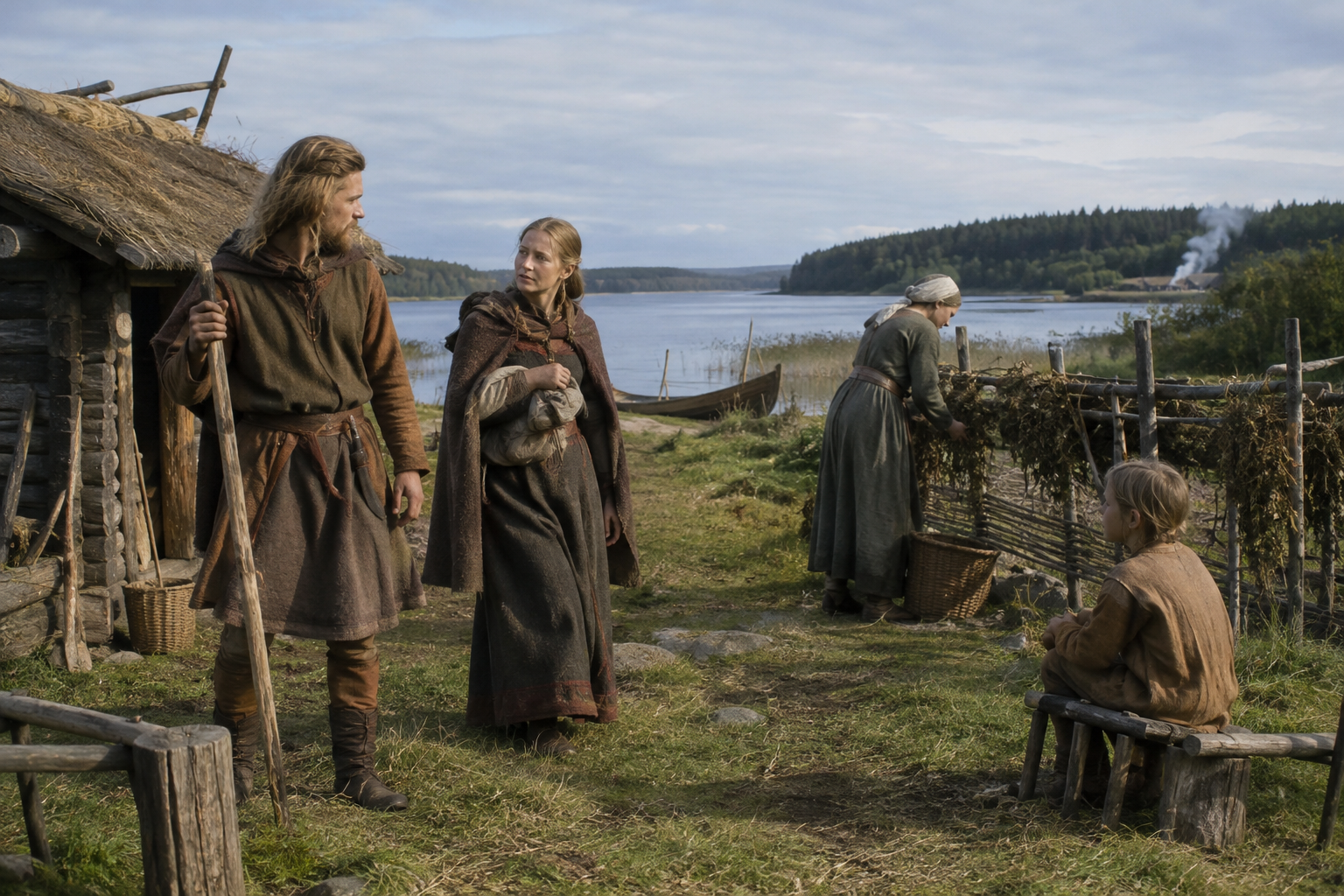
At Toppolanmaki in Valkeakoski, in the historical region of Hame in southern Finland, two early medieval men dated to around AD 1160-1168 stand out for a very specific reason. The individuals known as TOM001 and TOM003 are both associated with the Y-DNA haplogroup N1a1a1a1a2a1a1a1, a strikingly narrow paternal branch that appears here not as an abstract code, but in a real burial community on the edge of the Baltic world.
That matters because Finland in the 12th century was not some isolated afterthought of Europe. It was a region of local communities, long-distance contacts, shifting religious practices, and deep northern ancestry. When the same paternal branch turns up more than once at one site, it gives us a glimpse of continuity in male line descent, even if Y-DNA traces only one direct paternal line rather than a whole person's ancestry.
The two men come from the same site, Toppolanmaki, at Valkeakoski. Their dates are close: TOM001 is listed to AD 1168, and TOM003 to AD 1160. That is a narrow enough span to place them firmly in the later early medieval period, when inland southern Finland was tied into wider Baltic networks but still retained distinctive local population histories.
With only two named individuals, caution is essential. We cannot assume they were close relatives, village chiefs, or members of a single dynasty. But two men from one cemetery area carrying the same highly specific paternal branch is still informative. It suggests that this lineage was not a one-off arrival accidentally passing through the region. At the very least, N1a1a1a1a2a1a1a1 was present in the local male population represented at Toppolanmaki.
The site becomes more interesting when set against the broader archaeology of Hame. This was an inland region connected by waterways, forests, and exchange routes rather than by Roman roads or urban grids. Its medieval communities are often harder to recover in neat historical narratives than those of kings and bishops, which is precisely why ancient DNA is so useful here: it lets ordinary buried individuals re-enter the story.
The haplogroup in this article is very specific: N1a1a1a1a2a1a1a1. That is not the same thing as the whole of haplogroup N, nor even the whole of its European and Uralic-associated branches. In population history, broader branches of N are often discussed in connection with northern Eurasia, Uralic-speaking populations, and the spread of paternal lineages across the forest zone. But those large-scale patterns should not simply be pasted onto one tiny terminal branch without direct evidence.
What we can say is narrower, but still useful. A branch this fine-grained places TOM001 and TOM003 inside a paternal lineage that had already differentiated well before these men were buried. In other words, these were not merely carriers of a broad northern Y-DNA signature; they belonged to a more precise line found in early medieval Finland itself.
That sort of resolution is one of the pleasures of archaeogenetics. It moves us away from vague claims about "northern peoples" and toward actual men in actual places. The genealogy is still deep-time and technical, yes, but the archaeological setting keeps it anchored.
By the 12th century, southern Finland sat within a lively northern world shaped by trade, movement, and cultural overlap. Contacts linked the Finnish interior to the Baltic Sea, to Sweden, to Karelia, and farther east into the forest networks of northern Eurasia. A paternal branch like N1a1a1a1a2a1a1a1 makes sense in that setting: not because one can draw a single migration arrow across a map, but because Finland's medieval population history was formed through long regional continuities mixed with repeated contact.
The men at Toppolanmaki are therefore valuable precisely because they are ordinary enough to be trustworthy witnesses. They are not legendary founders or named rulers retrofitted into genetic stories. They are local early medieval individuals whose remains show that this paternal branch was part of the lived population of Hame.
A recent ancient DNA study of early medieval Finland, published on the genomics of the region, is especially relevant here because it places these kinds of burials into a larger framework of population change and Baltic connections. Even without overstating what can be inferred for any one grave, the broader lesson is clear: medieval Finland was genetically and historically legible in its own right.
Ancient DNA often works best when repetition appears in a constrained setting. One individual can always be exceptional. Two men, from nearly the same time and place, associated with the same narrow paternal branch begin to suggest local patterning. Not certainty about kinship, not a clan list, but patterning.
That is the case with TOM001 and TOM003. Their shared branch hints that some male lines in early medieval Hame persisted across generations within the same region. For family historians, this is perhaps the most exciting point: a haplogroup is not merely a label found in modern DNA test results, but something that can sometimes be located in a specific cemetery, in a specific century, among people buried in a recognizable historical community.
It also helps correct a common misconception. Finland's genetic past is sometimes flattened into a simple tale of isolation. Yet evidence from sites like Toppolanmaki shows something more textured: continuity, yes, but continuity inside a connected Baltic and northern Eurasian world. The paternal line may be stable at a site even while the wider population participates in broader exchanges.
There is a bigger historical backdrop behind this. Haplogroup N and several of its descendant branches are important in the population history of northern Eurasia and among many Finno-Ugric and other northern populations. But broad statements like that can feel rather bloodless until archaeology provides a stage. Toppolanmaki does exactly that.
Instead of discussing paternal history in the abstract, we can point to Valkeakoski, to Hame, and to two dated men: TOM001 and TOM003. There is an enormous difference between saying a lineage is "common in the north" and showing that it appears in early medieval inland Finland in documented burials.
For anyone exploring deeper context on northern paternal history, the wider background to Finnic populations and Y-chromosomal structure is worth keeping in mind, though the article's subclade should not be collapsed into its parent branches.
The most distinctive thing about N1a1a1a1a2a1a1a1 in the present evidence is not royal glamour or a grand conquest narrative. It is something quieter and, in its way, more convincing: this paternal line is attested in at least two men buried at the same early medieval site in Hame around the 1160s. That makes it a historically grounded Finnish medieval lineage, not just a modern testing result floating free of place.
If this is your paternal haplogroup, the best-supported connection is to the deep northern and Finnic historical world represented by sites like Toppolanmaki. That does not make every bearer "from Hame," of course. But it does mean your Y-line has a documented foothold in early medieval Finland, among real individuals whose graves still speak through ancient DNA.






Comments