Haplogroup N1a1a1a1a1a1a5

– 5 min read


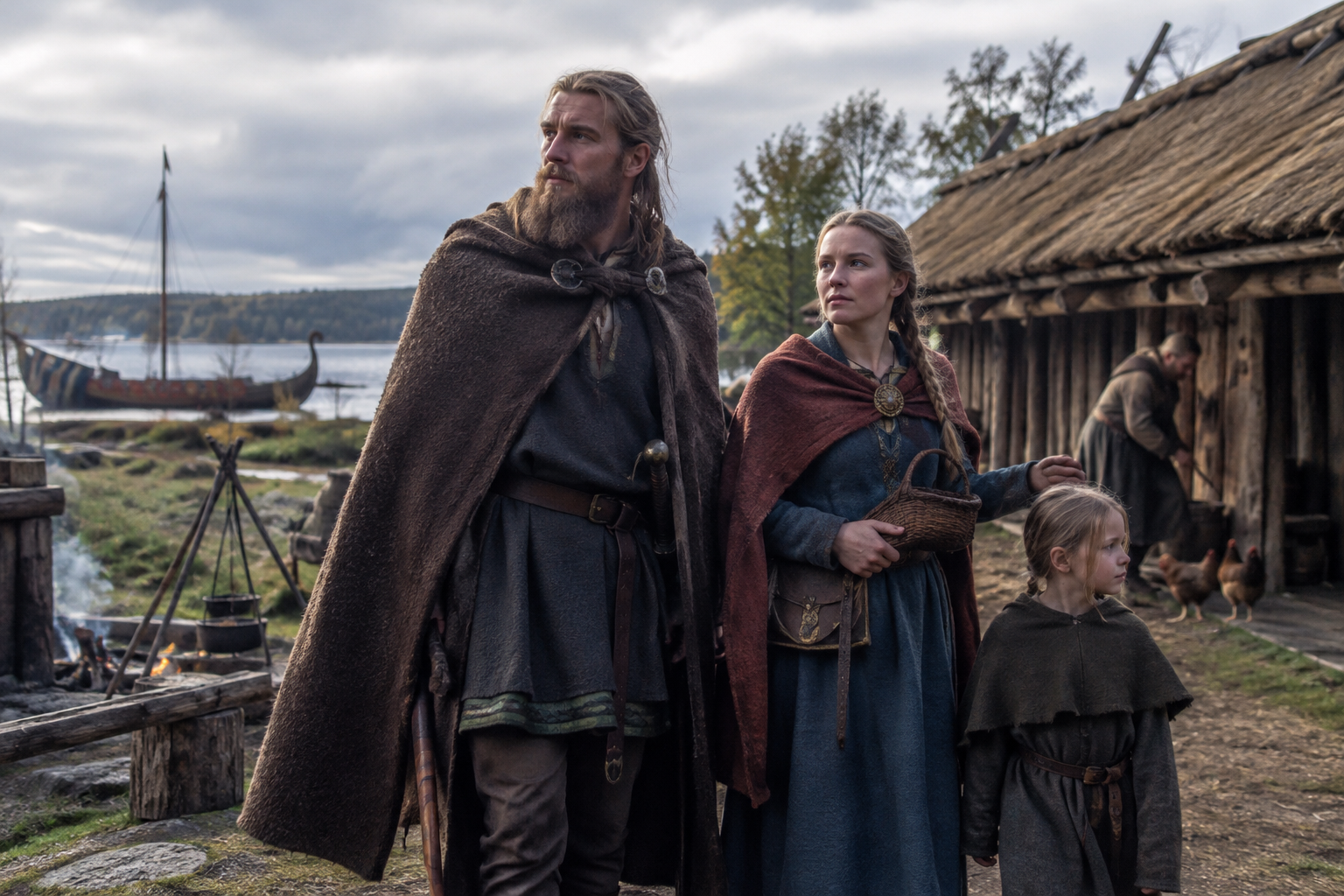
At Varnhem in Skara, in western Sweden, archaeologists and geneticists have been able to look closely at a Christian community living at the end of the Viking Age. One man from that landscape, sample VK406, dated to around AD 1050, is associated here with the Y-DNA haplogroup N1a1a1a1a1a1a5. That is immediately interesting, because this is not the Y-lineage most people casually imagine when they think of Viking-Age Scandinavia.
That does not make him an outsider in any simple sense. It makes him evidence. Y-DNA traces one direct paternal line only, not a person's whole ancestry, language, or identity. But a paternal lineage like N1a1a1a1a1a1a5 appearing in Viking-Age Sweden is precisely the sort of finding that reminds us how mixed, mobile, and historically entangled the Baltic and Scandinavian worlds could be.
Varnhem is best known as one of medieval Sweden's important ecclesiastical landscapes, but its deeper significance lies in continuity. By around AD 1050, this was a region moving through the great transition from the Viking Age into a more formally Christian and more politically consolidated Scandinavian order. People were being buried in new ways, communities were reorganising around churches, and old networks across the Baltic had by no means disappeared simply because the religious language had changed.
Within that setting, VK406 matters because he places the haplogroup N1a1a1a1a1a1a5 in a securely Scandinavian context at a historically sensitive moment. He is not a legend, not a saga hero, and not a dynastic mascot. He is more valuable than that: an excavated individual from a real burial population, attached to a date and place.
An ancient DNA study examining Viking and early medieval populations in the region helped make this broader picture possible, showing that Scandinavian burial grounds could contain a range of ancestries and lineages rather than one neat biological type. The research trail associated with this material includes genetic work on ancient Scandinavian populations, which has contributed to the growing picture of how varied the period really was.
The first thing to say is that N1a1a1a1a1a1a5 is a very narrow branch name. It sits deep within the wider Y-haplogroup N, a major paternal lineage with a long history across northern Eurasia. Broadly speaking, branches of haplogroup N are especially relevant to discussions of Uralic-speaking populations, northeastern Europe, the Baltic-Finnic world, and regions extending far into northern Asia. But one must be careful here: the ancient history of the large parent haplogroup is not the same thing as the documented history of this exact terminal branch.
That caution matters. With VK406, what we can say responsibly is that a man linked to this fine-scale paternal line was present in Viking-Age Varnhem. We should not pretend that this one burial by itself maps the whole route by which the branch reached Sweden, nor should we convert a Y-line into an ethnic label. Yet it does sit neatly within a much larger pattern in which Scandinavia, especially eastern and central Scandinavia, was connected to Finnic, Baltic, and northern Eurasian worlds by trade, marriage, warfare, service, and migration.
It is tempting to talk about Vikings as if they only went west, towards England, Ireland, and the North Atlantic. In fact, Scandinavian history also points eastwards all the time. The Baltic was not a fringe; it was a highway. Sweden in particular was tied into routes reaching Finland, the eastern Baltic, the river corridors of what is now Russia, and beyond.
That wider eastern orientation makes a haplogroup from the N family entirely plausible in a Swedish setting. The question is not whether such a lineage can appear there; the question is how often, in what regions, and in what social settings. A single sample like VK406 cannot answer all of that, but it shows that these paternal lines were present within the human fabric of late Viking-Age Scandinavia itself.
This is one reason the most interesting history here is not a crude search for "foreigners". Medieval and Viking-Age communities were perfectly capable of incorporating people whose paternal ancestry had different deeper roots. Over generations, such lineages could become simply part of the local population. By AD 1050, a man buried in Varnhem may represent recent movement, older regional mixing, or a paternal line that had already been in Scandinavia for quite some time.
Geography matters here. Skara and Varnhem sit in a part of Sweden that was deeply involved in the making of the early medieval kingdom, but that political story unfolded on top of older maritime and inland connections. Across the Viking Age, people, goods, and ideas circulated around the Baltic in complicated ways. Some moved seasonally, some permanently, some as traders, some as captives, some as marriage partners, some as members of retinues or military followings.
When a lineage such as N1a1a1a1a1a1a5 appears in this setting, it fits a world in which paternal ancestry could move without leaving behind a tidy written explanation. Archaeology often gives us that reality more honestly than medieval narrative texts do. The grave does not tell us what language VK406 spoke at home, whether his father's father's people came from nearby or from across the Baltic, or whether anyone in his community considered him unusual at all.
What it does tell us is that the late Viking and early Christian centuries in Sweden were peopled by more than the simplified national stereotypes of later centuries. The dead at sites like Varnhem are often better historians than the old myths.
There is an odd tendency in public discussions of ancient DNA to dismiss a single sample when it does not fit expectations, and to over-celebrate it when it does. Better, surely, to do neither. VK406 is only one individual, but one well-placed individual can still matter a great deal if he sharpens the historical question.
In this case, the question is how paternal diversity was distributed in Viking-Age and early medieval Sweden. Haplogroup N branches are often discussed in relation to northern and northeastern Europe, and that makes the Swedish evidence worth close attention. Not because it overturns Scandinavian history, but because it helps normalise a truer version of that history: one in which Sweden was part of a northern Eurasian contact zone as well as a Scandinavian kingdom.
Readers interested in how DNA is illuminating medieval Swedish burial communities may also find it useful to compare this case with other Christian-period Scandinavian cemeteries, where kinship, burial practice, and genetic diversity can all be examined together.
Christian tomb DNA in Skanninge
If your paternal line belongs to N1a1a1a1a1a1a5, VK406 offers something both modest and valuable: firm evidence that this branch, or a very close reporting association to it, was present in western Sweden around the close of the Viking Age. That does not make every modern carrier "Viking" in a simple sense, and it certainly does not reduce ancestry to one line of fathers. But it does place this haplogroup inside the lived history of medieval Scandinavia.
The most distinctive insight here is that a lineage with deeper connections to the wider northern Eurasian world appears in a Swedish burial community at exactly the period when old Viking networks and new Christian institutions overlapped. In other words, N1a1a1a1a1a1a5 is a reminder that Scandinavian history was never sealed off. It was made by movement, mixture, and local belonging all at once.






Comments