Haplogroup J2a1a2b2a2b2a2b

– 6 min read


Some Y-chromosome lineages arrive in the historical record with trumpets and banners; others appear more obliquely, through a burial, a battlefield, or a family seat remembered long after its walls have fallen. Haplogroup J2a1a2b2a2b2a2b belongs to one of those lineages best approached with a mixture of curiosity and restraint. It is a very specific branch within the wider J2 paternal family, and that wider family has long been of interest to archaeologists and genetic historians because it appears again and again around the eastern Mediterranean, the Aegean, Anatolia, and parts of southern Europe.
That does not mean, of course, that a Y-DNA haplogroup tells us everything about a person. Quite the reverse. Y-DNA traces only one direct paternal line, one father-to-son path among thousands of ancestors in any family tree. But precisely because it is so narrow, it can be historically useful. It lets us ask how a paternal branch moved, persisted, or reappeared across time, from the ancient Mediterranean to later historical regions where noble families built castles and fashioned stories about their own past.
The deeper history of this subclade has to be understood through its parent branches. J2 as a broader haplogroup is widely associated in genetic literature with populations of the Near East and Mediterranean, and it appears in many discussions of prehistoric farming dispersals, Bronze Age interaction, and later mobility around the Aegean and beyond. For a branch as specific as J2a1a2b2a2b2a2b, however, caution is essential: we should not simply pour the whole history of J2 into this one narrow twig of the family tree and pretend the job is done.
What can reasonably be said is that this lineage sits in a paternal cluster whose broader relatives have mattered in the history of seaways, colonies, trading circuits, and mixed societies around the Mediterranean basin. The Aegean, southern Italy, Sicily, and adjacent regions are especially important because they were never sealed worlds. They were crossing points: Greek, indigenous Sicilian, Phoenician, Italic, Roman, Byzantine, Norman, and many others, all layered over one another.
For readers interested in the earlier background to these eastern Mediterranean populations, the MyTrueAncestry community has a useful companion piece on prehistoric population structure in the region.
Explore the Prehistoric Aegean
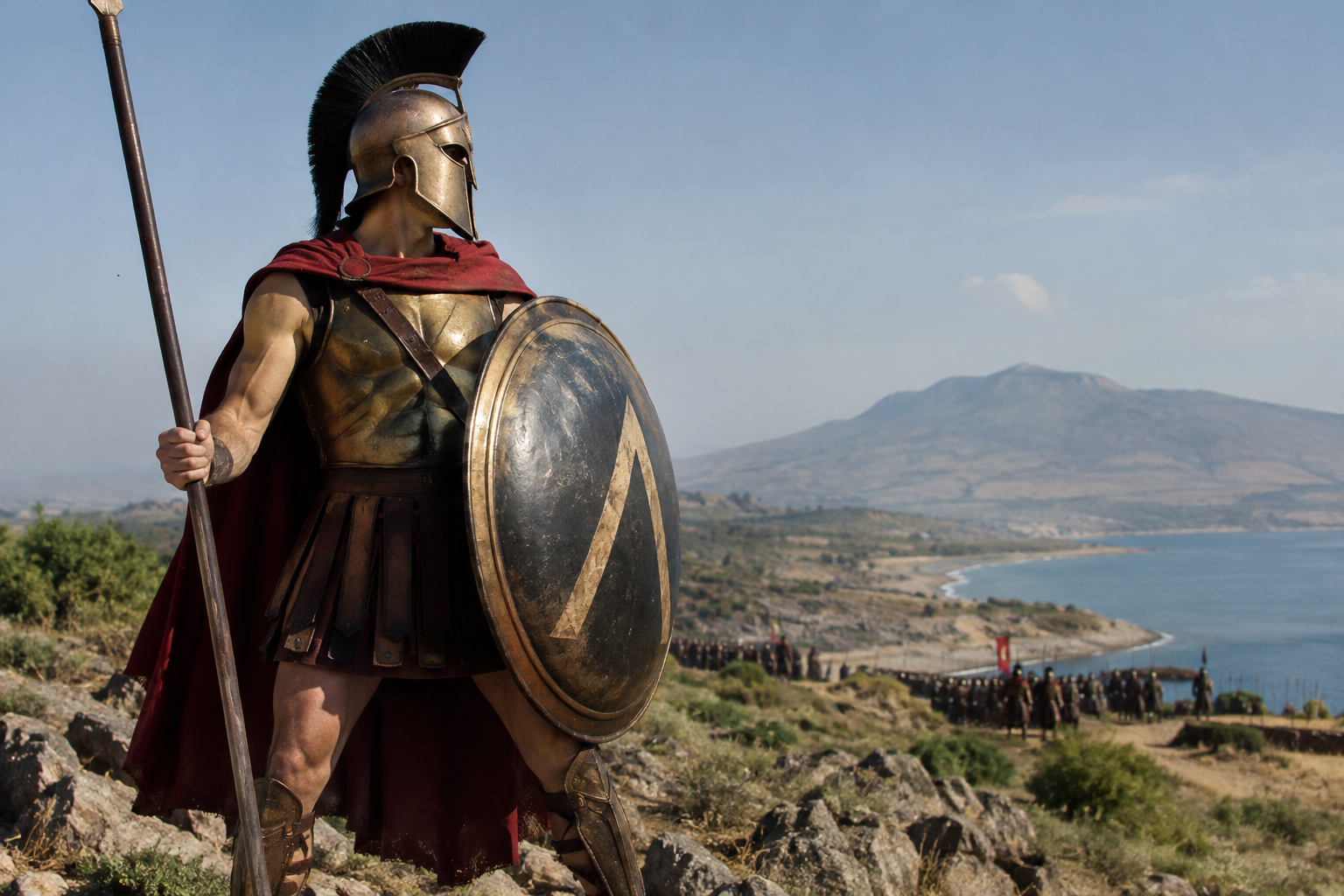
The clearest anchor supplied for this haplogroup is an evocative one: I17866, described as an Ancient Greek Warrior Second Sicilian War Himera Sicily Year:409 BC. That single line is enough to conjure one of the most dramatic corners of classical Mediterranean history. Himera, on the north coast of Sicily, was a place where Greek colonial ambition, Carthaginian power, and local Sicilian realities collided repeatedly. In 409 BC, the city was destroyed by a Carthaginian army in the course of the Second Sicilian War.
So when we encounter I17866, we are not looking at an abstract marker in a spreadsheet. We are looking at a man caught in that violent world of Greek Sicily, a world of fortified poleis, shifting alliances, and armies recruited from more than one place. If this individual is associated with the haplogroup under discussion, or with a closely related paternal branch, he becomes an important signpost for the presence of this lineage in the classical Mediterranean.
But what exactly does that prove? Not that all men in Greek Sicily belonged to this paternal line, not that this warrior was the ancestor of any later family, and not that haplogroup alone can define him as ethnically Greek in some simple modern sense. What it does show is that a branch within this paternal world was present in Sicily at a historically charged moment, embedded in the military and colonial landscapes of the late fifth century BC.
Sicily is especially valuable for this kind of study because it was so mixed for so long. Ancient DNA has repeatedly shown that islands are not sealed boxes; they are often magnets for movement. Readers who want to follow that wider Sicilian story may enjoy these related articles.
Discover Ancient DNA from Italian Islands
The world of I17866 also helps explain why paternal lineages such as J2-related branches can turn up far from any supposed point of origin. Greek colonization linked mainland Greece with Sicily and southern Italy. Later Roman expansion folded those same coasts into a larger imperial system. Armies, merchants, settlers, captives, and administrators all moved through it. A paternal lineage could persist locally for centuries, or travel with men who left one shore and settled on another.
That is one of the chief lessons of Y-DNA in history: continuity and mobility are not opposites. A lineage can be deeply rooted in one district and yet part of a broader network spanning seas and kingdoms. For J2-related lines, this is often the right mental picture - not a single march from A to B, but repeated episodes of circulation around the eastern and central Mediterranean.
Roman rule only made that denser. Sicily, southern Italy, and the western Mediterranean became tied to one another through military service, urban life, and trade. If you want to see how those imperial connections could leave a lasting genetic imprint in the far west, one good comparison is Roman Iberia.
Explore Roman Hispania's Genetic Legacy
At first glance, Clan Montgomery and Himera in 409 BC seem to belong to entirely different universes. One is classical Sicily under siege; the other is aristocratic Ayrshire in Scotland. Yet this is exactly where genealogical history becomes interesting. Not because we can leap from an ancient Sicilian warrior to a Scottish noble house, but because both genetics and family history are, in their different ways, methods for thinking about continuity.
The Montgomeries were long associated with the Eglinton estate in Ayrshire, and their later seat, Eglinton Castle, was built around 1797 for the Earls of Eglinton as a grand Gothic Revival statement. It was less a medieval fortress in the old hard sense than a noble performance of medievalism: an aristocratic house consciously staging the past. In the 1830s and 1840s it became famous for the spectacular Eglinton Tournament of 1839, an event so extravagantly romantic that the disastrous rain almost improved it. One can hardly imagine a better Victorian parable: noble dreams, chivalric costumes, and Scottish weather combining to puncture their own pretensions.
That matters here because castles preserve memory, not genes. Eglinton Castle tells us that the Montgomeries wanted to inhabit a noble past and display it in stone. It does not by itself prove a particular Y-DNA lineage for every branch of the family. Any association between a noble house and a haplogroup must be treated carefully unless supported by direct genetic evidence from documented male-line descendants or historical burials.
Still, the geography is suggestive in a broader way. Scotland, like Sicily, is a place where lineages have accumulated through repeated arrivals: prehistoric settlers, later Iron Age groups, Roman-era contacts to the south, Norse movement, Norman influence, and internal medieval reshaping. Noble families sit atop those older demographic layers, even when their written pedigrees reach back only so far.
For readers interested in the historical setting of this family, there is a direct community article worth exploring.
So what does haplogroup J2a1a2b2a2b2a2b reveal? First, that even a very specific paternal branch can open a door onto large historical questions: Mediterranean connectivity, the movement of soldiers and settlers, and the persistence of male lines through changing political worlds. Second, that ancient DNA gives us something written genealogy often cannot - a glimpse of real individuals in deep time, such as I17866 at Himera, standing in contexts no family archive could ever reconstruct.
But there are limits. Sharing a haplogroup with an ancient sample does not prove direct descent from that person. Sharing a broad branch with a noble family association does not establish membership in that family. And no Y-DNA lineage, however interesting, captures the full ancestry of any living person.
What it does offer is a disciplined kind of historical imagination. Not fantasy, not dynastic wishful thinking, but a way of placing one paternal line inside the real movements of the human past. From the battlefields of classical Sicily to the self-conscious grandeur of Eglinton in Ayrshire, the story is not one of simple identity. It is one of survival, migration, and memory.
If you have tested your DNA, MyTrueAncestry can help you explore whether your results show connections to ancient individuals, historic populations, and paternal lineages like the ones discussed here. Those matches can offer remarkable historical perspective, even when they do not prove direct descent from a named warrior or noble house.






Comments