Haplogroup J2a1a1b2a1b1b2c

– 5 min read


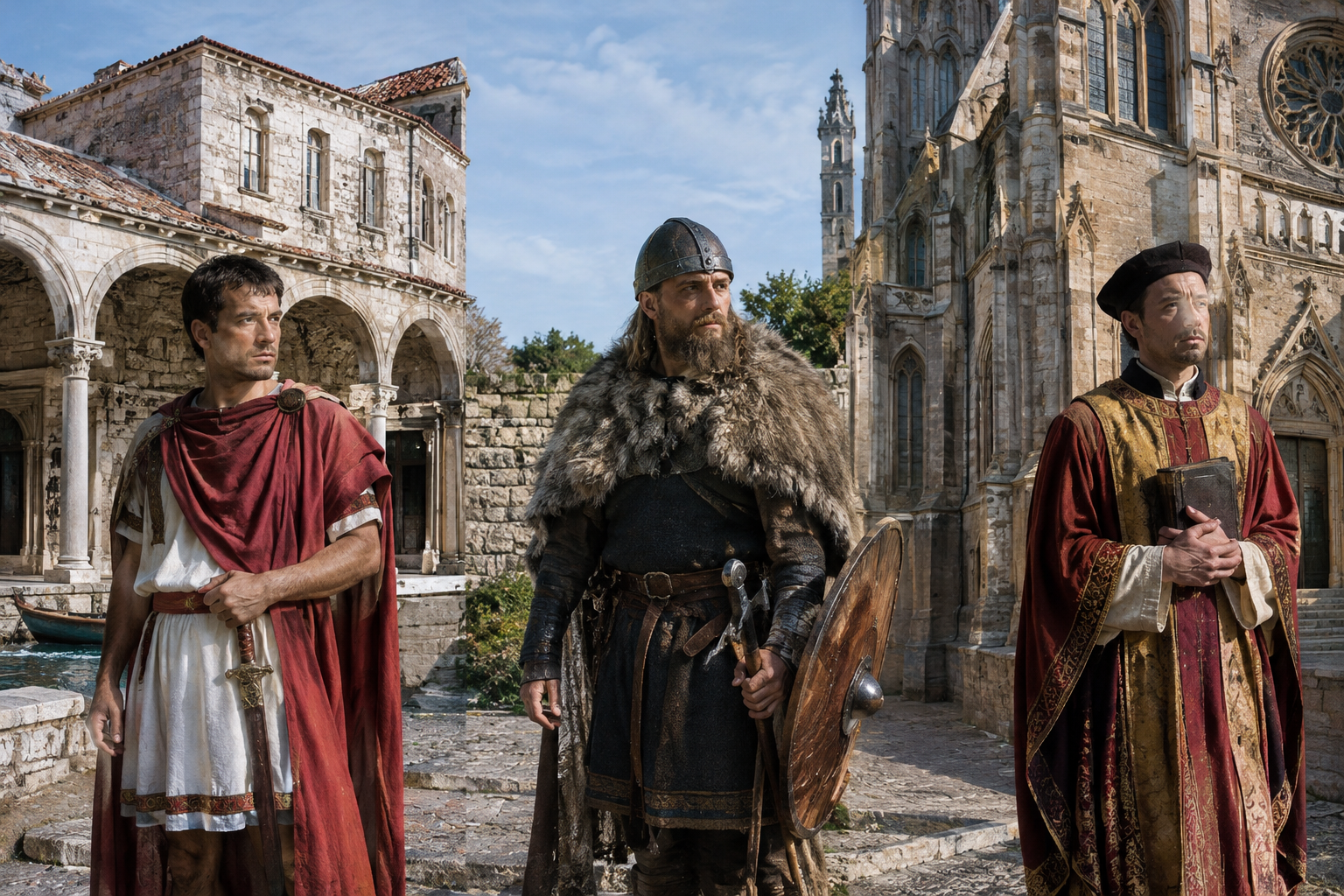
On the island of Hvar, in a Late Imperial Roman context at Radošević Palace, one man dated to around AD 400 stands out in more ways than one. Sample I33808 belongs to the Y-DNA lineage J2a1a1b2a1b1b2c, a very specific paternal branch that turns up here not in some obvious royal tomb or famous battlefield, but in the ordinary and revealing world of eastern Adriatic Roman life.
That is precisely what makes this lineage interesting. Rather than appearing in just one neatly bounded population, J2a1a1b2a1b1b2c is represented here by ancient individuals from Roman Dalmatia, Viking Age Sweden, and late medieval Rome. Y-DNA traces one direct male line only, not a person's whole ancestry, but even so, this is a striking little trail: a paternal signature moving through very different societies over more than a thousand years.
The Hvar sample is the best place to begin because the setting is historically rich even when the individual details are limited. By around AD 400, Dalmatia was no backwater. It sat within the long-connected Adriatic zone, tied to Italy, the Balkans, military routes, maritime trade, and the administrative structures of the late Roman Empire.
So when a lineage like J2a1a1b2a1b1b2c appears at Hvar, it fits a world in which men, families, and local communities were already shaped by centuries of movement. The mistake would be to force a single ethnic label onto him. He was living in Roman Croatia, but his paternal line may have had a deeper history somewhere else in the Mediterranean or Near East before reaching this island setting.
A study of the Hvar-Radošević material, published in Archaeological and Anthropological Sciences, helps frame that context by examining the site as part of Dalmatia's long and complicated biological history. What matters here is not a melodramatic origin story, but the reminder that Roman provincial populations were often more mixed, and more locally rooted at the same time, than older stereotypes allowed.
This long label sits deep inside haplogroup J2, one of the better-known Y-chromosome families in western Eurasia. Broadly speaking, J2 has often been associated with populations of the Mediterranean, the Aegean, Anatolia, the Caucasus, and parts of the Near East. But that broad map is only a starting point. The narrower branch J2a1a1b2a1b1b2c should not simply inherit every story ever told about J2 as a whole.
What the ancient evidence here really shows is something more modest and more useful. This branch, or samples associated with it at that level of reporting, appears in settings linked to Roman-era Adriatic life, medieval Scandinavia, and late medieval central Italy. That suggests durability and geographic spread, but not one simple migration event that explains everything.
In other words, this is not a lineage pinned to one tribe, one language, or one kingdom. It is the sort of paternal line that reminds us how untidy real history is. Men carrying related Y-chromosomes could be absorbed into very different cultural worlds while leaving only the thinnest direct genetic thread behind them.
The second ancient individual, VK42, comes from Skara Varnhem in Sweden and is dated to about AD 1050, right at the point where Viking Age Scandinavia was giving way to a more firmly Christian medieval order. Varnhem is an important place in Swedish early medieval archaeology, associated with church foundations, burial grounds, and the reshaping of society during conversion.
The presence of J2a1a1b2a1b1b2c in this context is intriguing because it does not fit the lazy expectation that every paternal line in Viking Age Scandinavia must look conventionally "Norse." By this period, Scandinavian worlds were tied into trade, raiding, mercenary service, marriage exchange, pilgrimage, and long-distance travel from the North Atlantic to Byzantium and beyond. A lineage with deeper southern or eastern Mediterranean associations turning up in Sweden is therefore not impossible at all; if anything, it is a useful corrective to oversimplified ideas about Viking populations.
Research on Viking Age genomics, including the widely discussed Science study on Viking world population history, has made that broader point very clearly: Scandinavian communities were not genetically uniform, and mobility ran in multiple directions. That does not prove the life story of VK42, but it does place him in a historical landscape where paternal diversity is entirely believable.
There is also a chronological point worth noticing. The Hvar man and the Varnhem man are separated by roughly 650 years and lived in very different societies, yet both are associated with the same narrow paternal branch. That is not enough to draw a family tree across Europe, but it is enough to show that this line endured through the end of the Roman world and into the medieval north.
The third sample, R1221, comes from the Cancelleria Basilica and is dated to around AD 1485. By then, Rome was a late medieval and early Renaissance city layered with old sanctity, new politics, papal ambition, and a constant influx of people from elsewhere in Italy and beyond.
A lineage like J2a1a1b2a1b1b2c appearing in this environment is, again, historically plausible in a very Roman way. Rome had long been a city of arrivals. Clerics, artisans, laborers, pilgrims, merchants, and administrators all moved through it. A Y-chromosome branch with older Mediterranean depth surviving into a burial connected with a basilica is less a surprise than a reminder of how much continuity and movement the city could hold at once.
If the Hvar sample shows this lineage in a late Roman Adriatic province, the Cancelleria individual shows it still present in the orbit of central Italy over a millennium later. That continuity does not mean the same family remained intact or traceable. It means that one paternal branch, among many others, kept finding its place in the urban and regional history of the Mediterranean world.
Put these three individuals side by side and a pattern emerges, though not a simplistic one. I33808 in Late Imperial Croatia, VK42 in Viking Age Sweden, and R1221 in late medieval Rome do not point to one clean route from point A to point B. They point instead to the sort of connectivity historians keep finding around the Mediterranean and Europe: ports, armies, marriages, colonization, religious institutions, and urban movement all repeatedly scrambled paternal lineages.
For this reason, J2a1a1b2a1b1b2c is best understood here not as a badge of fixed identity, but as evidence of participation in wider historical worlds. In the Roman case, that means the eastern Adriatic was thoroughly entangled with imperial circulation. In the Scandinavian case, it means Viking Age and early Christian Sweden was more open and connected than nationalist mythology once preferred. In the Roman basilica case, it means late medieval Italy still preserved deep and varied male-line legacies.
Croatia's shifting paternal lines
If your paternal line is J2a1a1b2a1b1b2c, these ancient matches suggest a branch that was at home in the connected worlds of the Mediterranean and, at least by the medieval period, could also appear much farther north. The most distinctive point is not a claim to one famous people or one lost dynasty. It is that this lineage shows up in real archaeological settings where empire, religion, travel, and local continuity all meet.
That is a rather Roman lesson, really: history rarely travels in straight lines, and neither do paternal lineages.






Comments