Haplogroup J2a1a1a2a1a2a2a

– 4 min read


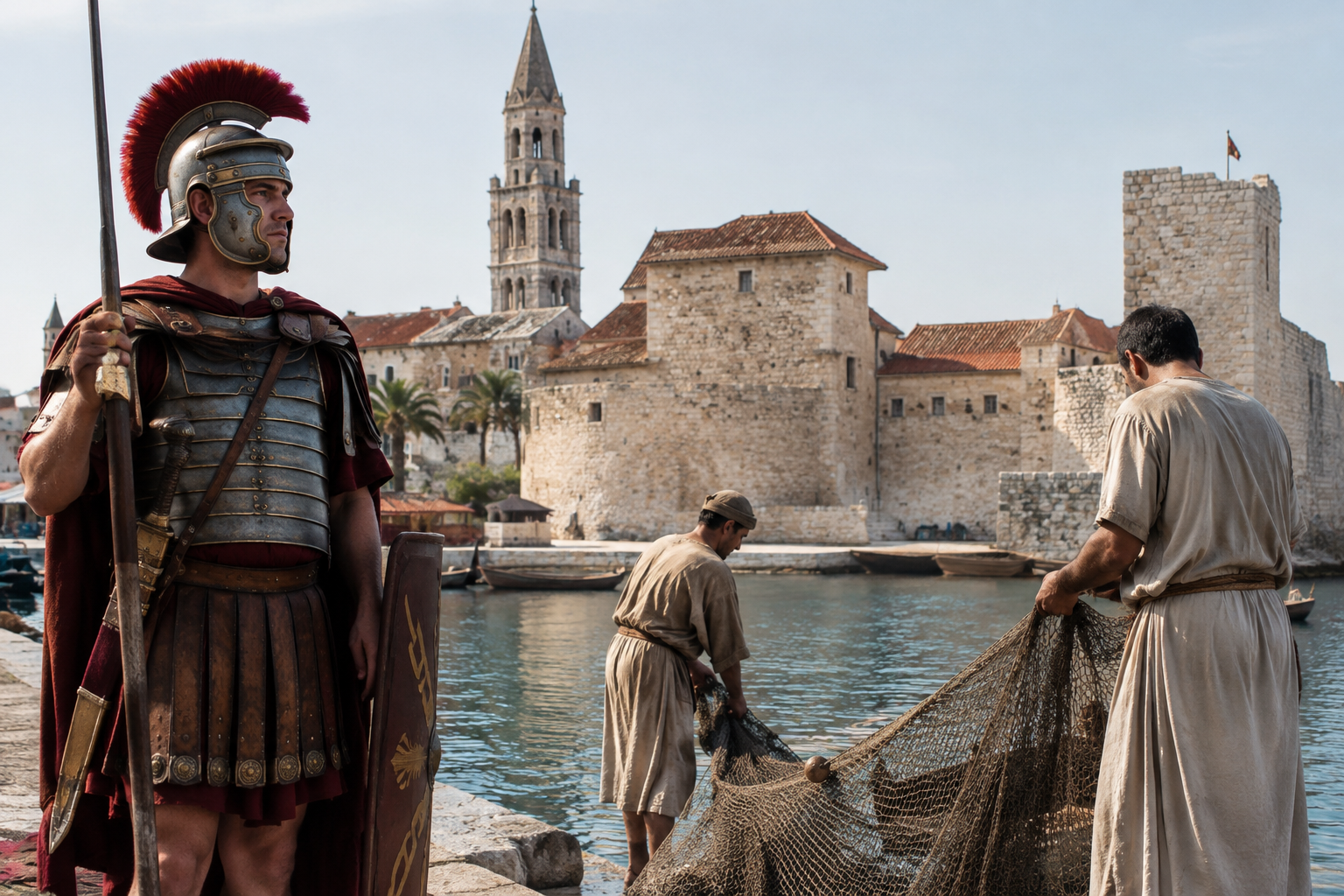
At Trogir-Dragulin on the Dalmatian coast of Croatia, one man buried in the Imperial Roman period has become a particularly useful signpost for the Y-DNA haplogroup J2a1a1a2a1a2a2a. The individual is recorded as sample R3665, dated to around AD 217. That is not simply a technical label. It places this paternal line in a very specific world: a Roman Adriatic port region where soldiers, merchants, freedpeople, sailors, administrators, and local families all moved through the same landscape.
That matters because Y-DNA follows one direct paternal line only, not a person's whole ancestry. Even so, a well-placed ancient sample can tell us something important about where a lineage appears in the historical record. In this case, J2a1a1a2a1a2a2a is represented not in some vague prehistoric setting, but in a documented Roman-era burial environment in coastal Croatia, within a region that linked the Balkans, Italy, and the wider eastern Mediterranean.
Trogir, ancient Tragurium, sat in one of the most connected zones of the Roman world. The eastern Adriatic was never a quiet backwater. It was threaded into shipping routes, military logistics, provincial administration, and urban life. A burial from this setting therefore carries more historical weight than its single sample number might suggest.
Sample R3665 comes from Imperial Roman Croatia, and that cultural label is important. We are not looking here at a prehistoric farmer or an Iron Age tribal burial being retrospectively folded into Roman history. We are looking at an individual who belongs to the period when Dalmatia was part of the Roman imperial system. His paternal line, associated here with J2a1a1a2a1a2a2a, belongs to that lived Roman landscape.
An ancient DNA study of Roman-period and later Croatian remains has helped place such burials into a broader framework of continuity and change in the region; see this research on ancient genomes from Croatia. Even without forcing grand conclusions from a single grave, the wider setting is clear enough: Roman Dalmatia was populated by people whose family histories could reach into different parts of the empire.
At a broad level, haplogroup J2 is often discussed in connection with the eastern Mediterranean, Anatolia, and parts of the Near East and Balkans. But one must be careful here. That broad parent background does not automatically define the exact history of the much narrower branch J2a1a1a2a1a2a2a. What R3665 gives us is something firmer and more modest: a secure appearance of this paternal line, or a lineage associated with it, in Roman-period Dalmatia.
And Dalmatia is precisely the sort of place where such a finding makes historical sense. Roman rule did not move people in a single direction. It created repeated, overlapping currents of mobility. Men with paternal lines rooted locally could end up in urban cemeteries; men with more distant family origins could settle, serve, trade, marry, and be buried there too. The eastern Adriatic was a corridor as much as a coastline.
That is why a lineage like J2a1a1a2a1a2a2a appearing in Trogir should not be made to carry a melodramatic story of one migration event. The Roman empire was messier than that, and more interesting. A single Y-line in a Roman burial can reflect generations of movement, integration, and provincial life rather than one memorable journey.
It is tempting to imagine the Roman Balkans as peripheral to the empire's real action, but archaeology has been undoing that assumption for years. Coastal Croatia was tied into Italy across the Adriatic, into inland Balkan routes, and into the commercial and military circuits of the wider Mediterranean. This is exactly the sort of region where paternal lineages from different backgrounds could meet and persist.
That broader Croatian picture also matters because ancient DNA from the region has shown both long-term local continuity and shifts in paternal representation over time. In other words, the men buried there across centuries were not all cut from one genealogical pattern. That makes R3665 more valuable, not less. He is one datable point within a changing male-line landscape.
For readers interested in how Roman-era populations in the western empire could leave lasting regional signatures, Roman Iberia offers a useful comparison: not because Iberia and Dalmatia were identical, but because both show how imperial rule worked through settlement, mobility, and admixture rather than neat ethnic boxes.
One of the most useful lessons from Roman archaeogenetics is that political labels and biological histories rarely line up in a simple way. "Roman" can describe a period, a state, a legal identity, or an archaeological context. It does not mean one ancestry profile, one language at home, or one paternal lineage. Sample R3665 belongs to a Roman-period burial context, but that tells us nothing simplistic about how his forefathers would have described themselves generations earlier.
This is where haplogroup articles are most useful when they stay grounded. If your own paternal line falls under J2a1a1a2a1a2a2a, the interesting point is not that you can claim one tidy ancient identity. It is that your line is already visible in an imperial Adriatic setting by the early 3rd century AD, in a region that connected Latin, Greek, Illyrian, and other local and immigrant histories.
The Roman world repeatedly produced communities like this. Studies from frontier zones and provincial towns have shown that burials can contain people of varied genetic backgrounds living under the same political order. Coastal Dalmatia fits that larger pattern of complexity rather well.
With sparse sample-by-sample detail, restraint is a virtue. We can say that R3665 places the article haplogroup J2a1a1a2a1a2a2a in Imperial Roman Trogir-Dragulin, Croatia, around AD 217. We can say that this is historically plausible in a region shaped by maritime exchange, provincial urbanism, and empire-wide mobility. We can also say that such a finding sits comfortably beside the growing body of work showing that the Roman Balkans were genetically and socially mixed.
What we should not do is pretend that one burial proves a dynasty, a tribe, or a single point of origin. Ancient Y-DNA is strongest when it gives us anchored moments. R3665 is one such moment: a direct paternal line turning up in the Roman Adriatic, not as legend but as evidence.
That makes this haplogroup especially evocative for family historians. J2a1a1a2a1a2a2a is not appearing here in abstraction; it is tied to a real man from a real Roman-period cemetery on the Dalmatian coast. For anyone tracing this paternal branch today, that is a solid historical foothold: not the whole story of your ancestry, but a memorable chapter in it.






Comments