Haplogroup J1a2b2~

– 5 min read


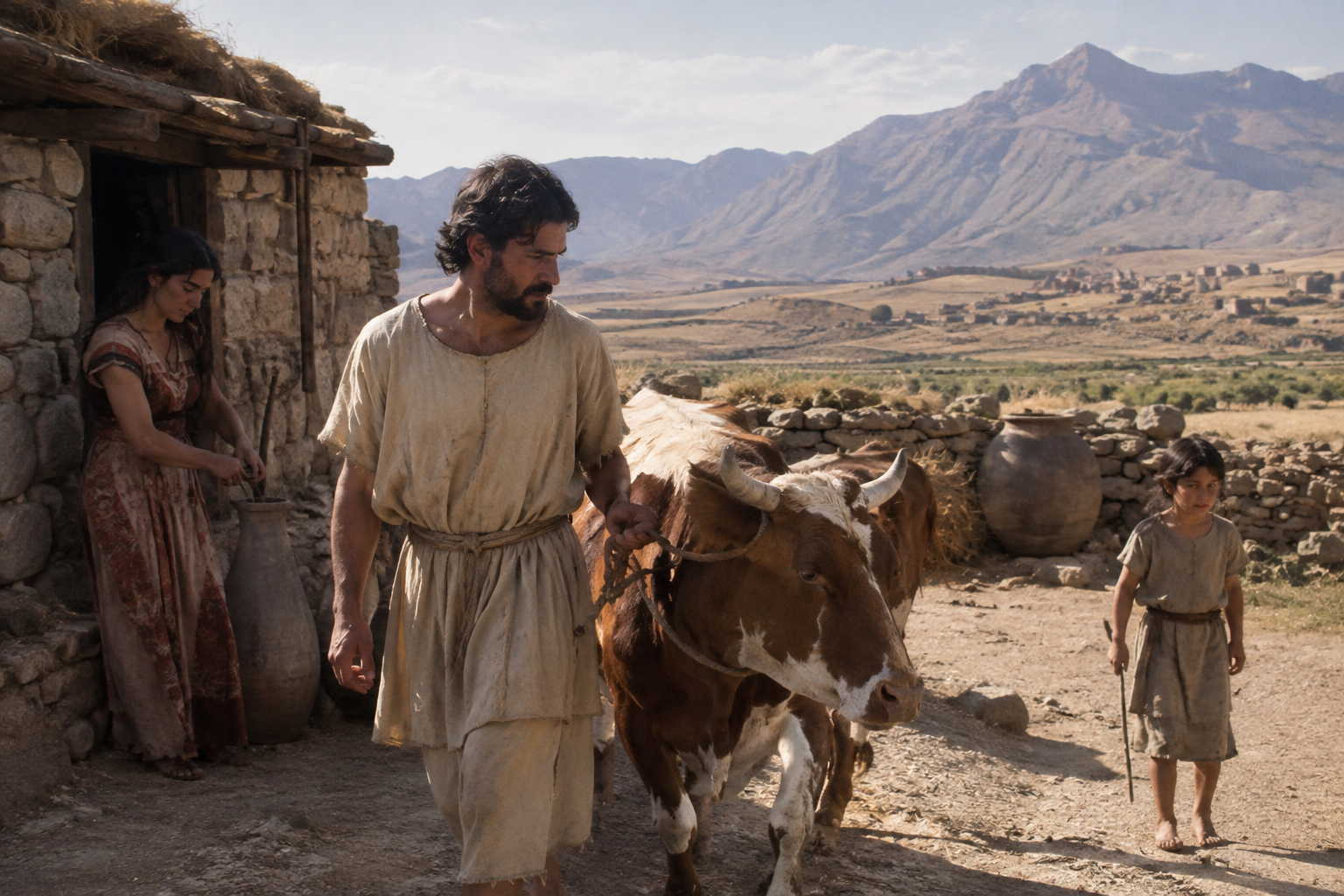
At first glance, I2495 is a modest label: one Bronze Age man from Anatolia, dated to around 1625 BC. Yet for the paternal lineage J1a2b2~, that single ancient individual is precisely the sort of evidence that matters. It places this branch, or an association with it, in the heart of Bronze Age Anatolia, a region that was not a remote edge of the ancient world but one of its great crossroads.
That is the intriguing part. Anatolia in the second millennium BC was tied into trade, warfare, diplomacy, and migration stretching from the Aegean to northern Mesopotamia and beyond. So when a Y-chromosome line linked to J1a2b2~ appears here, the question is not simply where the branch "came from," but what sort of historical world carried it: village continuity, urban networks, elite movement, or the ordinary churn of families over generations.
The sample I2495 is identified as Anatolia Bronze Age, dated around 1625 BC. That date places him in a period when Anatolia was politically complex and culturally connected. This was the age of powerful regional kingdoms, long-distance exchange, and shifting populations, all long before the classical Greek and Roman landscapes more familiar to many readers.
For a paternal lineage study, one sample can never stand for an entire people. But one sample can do something more precise: it can show that a branch had already entered a particular historical setting by a particular time. In this case, J1a2b2~ is not just a modern distribution on a map. It is anchored, however briefly, to a real man living in Bronze Age Anatolia.
A wider ancient DNA study of Anatolia and neighboring regions helped establish just how important this zone was in the making of later West Eurasian populations, and that broader context is worth keeping in view when thinking about I2495 and related paternal lines: research on ancient genomes from the region has shown that Anatolia cannot be reduced to a single isolated ancestry block.
Y-DNA follows one narrow line of descent: father to son to son. That makes it powerful for tracing paternal continuity, but limited if we ask it to explain a whole person's ancestry, language, or identity. A man assigned to J1a2b2~ may have had most of his overall ancestry shaped by many other lines entirely invisible to the Y chromosome.
That matters especially for Anatolia. The region repeatedly absorbed and reworked populations over thousands of years. A branch like J1a2b2~ may therefore point to one thread in a much larger historical fabric: a paternal line moving through farming communities, local elites, traders, herders, or mixed settlements, without letting us collapse all of that complexity into one neat ethnic label.
The tilde in J1a2b2~ is also a useful note of caution. It suggests an approximate or associated placement rather than a fully secure, named terminal twig in every case. So the responsible way to read I2495 is not as the founder of a neatly bounded clan, but as evidence that this paternal branch, or something very close to it, was present in Bronze Age Anatolia.
It is easy to speak of Anatolia as though it were merely a land bridge between continents. In the Bronze Age it was much more than that. It was a center in its own right, full of local traditions and regional histories, while also connected to the Caucasus, the Levant, the Aegean, and Mesopotamia.
That setting makes J1-related paternal lines historically interesting. In later and modern populations, branches under haplogroup J often appear across the Near East, eastern Mediterranean, and adjacent regions. But one must be careful: the history of the broad parent haplogroup cannot simply be pasted onto the narrower label J1a2b2~. What I2495 securely gives us is a Bronze Age waypoint in Anatolia, not a complete migration map.
Still, waypoints matter. A lineage found in Anatolia around 1625 BC belongs to a world of contact zones. Such lines could persist locally for centuries, spread through marriage networks, or be carried by newcomers whose descendants quickly became part of the local population. Archaeology often shows that ancient communities were neither static nor endlessly uprooted, but something in between: stable places with mobile people.
Neolithic Expansion in the Aegean
Readers sometimes assume that one ancient sample is too little to say anything useful. In one sense that is true: it cannot prove the homeland of an entire lineage, nor can it tell us that every later carrier of J1a2b2~ descends from Anatolia. But in archaeology, one securely placed individual can be enormously informative when the branch itself is otherwise elusive in the ancient record.
I2495 tells us that this paternal signal was already part of the Bronze Age human landscape in Anatolia. That is valuable because the second millennium BC was a formative period in the eastern Mediterranean and Near East. Populations were interacting at scales large enough to shape later history, yet still local enough that lineages could survive in regional communities for generations.
It also helps correct a common modern habit: imagining paternal haplogroups as belonging to modern nations. Bronze Age men did not live inside our genetic categories. They lived in settlements, valleys, kingdoms, and frontier zones. Their descendants might later appear in many different historical populations without any one of those populations owning the lineage outright.
Although this article rests on a single ancient individual, the broader historical direction is clear enough to state cautiously. Anatolia repeatedly fed people into the histories of the Aegean, the Balkans, the Levant, and eventually the Roman world. Paternal branches present there in the Bronze Age had every opportunity to be carried onward through trade, resettlement, soldiering, marriage, and ordinary demographic growth.
That does not mean every modern J1a2b2~ line traces a straight, documented road from I2495. Ancient DNA rarely works like a family tree with every missing generation filled in. But it does mean that Bronze Age Anatolia is a serious historical setting for this branch, not a speculative afterthought.
For readers interested in how Anatolian and eastern Mediterranean ancestry later continued to matter in classical and imperial settings, the Roman story is especially revealing.
If your Y-DNA falls under J1a2b2~, the most solid ancient clue here is not a legendary dynasty or a romantic migration tale. It is a Bronze Age man, I2495, living in Anatolia around 1625 BC. That places your paternal line, or a closely related one, in one of the most historically connected regions of the ancient world at a very early and important date.
That is enough to make the lineage historically rich, even if the evidence is still sparse. J1a2b2~ currently looks less like the signature of a single dramatic event and more like part of the deep human continuity of Anatolia and its neighboring worlds: local, mobile, and entangled with the wider history of the eastern Mediterranean.






Comments